
Bristol adopts FY2026 budget, cites landfill costs and boosts for first responders
Get AI-powered insights, summaries, and transcripts
Sign Up Free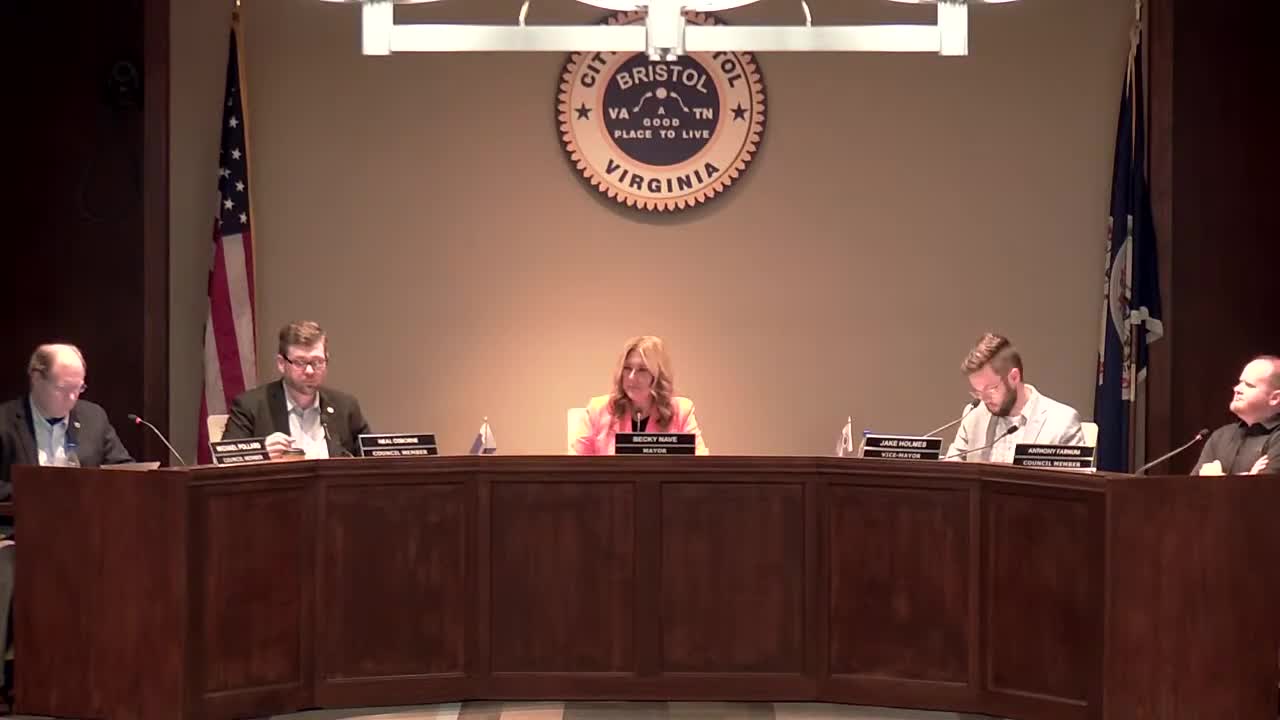
Summary
Bristol City Council approved the fiscal year 2025–26 budget on May 27, 2025, effective July 1, 2025. Council members highlighted increased spending for public safety and ongoing landfill remediation expenses; the council adopted the ordinance on a 4-1 vote.
The Bristol Virginia City Council on May 27 adopted its fiscal year 2025–26 budget, which becomes effective July 1, 2025. The ordinance passed on a 4–1 roll-call vote, with Councilmember Pollard recorded as the lone dissent.
The budget ordinance appropriates $95,298,016 for the general fund and includes line items across city and school funds; the reading adopted by council lists combined appropriations for operating and capital funds and fixes tax rates for fiscal year 2026. Councilmembers said the measure includes targeted increases for police and fire to support recruitment and retention.
City staff presented the city’s fiscal outlook for the quarter ended March 31, 2025. Tamara, the staff member who presented the financial report, said, “this is the financial information for the quarter ended 03/31/2025.” On a cash, unaudited basis she reported general fund budgeted revenues of about $91.6 million and year-to-date revenues just over $78.0 million (approximately 85% of budget); expenditures were about $59.2 million (65% of budget), leaving a reported fund balance of $18.8 million.
Tamara told council that $15.7 million of the general-fund receipts are related to Department of Environmental Quality (DEQ) funding for landfill remediation; removing those receipts would reduce the reported surplus to roughly $3.1 million and lower revenue realization from 85% to about 68%. Council and staff repeatedly noted that landfill work remains an ongoing and expensive multi-year program.
Council and staff flagged debt and interim borrowing as fiscal pressures. The presentation said the city’s 2023 bond anticipation notes for landfill projects are callable this fall (2025) and that payoff or refinancing decisions will affect the debt service schedule; the city’s written plan anticipates pressure on committed reserve funds and additional debt-service needs in fiscal 2026 and beyond.
Council discussion before the vote emphasized funding for first responders and the continuing financial burden of landfill remediation. Multiple councilmembers thanked staff for balancing payroll, benefits and debt while finding funding for police and fire; one member noted there is a tax increase attached to the budget but did not specify an amount during debate. The ordinance passed by roll call: Farnam — yes; Holmes — yes; Osborne — yes; Pollard — no; Nate — yes.
The council approved the ordinance by formal motion and second at the meeting’s second reading and ordered the appropriations printed into the record. The budget document adopted by council includes separate appropriations for school operating and capital funds and several federal and state grant-funded capital funds; the full appropriation text was read into the minutes during the meeting.
Forward-looking items flagged by staff include a planned effort to address the callable bond anticipation notes this fall and ongoing monitoring of landfill project costs. Councilmembers asked that staff continue to brief the council on debt-service options and the city’s reserve position as the fiscal year progresses.