Get Full Government Meeting Transcripts, Videos, & Alerts Forever!
Get email alerts on the Public Prosecutor Office topic
No spam. Unsubscribe anytime.
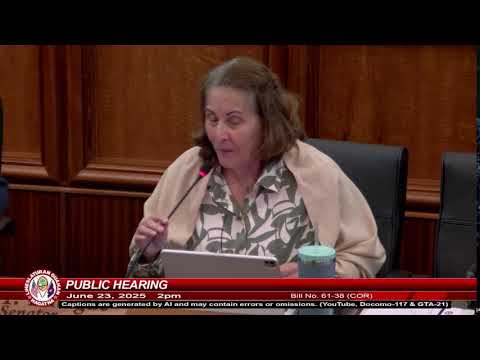
Senators debate Bill 61‑38 to create elected public prosecutor and revert AG to governor appointed position
Summary
Senator Parkinson introduced Bill 61‑38 on June 23 to create an elected territorial public prosecutor and revert the attorney general to a governor‑appointed position; testimony ranged from former attorneys general and judges supporting separation to lawyers and citizens raising concerns about independence and costs.
Senator Parkinson introduced Bill 61‑38 during a June 23 hearing, proposing creation of an elected Office of the Public Prosecutor and a return of the attorney general to a governor‑appointed role. The bill would carve prosecutorial duties out of the Attorney General’s Office, make the public prosecutor an independent, territory‑wide elected position with a four‑year term and bar party affiliation for that office; it also includes provisions for victim assistance funds.
Why it matters: Sponsors and supporters said the measure resolves repeated conflicts that arise when one office provides legal advice to agencies while also prosecuting crimes. Opponents warned the change could reduce the attorney general’s independence, risk politicizing budgets or disrupt existing programs and staff; several witnesses raised concerns about transition costs and asked how existing programs would be funded if prosecutorial functions are spun out.
What sponsors say Senator Parkinson told the committee the bill is meant to preempt conflict rather than rely on ad‑hoc remedies. He argued the Organic Act contemplated both offices and said the proposal restores a separation long authorized by federal statute: "By separating prosecution from advisory duties, the bill eliminates conflicts, protects victims, and strengthens the rule of law," he said.
Supportive testimony - Former Attorney General Elizabeth Barrett Anderson, testifying as a private citizen, said she supports the bill’s separation of functions and offered to provide further technical suggestions after additional review. She urged the committee to correct statute language that could inadvertently bar eligible lawyers from holding office if they are on inactive lists.
- Former and current prosecutors and private attorneys (including Jay Arriola, retired prosecutors and other longtime practitioners) generally supported bifurcation, saying prosecution often received less institutional attention when combined with civil/legal advisory duties and that an independent prosecutor would focus resources on criminal practice and victims’ services.
Concerns and fiscal questions - Several speakers, including Department of Administration counsel and other witnesses, noted a BBMR estimate from an earlier version of the proposal that separating the offices could cost several million dollars (the committee referenced an approximate $5.5 million estimate from earlier analysis). Witnesses urged the committee to identify funding sources and explain how services now performed by the Attorney General’s Office would continue during transition.
- Opponents warned that reverting the attorney general to a governor‑appointed position could reduce the office’s independence. One testifier said the attorney general should remain independent from the governor and that returning the AG to an appointed post could "destroy that independence." Others suggested alternative models — for example, making both offices elected — as a compromise.
Legal and administrative context Supporters cited the Guam Supreme Court’s recent opinions addressing conflicts of interest when the AG represents agencies that are later subject to prosecution, and pointed to historical legislative efforts and federal authorization that contemplated a public prosecutor. Testimony described earlier attempts in 1982 and 1998 to separate prosecutorial functions; several witnesses advised the committee to seek broader input from the Guam Bar Association and the public.
Next steps and committee direction The committee did not take a vote on Bill 61‑38 during the hearing. Chairpersons asked for written testimony, recommended the Guam Bar be surveyed, and indicated budget and implementation questions (staffing, program continuity, VOCA funding and transition costs) require follow‑up. Senator Parkinson said he is open to alternate structures, including electing both the attorney general and the public prosecutor, but emphasized the immediate goal is to separate prosecutorial duties from legal advisory duties.
Ending note Witnesses and senators agreed the subject raises constitutional, administrative and fiscal issues that merit further study and public input. The committee left the record open for written testimony and signaled follow‑up on fiscal impact and transition planning.