Get Full Government Meeting Transcripts, Videos, & Alerts Forever!
Get email alerts on the Mayors Council Budget topic
No spam. Unsubscribe anytime.
Mayors’ Council asks Legislature for $20.96 million for FY2026 as senators probe gap with governor’s $9.62 million proposal
Summary
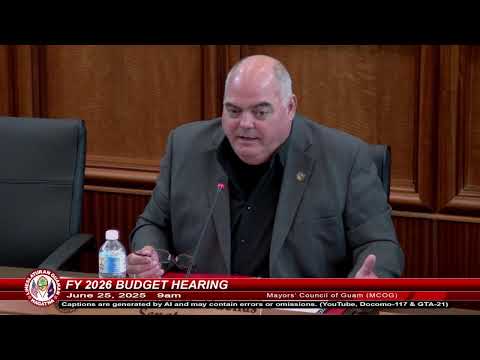
At a June 25 budget hearing, the Mayor’s Council of Guam requested $20,956,877 for fiscal 2026, citing expanded duties, new facilities and unfunded mandates; senators and mayors said the executive branch submitted a much smaller $9.62 million figure and pledged further review.
The Guam Legislature’s Committee on Finance and Government Operations heard testimony June 25 on Bill 44-38 COR, the governor’s FY2026 executive-branch appropriation bill, during a public budget hearing focused on the Mayor’s Council of Guam. Joy Jean Arceo, executive director of the Mayor’s Council of Guam, told the committee the council is requesting $20,956,877 for fiscal year 2026, “an increase of 3,700,000.0 from last year's appropriation.”
The budget request is intended to cover personnel, operations and capital needs for the council and 19 village mayor’s offices that provide frontline services across the island, Arceo said. “This is not a wish list. It is a focused and necessary investment in the basic services, emergency response, and community support that our mayors are expected to provide every day,” she testified.
Nut graf: Mayors and council staff told senators the mayor’s offices now perform duties that extend beyond their statutory roles — from disaster response and sheltering to road clearing, elderly and youth programs and temporary distribution centers — and that current funding levels leave many villages unable to maintain facilities or respond quickly in emergencies. Witnesses and senators said the mayor’s request differs sharply from a lower executive recommendation: the mayor’s materials show an authorized FY2025 level of $17,230,007, a supplemental appropriated $4,500,000 (Public Law 37-135), and a mayoral request of $20,956,877; office materials cited a governor’s request figure of $9,624,109, which the mayors said they learned about only during the hearing.
Committee chair Senator Christopher Duenas said the committee will reconcile the differences and hold further discussions, calling for frank talks among the Legislature, the Mayor’s Council and executive agencies.
Most important details first: the Mayor’s Council’s budget text and multiple mayors’ testimony spelled out specific increases sought and priorities. The council seeks to staff 237 positions in FY2026 (about 16 more positions than FY2025), continue funding for roughly 240 existing village employees, and add targeted capital outlays. The administration request included $2,800,000 in capital: $1,200,000 for district vehicles, $600,000 for a village data-management and Mayor’s Council software system, and $300,000 for heavy equipment; the council also proposes training and procurement upgrades.
Mayors from several villages described routine duties that have expanded into functions traditionally handled by other agencies. Robert Hoffman, mayor of Senania and acting president of the Mayor’s Council, read a statement from Mayor Jesse LG Alig, president of the Mayor’s Council, arguing the mayoral offices “do more with less” and warning that “the cost of continued underfunding is too high in dollars and in human terms and in missed opportunities.” June Blas, mayor of Barrigada, and other mayors recounted providing COVID‑19 vaccination support, food distribution, emergency sheltering and after‑school and senior services — tasks they say require vehicles, equipment, utilities and staff time.
Several mayors asked for flexibility in how appropriations may be used at the village level, changes to job-title classifications to improve outside-market competitiveness for employees, and reduced barriers to using available federal surplus property. The council’s request also highlights public‑health and safety items such as ongoing participation with the U.S. Department of Agriculture’s feral swine program and the need to continue an EPA‑funded abandoned‑vehicle/white‑goods removal contract (the council said it is facilitating a $1,500,000 EPA program through procurement).
Senators pressed for detail. Senator Sabrina Salas Montanani asked why the reported governor’s request ($9,624,109) diverged so widely from the Mayor’s Council’s request; several mayors said they had not been contacted by the governor’s office about the lower figure. Senator Gulati and others expressed support for the mayors while noting the tight fiscal environment and pledged to review agency responsibilities and overlapping work with the Department of Public Works, Department of Education and others.
Committee and council bookkeeping details surfaced in questioning. The council said FY2026 benefit costs appeared lower largely because FY2025 included annual leave payout obligations tied to turnover; the council estimated roughly nine longstanding vacancies and described a plan to fill positions tied to new gym and community facilities. The council also said it plans to obligate approximately $3,000,000 of current funds on identified procurements and that a handful of vendors (the council estimated about seven major suppliers) have existing outstanding invoices that have at times complicated local procurement relationships.
On capacity and procurement, Arceo described a push for training and a centralized procurement and data‑management system so villages can track service requests, inventory and grant compliance. “We are preparing our teams to do more and to do it responsibly,” she said, adding that improved software would streamline procurement and reduce human error.
What did not happen: the hearing was an informational budget oversight session; no votes were taken. Chair Duenas closed the hearing by directing continued work between the Legislature, the Mayor’s Council and executive agencies to reconcile the budget gap; the committee will accept written testimony for seven days following the hearing.
Ending: The committee said it will hold additional executive‑level meetings and expects to deliberate mayoral appropriations alongside other fiscal priorities in upcoming budget sessions. The public hearing record remains open for seven calendar days for written submissions; the hearing adjourned at about 11:43 a.m.