Get Full Government Meeting Transcripts, Videos, & Alerts Forever!
Get email alerts on the Artificial Intelligence Regulation topic
No spam. Unsubscribe anytime.
Guam lawmakers hold public hearing on bill to create AI regulatory task force, stakeholders urge permanent OTECH role and funding
Summary
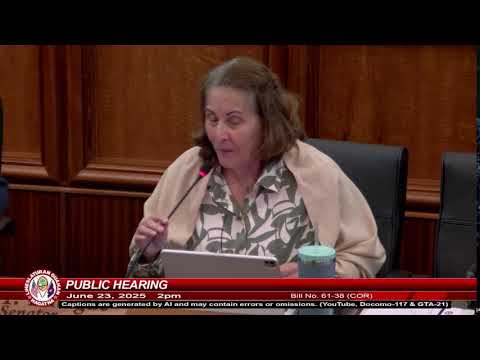
Chairwoman Tydegui convened a June 23 public hearing on Bill 64‑38 to create a Guam Artificial Intelligence Regulatory Task Force; government and private witnesses urged codifying AI responsibilities in the Office of Technology and providing dedicated funding.
Chairwoman Tydegui convened a public hearing June 23 on Bill 64-38, which would establish a Guam Artificial Intelligence Regulatory Task Force to develop a comprehensive framework for AI use in government and the private sector. Testimony from the Office of Technology, Homeland Security/Office of Civil Defense, the Judiciary of Guam, the Bureau of Statistics and Plans and several private-sector firms urged the legislature to give the Office of Technology a permanent AI role and to fund that work.
Bill 64-38 seeks to add a new chapter to Title 5, Guam Code Annotated, to create a temporary, 24‑month task force to study AI risks and recommend a regulatory framework. Nicole Nelson, acting chief technology officer for the government of Guam, read testimony from OTech’s CTO noting, "we wholeheartedly support the intent of this bill" and recommending that AI responsibilities be explicitly codified within OTech’s statutory mandate (5 GCA chapter 1, article 12) and funded so the agency can provide ongoing oversight.
Why it matters: witnesses said Guam’s geographic isolation and critical infrastructure make AI governance a public‑safety as well as economic issue. Lucia Perez of the Office of Civil Defense and Homeland Security recommended NIST cybersecurity alignment, human‑in‑the‑loop controls for life‑critical systems, recurring vulnerability assessments and dedicated training for emergency‑management personnel. Chief Justice Torres told the committee the judiciary has adopted an internal AI policy effective May 1 and warned that "final responsibility always rests with the human. A human in the loop, a human on the loop, and not a human out of the loop."
Key testimony and recommendations - Office of Technology (Nicole Nelson, acting CTO): Strongly supported the bill, recommended adding an explicit AI duty to OTech’s statutory mandate (5 GCA ch. 1, art. 12) and said the role "must be adequately funded." OTech suggested the task force include multidisciplinary expertise (technical, legal, ethicists, civil society) and align with international frameworks such as the EU AI Act and U.S. NIST guidance. The testimony noted a fiscal note from BBMR dated March 5, 2025.
- Guam Homeland Security / Office of Civil Defense (Esther Agee) and ESF‑2 (Lucia Perez): Supported the bill’s intent but recommended permanent oversight under OTech, robust cybersecurity standards, fail‑safe mechanisms for critical infrastructure, routine vulnerability assessments, and AI literacy and certification pathways for mission‑critical roles. Perez urged strict PII protections for emergency systems and human oversight for life‑critical AI decision support.
- Judiciary of Guam (Chief Justice Torres): Described an internal AI policy already in effect and said the judiciary would contribute to a territorial framework rooted in fairness, accountability and transparency.
- Bureau of Statistics and Plans (Lola Leon Guerrero): Supported the bill’s objective but recommended housing AI policy development within OTech to avoid duplicative bodies, and suggested OTech submit an annual report to the governor and legislature.
- Private sector (DOCOMO Pacific): Jared Roberto of DOCOMO Pacific and Eleazar Tandock (security program manager) said the company uses AI for operations and customer service, adheres to customer‑data rules and is prepared to share technical insights with a task force.
- Local technologists and community speakers: Testimony ranged from supporting a task force as an outreach and education vehicle to urging the measure emphasize workforce and economic development rather than prescriptive regulation that could stifle local innovation.
What the bill would do and limits noted in testimony Bill 64-38 would create a task force to draft recommendations and a framework; the measure as written contains a 24‑month sunset and provisions for working groups (education, procurement, workforce). Several witnesses recommended instead that OTech be given a permanent statutory AI stewardship role and sufficient appropriations so governance can continue after any temporary task force concludes. Witnesses cautioned the committee to watch for federal developments that could affect local regulation.
Next steps The hearing recorded no committee vote on Bill 64-38. Chairwoman Tydegui said written testimony will remain open for submission and that questions left for off‑island staff would be collected and answered before future markup. BBMR has provided a fiscal note; several testifiers urged the committee to include explicit funding language and to define timelines, membership and reporting requirements for any task force or OTech mandate.
Ending note Testimony emphasized a combined approach: short‑term study and outreach to build public awareness plus a durable, funded institutional home (OTech) to oversee AI adoption, cybersecurity alignment and workforce development for Guam.