Get Full Government Meeting Transcripts, Videos, & Alerts Forever!
Get email alerts on the Workforce Housing Zta 25 02 topic
No spam. Unsubscribe anytime.
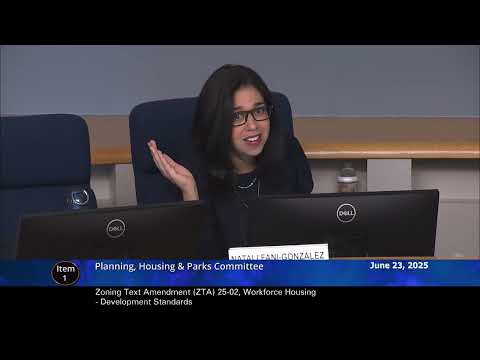
Committee advances ZTA 25-02 on workforce housing standards after technical refinements
Summary
The Montgomery County Planning, Housing and Parks Committee voted 2–1 to forward Zoning Text Amendment 25‑02 — the workforce housing development standards proposal — to the full County Council with technical edits and a request that staff publish clearer parcel maps and draft a companion subdivision regulation amendment (SRA).
The Montgomery County Planning, Housing and Parks Committee voted 2–1 to forward Zoning Text Amendment (ZTA) 25-02, the workforce housing development standards proposal, to the full County Council with committee amendments and a set of follow-up tasks for staff.
The committee’s action preserves the introduced development standards — including a 40-foot height limit for eligible workforce housing development, a 15% workforce housing unit set‑aside (at or below 120% area median income), and existing parking rules — while approving technical clarifications and asking staff to provide more detailed parcel mapping and a separate subdivision-related regulation (an SRA) to address consolidation and through/flag‑lot concerns.
Committee members and planning staff said the amendments and the SRA are intended to clarify how the ZTA will work in practice and to avoid unintended outcomes on specific lots. Council staff noted that the ZTA does not change existing parking requirements: “We’re not making changes to those parking standards,” the staff presentation said, citing the draft language as introduced.
Planning department staff presented diagrams and development scenarios showing what could fit on consolidated lots in several residential zones (R-60, R-90, R-200). Atul Sharma, a planner who led the visual exercises, said consolidation "did provide flexibility to the sites, but it doesn't necessarily guarantee that you're gonna get a higher density development on these sites." The visuals and analysis showed typical achieved floor‑area ratios ranging roughly from 0.6 to 0.9 in the tested scenarios and noted that lot coverage and on‑site parking, not the maximum FAR alone, often limit actual buildable density. The presentation also warned that underground parking — which can increase achievable FAR — is costly, typically on the order of $50,000–$75,000 per space.
Committee members debated several possible amendments that would have materially increased or reduced the number of eligible parcels. Council staff reported the ZTA’s original parcel list totaled about 2,472 eligible parcels; after removing 27 parcels on controlled major highways the working total discussed at the meeting was about 2,445 eligible parcels. Staff said including corner lots that abut corridors would add roughly 475 parcels; adding service‑road parcels accounted for about 630 of the original 2,470 figure (roughly 25%).
Members agreed to multiple clarifications and limited changes: amend the townhouse minimum lot size in the R-200 zone from 2,000 to 1,500 square feet (committee vote 3–0) and add explicit triplex parking requirements (technical addition). The committee also agreed, by majority, to direct staff to translate the online eligibility map into a searchable form and to color‑code public/county‑owned parcels so the public can more easily see which parcels are county‑owned and therefore unlikely to redevelop. Planning director Jason Sartore told the committee that staff can translate the map into a list of parcels and make that available online.
On consolidation and through/flag lots, the committee instructed staff to draft a companion subdivision regulation amendment (SRA) and to return with language that would: prohibit creation of new through lots and flag lots for the purpose of gaining eligibility under this ZTA, and limit lot consolidations eligible for the optional method workforce housing review to a maximum of three consolidated lots (the SRA will be introduced and go through a separate public hearing process). The committee also voted (3–0) to expressly exclude existing flag lots and through lots from eligibility under the ZTA.
On affordability, the ZTA ties workforce housing obligations to the county’s workforce housing program; committee members discussed but did not adopt changes to the underlying affordability control period. Committee staff noted that workforce housing controls are currently administered by the Department of Housing and Community Affairs and that changing the control period or creating a separate affordability regime would require additional administrative work and possibly changes in Chapter 25A (the county’s workforce housing implementation rules).
Several members urged clarity about displacement risk and preservation. Lisa Givony, a planning supervisor who analyzed recent sales data, told the committee staff could not identify consistent, countywide trends from the small sample of relevant “naturally occurring affordable” sales; data showed modest differences by county subarea (East County, West County, Upcounty), but staff characterized the sample sizes as small.
The committee split on several policy tradeoffs but repeatedly returned to a central point: the introduced ZTA already contains multiple dimensional controls (lot coverage, setbacks, height limits and parking requirements) that constrain the scale of redevelopment. Staff emphasized that most consolidation scenarios they tested did not approach the maximum FAR in the draft text.
What the committee decided: the ZTA as amended will move to the full council with a committee recommendation of 2–1. The committee adopted the technical edits described above and asked planning staff to (1) publish an updated, searchable parcel list and color‑coded map reflecting county‑owned parcels; (2) prepare and introduce an SRA to address future creation of through and flag lots and to cap consolidations used to obtain optional method review at three lots; and (3) provide a follow‑up memo identifying existing flag/through lots among the eligible parcels.
Committee members said further debate is likely at full council; staff and sponsors also intend additional community outreach. The ZTA will next be scheduled for full‑council consideration with the committee recommendation and the draft SRA expected to follow its own public review process.