Get Full Government Meeting Transcripts, Videos, & Alerts Forever!
Get email alerts on the School Budget Reconciliation topic
No spam. Unsubscribe anytime.
PGCPS staff outline FY‑26 budget reconciliation, warn final state aid could alter figures
Summary
Prince George’s County Public Schools budget staff told the Operations, Budget and Fiscal Affairs Committee on June 18 that the district will present a reconciled FY‑26 budget to the full board for adoption next week but remains exposed to changes because the Maryland State Department of Education (MSDE) had not yet issued a final state aid document.
Prince George’s County Public Schools budget staff told the Operations, Budget and Fiscal Affairs Committee on June 18 that the district will present a reconciled FY‑26 budget to the full board for adoption next week but remains exposed to changes because the Maryland State Department of Education (MSDE) had not yet issued a final state aid document.
The district’s chief financial officer, Cindy Howe, said the board will consider adoption on Thursday, June 26, and staff will seek signatures for required transmittal documents the following day. “We have to load every FTE and expenditure line item into the budget so that there is a budget to actually execute come July 1,” Howe said.
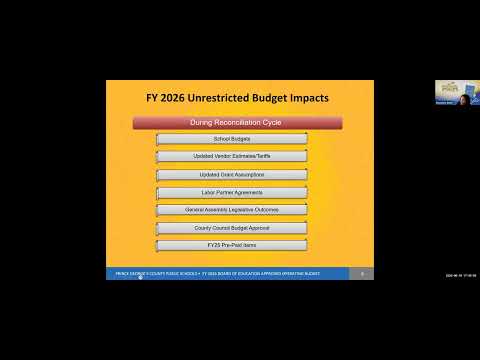
Director of Budget and Management Services Shavon Smith told the committee the reconciliation is “based off of the projections we already had” and updated by changes from the county. Smith said restricted grant funding expectations shifted during the county’s review and that some items the district had requested the county to fund were not approved, requiring the district to cover local shares from unrestricted revenue.
Why it matters: the final MSDE document sets the official state aid and influences the county minimum contribution. Smith warned that certifying a budget before that document arrives could produce misalignment with later state calculations. “We are going to certify a budget that may not align to that documentation,” Smith said.
Key budget details and near‑term steps
- Total expected operating revenues for FY‑26 were presented as about $2.96 billion; staff reported a net year‑over‑year increase of roughly $57 million compared with FY‑25. Smith said unrestricted revenue availability decreased by about $14 million from the requested cycle, driven by shifts in restricted grants and county funding decisions.
- County contribution: staff reported county funding of about $969 million for FY‑26, an increase of nearly $60 million versus FY‑25’s approved budget.
- Nonpublic placements: Smith said legislative changes shifted the state/local split for nonpublic special‑education placements from 70/30 to 60/40, increasing the district’s local share by about $4 million.
- Labor agreements: the district is still negotiating with two labor partners (PGCEA and Local 2250). Howe and Smith said projected economic costs from anticipated agreements are being estimated and factored into the adopted budget; the district has prepay strategies in FY‑25 to create space in FY‑26 for negotiated payroll increases.
- Fund balance: Chief Powell (staff) and Smith said the FY‑26 plan includes using $95 million from fund balance; the district carried an assumption to use $120 million for FY‑25 and planned $95 million for FY‑26, subject to final closeout numbers.
Blueprint and school‑level funding
Budget staff outlined ongoing work to meet the Blueprint requirement that a minimum share of funding “follow the student” to schools. Smith said the district attempted to set a 72% baseline for school allocations during planning but acknowledged many schools remain below the 75% target and that further reallocation will be discussed with school leadership and the board over the summer. Chief Howe explained some schools experienced simultaneous reductions in Title I allocations (the district planned for a 20% reduction but preliminary guidance reduced that estimate to about 9%), complicating allocation decisions.
Process and publication
Howe and Smith described tight deadlines: after board adoption, staff must prepare certification documents, load positions and line items into the financial system, and publish the approved budget book. Smith asked the board for future dialogue on the budget book’s format and on mechanisms for more substantive pre‑meeting engagement to give board members and stakeholders time to review complex budget choices.
What the committee did: the committee heard the update and will receive the FY‑26 budget for board adoption on June 26; no final vote on adoption was recorded at this meeting.
Ending note
Staff emphasized that reconciliation will continue after July 1 as state and county final documents and post‑adoption adjustments are received, and they flagged the need for continued board‑district collaboration over the summer to align priorities, incorporate negotiated labor outcomes, and refine school allocations.