Get Full Government Meeting Transcripts, Videos, & Alerts Forever!
Get email alerts on the City Hall Construction topic
No spam. Unsubscribe anytime.
City leaders hear update showing Franklin City Hall project tracking higher on contingency amid tariff uncertainty
Summary
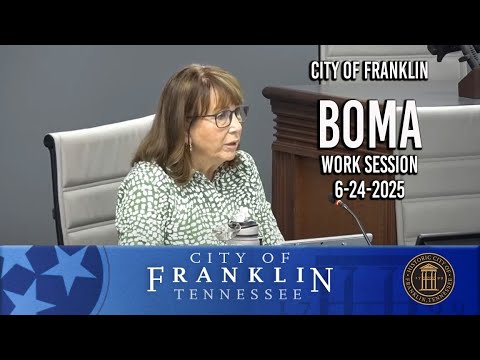
City of Franklin staff told the Board of Mayor and Aldermen at a June 2025 work session that the new City Hall project remains on schedule for mid‑2027 but that the current cost estimate had increased to a range of about $103.9 million to $112 million after the team added tariff and contingency allowances.
City of Franklin staff told the Board of Mayor and Aldermen at a June 2025 work session that the new City Hall project remains on schedule for mid‑2027 but that the current cost estimate had increased to a range of about $103.9 million to $112 million after the team added tariff and contingency allowances.
The update, presented to the board during the work session, said demolition is complete, excavation and shoring were beginning, and the project was roughly 20–25% complete on construction activities. Project staff said they have added a named “tariff contingency” and other allowances that together total roughly $14 million within the headline estimate.
Why it matters: the board has approved a multi‑year program for a three‑story municipal building plus an expanded plaza and park; changes in global material costs and lengthy lead times for major equipment can affect both the schedule and the amount of city funds needed to reach the board’s building program.
City project staff described the estimate change as largely driven by uncertainty around new and fluctuating tariffs and longer supplier lead times. “There’s a tariff contingency within these numbers,” the project presenter told aldermen, adding that electrical gear and HVAC equipment were examples of materials and systems with long lead times and price volatility. Staff said they were working with contractors to include allowances in subcontractor contracts so the city can validate any tariff‑related increases before paying them.
The presentation laid out how the board’s early‑release work packages (ERPs) are structured: ERP 1 covered demolition and initial site work; ERP 2 (foundations, structure and initial MEP procurement) was being bid; and later ERPs would bring the guaranteed maximum price (GMP) in early 2026. Staff said some competitive bidding in ERP 2 has helped lower concrete and structural costs compared with earlier estimates, offsetting some increases in other areas.
Aldermen pressed staff for clarity on the estimate ranges and contingencies. One member said the public watches the headline figures and will notice the increase from earlier budget estimates in the high‑$80 millions to the current range. Staff responded that if the board prefers, they can separate tariff‑specific allowances into a discrete owner contingency line item and then draw from it only for validated tariff impacts.
On the park and plaza elements adjacent to the building, staff highlighted phasing and value‑engineering options. The park build‑out shown in the program was the full‑build vision; staff recommended the board could select a phase‑1 scope that accomplishes key infrastructure and landscaping while deferring some amenities. The presenter said staff had already identified 61 value‑engineering items, of which five had been priced and saved about $2.2 million; additional items were under review.
Project staff also discussed soft costs — notably furniture, fixtures and equipment (FF&E) and AV systems — as a separate area that could be phased or postponed to reduce near‑term cash needs. An example cited during the session: moving some conference tables to the wall saved roughly $10,000 per table because it reduced slab penetrations and associated construction work.
Board members asked about project schedule and lead‑time risk. Staff said demolition put the project a few days ahead on that early package and that the overall completion remained “mid‑2027” under current plans. Staff warned that some mechanical and electrical equipment has 12–18 month lead times and in some cases manufacturers were quoting 52 weeks for HVAC and up to 120 weeks for specific electrical gear; those timelines were part of the reason for the added contingency and for close procurement coordination.
The presentation included a brief review of value‑engineering progress: staff reported about $2.2 million in identified savings so far and many additional options still being priced. The board asked staff to return monthly with updated bids, contingency positions, and phasing options for the park and FF&E so the aldermen could decide whether to accept those trade‑offs.
Board members and staff agreed on next steps: continue monthly reporting, pursue additional VE savings, and bring firm GMP proposals and contract language that separates tariff allowances for board review. Staff said they would return with more detail when ERP 2 bids were completed and as part of the GMP package targeted in early 2026.
Ending: Project staff said the team will keep reporting monthly and will provide more granular cost and procurement details as ERP bids close and greater specificity emerges in the construction documents. The board signaled interest in phasing the park and moving nonessential FF&E to later budget years if that helps keep the near‑term capital need below the board’s informal target.