Get email alerts on the Criminal Justice Staffing topic
No spam. Unsubscribe anytime.
Hunt County DA seeks two prosecutors and permanent funding for victim services coordinator
Summary
First assistant DA Steve Lilly asked commissioners to add two attorney positions to handle rising felony filings and to fund the victim's assistance coordinator position currently paid by a state grant (SB 22). Commissioners raised questions about long-term funding and space.
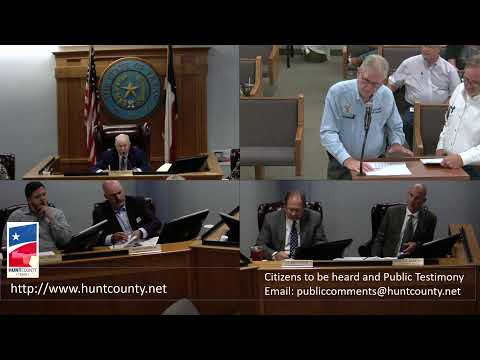
Steve Lilly, first assistant district attorney for Hunt County, asked the Commissioner’s Court on June 24 to fund two additional prosecutors and to consider making the office’s grant-funded victim’s assistance coordinator a permanent, county‑funded position.
Lilly said intake and case-review work have grown substantially since the office last added an attorney in 2015; he told the court that if current filing trends continue the office will review roughly 1,200 felony cases in the calendar year and that the intake function is currently handled by one person. “We need more prosecutors. We need 2 new prosecutors,” Lilly said.
Lilly explained the workload growth in two parts: the number of felony cases has risen roughly 25–33% since 2015, and the complexity of cases has increased because of more digital evidence and investigative work that prosecutors must review. He said about 40% of current felony filings come from the Hunt County Sheriff’s Office, with Greenville and other agencies making up the remainder.
The prosecutors would be used to bolster intake review and to assist with trial responsibilities; Lilly noted the positions could be structured differently depending on candidate qualifications. He also said the office’s new victim’s assistance coordinator — added last year and funded largely by SB 22 grant money — has eased workload for trial attorneys, and Lilly recommended the county eventually assume funding for that position. “We do want to have that position funded by the taxpayers, because we think it's important eventually,” he said.
Commissioners raised fiscal questions: whether the county would absorb salaries currently paid from SB 22 if the grant funding ends, and whether funding two attorneys at county pay scales would leave the office non‑competitive with grant-funded salaries. Commissioners asked how to pay for the positions and whether to phase hires to address space and budget constraints. Lilly suggested timing hires with facilities changes and said the office could work with the court on a phased plan.
No hiring decisions were made. Commissioners asked the DA’s office to provide more detailed cost and phasing options. Several commissioners emphasized the county’s uncertainty over the long-term availability of SB 22 funds and asked for proposals that limit the county’s exposure if grant funding ceases.
Lilly also compared Hunt County to similar counties and said some comparable counties have more felony prosecutors for similar population sizes; he argued Hunt County’s staffing has not kept pace with county growth since 2015.
The court took no formal action on the request; commissioners directed staff to return with budget scenarios and implementation options for consideration in the budgeting process.
AI generated
The text on this page is AI generated. Summaries, highlights, analysis, and video transcripts are all produced from the original source material.
AI can make mistakes, so if you spot one, and we will fix it for everyone.
Note: the source content is unaltered by us. Any content source we link to, be it a video, an audio recording, or a document, is presented exactly as its publisher released it. That publisher is usually a government body, sometimes an individual official or another organisation.