Get Full Government Meeting Transcripts, Videos, & Alerts Forever!
Get email alerts on the Air Service Fund topic
No spam. Unsubscribe anytime.
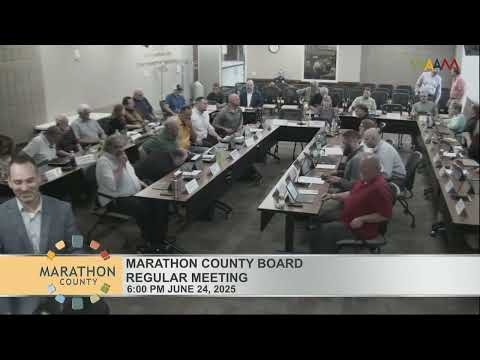
Marathon County board directs $150,000 placeholder for airport air-service fund after heated debate
Summary
The Marathon County Board of Supervisors voted June 24 to direct the county administrator to include $150,000 in the 2026 budget as a seed for a regional air service incentive fund for Central Wisconsin Airport; supervisors debated budget timing, private-sector matching and whether taxpayers should underwrite carriers’ losses.
Marathon County supervisors voted June 24 to direct the county administrator to include $150,000 in the proposed 2026 budget as a county contribution toward a regional air service incentive fund intended to help recruit or stabilize passenger flights at Central Wisconsin Airport.
The move — carried by the board but not unanimously — is meant as a signaling device to encourage private and neighboring-county partners to commit matching funds, supporters said, while opponents said it short-circuits the budget-prioritization process and risks subsidizing airlines that may not provide long-term service.
County Administrator Leonard said the resolution is “an expression of support” that does not by itself obligate county spending. “This expression of support does not actually tie any funds to, to being allocated in 2026,” Leonard said. He told supervisors the administrator will present a budget to the Human Resources, Finance and Property Committee in September that reflects the direction in the resolution and that any board member may offer amendments when the budget is adopted in November.
Supervisor Robinson argued the early commitment would help airport negotiators secure private partners and said the county historically has used seed funding to leverage outside funding for local projects. “One of the reasons why we're considering this at this time is to give an indication of commitment so that the administrator [and] the airport director can go out and negotiate with firms to get them in line and in place for next year,” Robinson said, adding that representing county support now could avoid losing six months to a year in recruitment efforts.
Supervisor Rosenberg, who opposed the measure, critiqued the idea of taxpayer-backed guarantees for carriers and suggested carriers “are able to calculate the routes, times, price, advertising needed to be successful and do not require the taxpayers to assure them 2 years to succeed with no obligation to continue.” Rosenberg added, “I have no interest in subsidizing discount air carriers flying to vacation destinations, and I don't think, generally speaking, the taxpayers of Marathon County will be either.”
Vice Chair Dickinson described the funding direction as necessary to meet the airport’s strategic goals and to support local businesses and residents. “This is what is necessary for our airport, which means our strategic plan goals. It's for our residents, our businesses. It's for the entire community,” Dickinson said.
Airport Director Griefy answered questions from supervisors about who the board intended by “business community” and suggested broader wording might give staff more latitude in pursuing partners. “If that were to be a little more generic in that, the 2 owner counties and an outside funding source, that would give me a little more latitude in who and how I'm working,” Griefy said.
An amendment offered by Supervisor Robinson to make Marathon County’s commitment contingent upon matching participation by Portage County and the business community was discussed, then withdrawn by Robinson, who said he would prefer to have the airport director report back on partner commitments when the budget is presented. “I would be willing to withdraw the motion, in light of the question and confusion with the intent that the airport manager worked with the other counties,” Robinson said.
County counsel clarified that the draft resolution directs the administrator to include a $150,000 sum in the 2026 budget; counsel said it was unclear whether a contingency amendment would instruct the administrator not to include the sum if outside commitments were not in place. Counsel’s comment helped prompt Robinson’s withdrawal of the amendment and the board’s request for a status report when the budget is presented.
The board approved Resolution 39-25 to authorize the inclusion of $150,000 in the 2026 budget proposal; the vote carried but was not unanimous. The administrator and airport director will provide budget materials and status of outside commitments during the September budget process, and any final appropriation would depend on the November budget adoption and any subsequent amendments.