Get Full Government Meeting Transcripts, Videos, & Alerts Forever!
Get email alerts on the Emergency Response topic
No spam. Unsubscribe anytime.
Dodge County officials recap response after multi-tornado event, outline recovery steps
Summary
Dodge County emergency managers, the sheriff and public health officials described damage from six confirmed tornadoes, sheltering and recovery work, gaps in radio communications and options for municipal reimbursement through the Wisconsin Disaster Fund and FEMA.
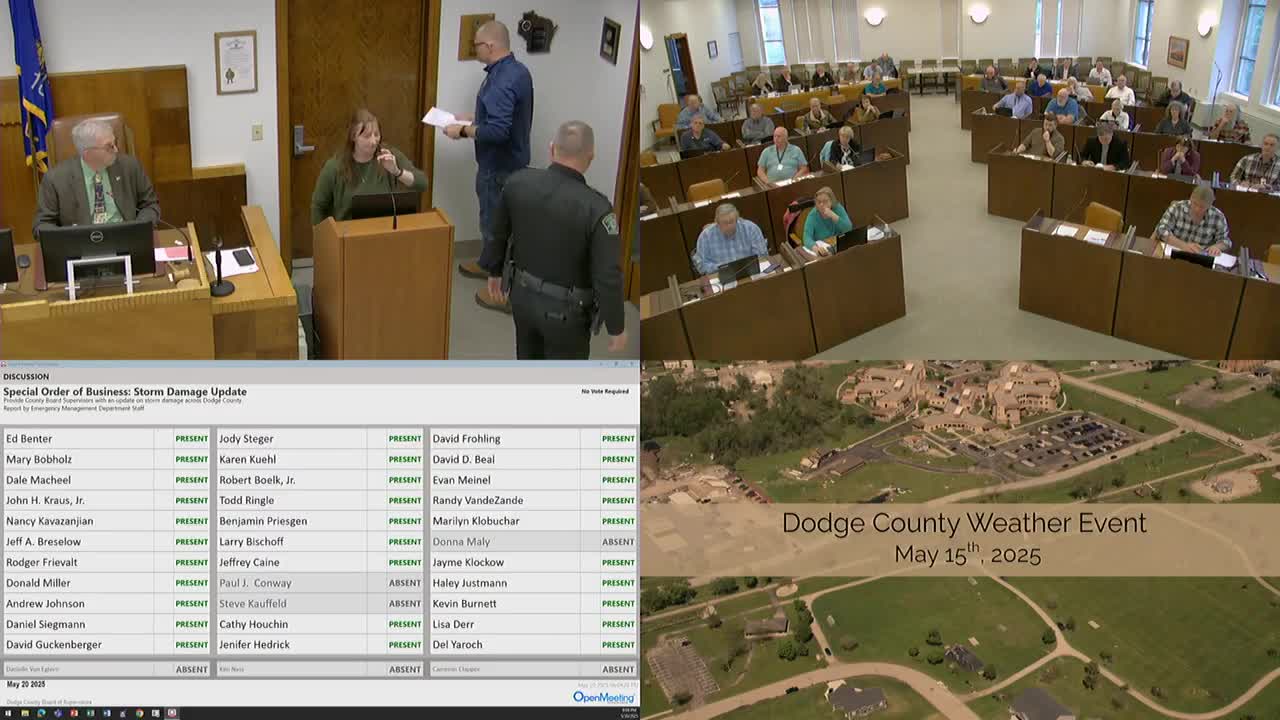
Dodge County emergency management and law-enforcement officials on Thursday described the county's response to a multi-tornado event that the National Weather Service later confirmed produced six tornadoes across the county.
Emergency Management Director Joe Maher presented a timeline of radar-confirmed rotations and preliminary damage findings, and Sheriff Schmidt and county public-health and human-services staff summarized sheltering, health support and county infrastructure impacts.
The presentation matters because officials said the storms produced widespread property damage, displaced residents and exposed limits in countywide communications during a major incident.
Maher said the National Weather Service initially alerted the county to a radar-confirmed tornado at 17:49 (local) and that the agency's damage surveys identified six tornado tracks in Dodge County. He reported that the Juneau tornado was preliminarily classified as an EF-2 with peak winds near 120 mph and a ground path of about 11.76 miles; other confirmed tornadoes were preliminarily rated EF-1 or EF-2 with shorter tracks. Maher said one injury related to the Juneau tornado required hospital transport and that other incidents produced minor injuries.
Sheriff Schmidt outlined response operations, including early establishment of two command posts and door-to-door checks in affected neighborhoods. He credited deputies, local fire and EMS crews, mutual-aid agencies and volunteers for stabilizing the scene by midmorning after the storms. Schmidt said county buildings sustained damage including flooded areas in the county jail, damage to hangars at the airport (hangars are privately owned), blown covers on salt sheds, and a removed roof on a county impound building. He added that the county's new command vehicle and a $450,000 grant to equip it were crucial in the response.
Officials described sheltering operations: Dodgeland School opened as a short-term shelter for Juneau residents and Mabel High School served as a longer shelter in Mayville with the Red Cross, the Dodge County Mental Health crisis team and Salvation Army providing support. Amanda Pulvermacher, who coordinated sheltering operations while Maher was briefly away, said public-health workers and mental-health crisis staff assisted residents and that public health helped place eight or nine displaced people in temporary weekend housing.
Officials also highlighted communications shortfalls. Schmidt said the county did not have enough radio channels to support simultaneous operations in Juneau, Mayville and other damaged areas and that the shortage hampered coordination when multiple agencies converged on both command posts. Maher and county staff said they will use an ongoing radio-system study to determine additional countywide frequencies and other improvements.
County staff reviewed financial-recovery options for municipalities and residents. The presentation explained the Wisconsin Disaster Fund (WDF) reimbursement thresholds ($4.72 per capita for municipalities to become eligible) and potential 70% reimbursement for eligible Category A (debris removal) and emergency protective measures. Officials said that state or federal assistance from FEMA would require significantly higher thresholds (county threshold cited about $421,949 and a state threshold above $11 million) and a governor's presidential request, making FEMA public-assistance less likely for this event. Staff advised residents to contact insurance carriers first because most policies in Wisconsin cover wind-related damage.
Clearview Behavioral Health Director Ed (first name only in record) and Clearview staff described heavy damage to Clearview facilities, including dozens of broken windows, a damaged group home roof and about 15 rooms made temporarily uninhabitable. Ed credited staff actions for moving residents to safer locations; in one instance staffer Maggie Sanford carried a resident to a basement as the roof was torn off. Ed said temporary repairs and cleanup began immediately and that an insurance adjuster and restoration contractor were on site within a day.
The board confirmed that emergency declarations from Dodge County and the affected municipalities were signed; county staff said they may present a ratification to the board next month if timing or funding needs make it necessary. Maher and public-health staff urged residents and municipal officials to document damage, contact insurers and track costs in case WDF or other reimbursements become available.
"It really takes a whole county to help out communities in our time of need," said Mayor Rob Belk of Mabel during public comment, thanking volunteers and mutual aid. Amanda Pulvermacher urged anyone with questions about recovery to contact the county emergency-management office.
Officials said the item will proceed to an after-action review and that proposed follow-ups include expanding county radio capacity, reviewing sheltering agreements and confirming financial thresholds and application steps for state disaster funding.