Get Full Government Meeting Transcripts, Videos, & Alerts Forever!
Get email alerts on the Algorithmic Rent Pricing topic
No spam. Unsubscribe anytime.
Seattle council bans algorithmic rent pricing, adds enforcement and damage remedies
Summary
The Seattle City Council on June 24 passed Council Bill 121000, prohibiting algorithmic rent fixing for residential units and adopting amendments that add landlord outreach, narrow coverage, per-unit penalties and a private right to actual damages; final vote was 7 in favor with 1 abstention.
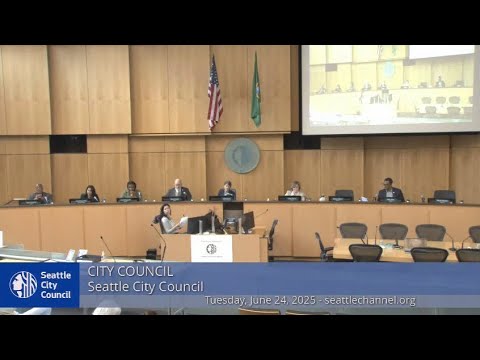
The Seattle City Council passed Council Bill 121000 on June 24 to prohibit algorithmic coordination of rent pricing for residential units, adopting several amendments that clarify enforcement and remedies. The final vote on the ordinance as amended was recorded as seven in favor and one abstention.
Sponsor Council member Teresa Moore framed the bill as an anti‑competitive tool intended to reduce rent pressure and help prevent displacement. "This ordinance ... has the power to change it," Lydia Felty, a renter in District 3 and co‑chair of the Seattle Renters Commission, said during public comment in support of the measure.
Council amendments adopted before final passage included: - Amendment B (sponsored by Council member Strauss): requests that the Seattle Department of Construction and Inspections (SDCI) conduct outreach to educate landlords about the ordinance and provide a report on outreach and potential implementation assistance by Jan. 31, 2026. - Amendment C (sponsored by Council member Moore): replaces the term "person" with a defined "service provider," narrows the ordinance to residential properties by excluding short‑term rentals and hotels, and clarifies that basic record‑keeping software is not prohibited. - Amendment D (sponsored by Council member Rink): allows the city attorney to charge a separate violation per dwelling unit where prohibited coordinating services are used and expands the private right of action to permit recovery of actual damages in addition to attorney's fees; the amendment also emphasized penalties of up to $7,500 per violation.
Public testimony at the meeting reflected broad support from tenants rights advocates and renter organizations and opposition from industry. Kate Rubin, co‑executive director of b Seattle, urged the council to pass the ordinance with a strengthening amendment and said, "Studies show that every $100 in median rent increases lead to a 9% increase in homelessness." Alan Francis and other tenant advocates described algorithmic pricing as a driver of displacement. RealPage, the property‑management software firm, registered opposition: Mike Semko, RealPage's vice president and legal counsel, told the council, "We are opposed to item number 2 ... It is essentially a total band on algorithmic pricing."
Council debate focused on balancing enforcement and avoiding unintended consequences for basic software tools and small landlords. Council members agreed to amendments that the sponsors and central staff described as aligning local language with model or previously proposed state legislation while adding local implementation measures. The council adopted Amendment B and Amendment C by recorded votes of seven in favor and one abstention; Amendment D passed with six in favor, one opposed and one abstention.
On final passage the roll call showed seven yes votes and one abstention (Council member Rivera recused herself because she said she is a small landlord). The chair signed the legislation, and the clerk was directed to affix signatures. The ordinance adds a new chapter to the Seattle Municipal Code (new chapter 7.34) prohibiting the use of coordinated algorithmic rent‑setting services for residential properties and provides enforcement and private‑rights mechanisms described above.