Get Full Government Meeting Transcripts, Videos, & Alerts Forever!
Get email alerts on the Development Finance Program topic
No spam. Unsubscribe anytime.
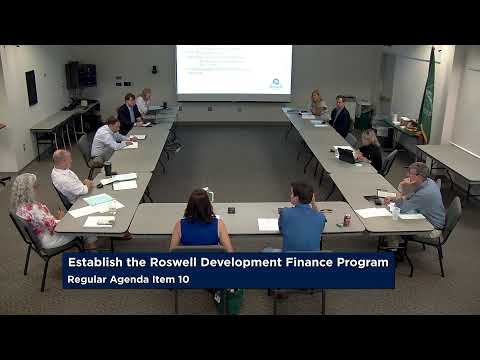
Roswell committee backs ordinance to create development finance program to support targeted hotel projects; council schedules first reading
Summary
The committee approved moving forward with an ordinance to establish the Roswell Development Finance program under OCGA 36-62-17 to help finance energy, water-conservation and resiliency improvements for targeted hotel projects. Staff said loans would be third-party financed, repaid through a special assessment on the property, and administered
The Roswell Mayor and Council committee voted June 24 to advance an ordinance establishing a Roswell Development Finance program intended to help finance targeted hotel developments by enabling third-party capital to finance eligible energy-efficiency, water-conservation, renewable-energy and resiliency improvements.
What the program does: Daryl Connolly, director of economic development, said the program is structured under OCGA 36-62-17 (the Commercial Property Assessed Conservation, Energy and Resiliency provisions enacted by the state) and would be administered through the Roswell Development Authority under an intergovernmental agreement. The program uses private capital (not city general funds) to finance eligible improvements and repays lenders through a special tax assessment on the property; Connolly said that structure allows lenders to offer lower-cost, longer-term financing because the assessment runs with the property and has priority similar to tax liens.
Eligibility and mechanics: Staff proposed the program focus on new hotel projects and ancillary commercial uses citywide with a minimum loan of $4,000,000 and lender financing that may replace mezzanine capital in conventional debt stacks. Proposed program fees included a nonrefundable $500 application fee, a 1% administrative fee of the loan amount at closing, a 0.5% legal fee for documentation at closing, and a 1% servicing fee applied to annual payments and added to the property tax bill.
Questions and clarifications: Councilmembers asked whether the city or RDA would be on the hook for loans and how bond issuance might affect residents. Connolly and city staff emphasized the loans are private third-party financing and said the city would not be the lender; if the RDA chose to issue revenue bonds to leverage the program in the future, staff said those would be structured as revenue bonds and not general-obligation debt paid from the city’s general fund. Councilmember Morthland asked whether the housing authority could be included; staff said legal would research that option and proposed moving the ordinance’s first reading to a later calendar date to allow review.
Action and scheduling: The committee voted to advance the ordinance and scheduled initial readings and associated RDA actions; councilmembers later clarified and voted to set the first reading for July 28 to allow legal staff to review inclusion of additional entities such as the housing authority.
Limits and context: Connolly said the program targets projects of a size where fees cover administrative costs and that private lenders would provide the capital; the city would collect fees and service payments but would not originate or underwrite the loans. Staff said the program is designed to improve project economics for catalytic hotel projects identified in the city’s economic-development strategy.