Get Full Government Meeting Transcripts, Videos, & Alerts Forever!
Get email alerts on the Inclusionary Housing topic
No spam. Unsubscribe anytime.
Atherton leaders direct staff to draft inclusionary housing ordinance focusing on school-site overlays
Summary
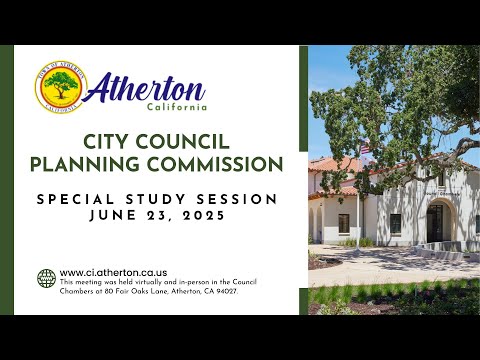
The Atherton Town Council and Planning Commission on June 23 directed staff to draft an inclusionary housing ordinance that at minimum would require on‑site affordable units on RM‑20/RM‑40 overlay sites (Menlo College, Menlo School and Sacred Heart) and forward the ordinance to the Planning Commission for review.
The Atherton Town Council and Planning Commission on June 23 directed staff to draft an inclusionary housing ordinance that, at minimum, would require on‑site affordable units on the RM‑20 and RM‑40 overlay sites that include Menlo College, Menlo School and Sacred Heart, and then send the draft to the Planning Commission for review.
The matter matters because the town’s certified housing element relies on a mix of accessory dwelling units (ADUs) and multifamily capacity on those school and public‑facility overlays to meet its Regional Housing Needs Allocation (RHNA) and guard against a shortfall. The California Department of Housing and Community Development (HCD) recently certified Atherton’s housing element but flagged steps the town should take on implementation, including program 3.811 c, which anticipates a 20% inclusionary requirement on the school sites.
City Manager George Rodix briefed the joint bodies that staff presented four implementation options: do nothing; confine an ordinance to RM‑20 and RM‑40 overlay sites requiring on‑site affordable units; expand to include RM‑10 overlay sites with an in‑lieu fee option; or implement a townwide program that would apply to single‑family development and create a funding mechanism for off‑site affordable housing. Rodix said staff’s minimum recommendation was the RM‑20/RM‑40 option to remain consistent with state mandates and the town’s housing strategy.
Town Planner Britney Bennetts summarized the background and the consultant work by Bay Area Economics (BAE), noting the earlier feasibility and in‑lieu fee analyses and reminding the bodies that HCD’s certification letter pointed toward adopting program 3.811 c. “The way that we address that in the housing element was to rely on the RM‑20 sites RM‑20/40 sites,” Bennetts said, adding that the multifamily overlay strategy in the housing element anticipates about 96 units coming from the private school sites.
Public commenter Jed Riddle urged a townwide funding mechanism and an inclusionary fee to create a local affordable‑housing fund. “I am in favor of tabling the Bay Road, and other RM‑10s from this meeting so that it can be considered as to whether or not they're appropriately designated RM‑10s,” Riddle said, and also said he “think[s] it makes good common sense to have an inclusionary fee on all work done on all properties throughout Atherton.”
The consultant, Stephanie Hager of Bay Area Economics, told the group that BAE’s feasibility work was based on the 20% inclusionary rate in the housing element and that RM‑20/RM‑40 sites generally could support the 20% baseline. “We did our study based on the 20% that was in the housing element,” Hager said, and added there might be “a little bit of room for feasibility, to up it if you wanted to,” while cautioning that the study used data from 2023 and might change if updated to current market values.
Council and commission discussion focused on three main questions: whether to adopt no ordinance (staff and several members opposed doing nothing), whether to limit an ordinance only to RM‑20/RM‑40 sites or to add RM‑10 sites (members were split), and whether to pursue a townwide fee that would apply to single‑family new construction, demolitions/new builds, or additions.
On density bonus and in‑lieu fees, the council sought clarification. Bennetts answered a public question directly: “The answer is no. They don't. In order to get the density bonus, you have to provide the actual affordable units,” meaning paying an in‑lieu fee would not make a project eligible for the state density bonus benefits. That point was repeated by staff and helped resolve a public concern that paying a fee would automatically trigger state density‑bonus concessions.
Council members repeatedly returned to Menlo College’s stated need and the funding gap for campus housing. Staff said the schools had provided letters indicating potential unit counts but no contractual financing: Menlo College has expressed a clear need and the work to build on campus would likely require tens of millions of dollars. Staff estimated a full college project could be on the order of tens of millions (one comment referenced roughly $35,000,000 for a full project).
On the RM‑10 overlay question (private parcels including Bay Road, Ringwood and Ravenswood), several commissioners and council members expressed concern about unintended consequences — for example, developers pursuing broader concessions under the state density bonus program. Others argued including RM‑10 would expand options and generate in‑lieu fees that could fund affordable housing. Staff noted the BAE in‑lieu fee ranges for RM‑10 scenarios presented earlier ranged widely — roughly $26 to $212 per square foot depending on prototype assumptions — and that different fee levels would change developer incentives to build on‑site versus pay the fee.
The townwide fee option prompted a separate debate about feasibility and legal constraints. Staff said BAE’s existing analysis addresses vacant‑lot single‑family new construction; applying a fee to demolitions/new construction or to additions would require additional analysis. Consultants estimated supplemental work to update and expand the study could run tens of thousands of dollars (discussion referenced a smaller supplemental estimate and a later combined update and supplemental package in the approximate range of $75,000). Several council members indicated they did not want to allocate funding for that supplemental analysis at this time.
The bodies also discussed ADUs and state limits on requiring deed restrictions. Town Attorney Mona (City Attorney) explained HCD guidance limits the town’s ability to compel deed‑restricted status on state‑mandated ADUs; however, locally allowed “bonus” ADUs (additional units allowed by local ordinance beyond state minimums) could be subject to deed‑restriction requirements. That distinction shaped members’ views on whether ADU production would be a reliable way to meet RHNA targets and whether a townwide fee would actually generate revenue (many said owners would opt to build ADUs rather than pay a fee).
By the meeting’s close the council had several clear directions for staff: do not adopt a “no action” posture; move forward at a minimum with drafting an inclusionary ordinance that covers the RM‑20 and RM‑40 overlay sites and return the draft to the Planning Commission for review; and continue exploring options to support Menlo College housing, including private fundraising and conditional funding approaches. The council remained split on immediate inclusion of RM‑10 in the ordinance and on commissioning an expensive supplemental BAE analysis to expand a townwide fee to demolitions/new construction; several members were opposed to funding that update at the meeting.
Next steps: staff will draft an ordinance based on the direction to prioritize RM‑20/RM‑40 on‑site requirements, coordinate with BAE as needed, present the draft to the Planning Commission, and then return to Council for introduction and subsequent readings. The timeline noted by staff anticipates Planning Commission review followed by at least two council hearings (introduction/first reading and a second reading) before final adoption.
Quotes in this article are taken from the meeting transcript and attributed to speakers who appeared in the session.