Get Full Government Meeting Transcripts, Videos, & Alerts Forever!
Get email alerts on the Transient Lodging Tax topic
No spam. Unsubscribe anytime.
Lawmakers consider shifting transient lodging tax flexibility to help local public services
Summary
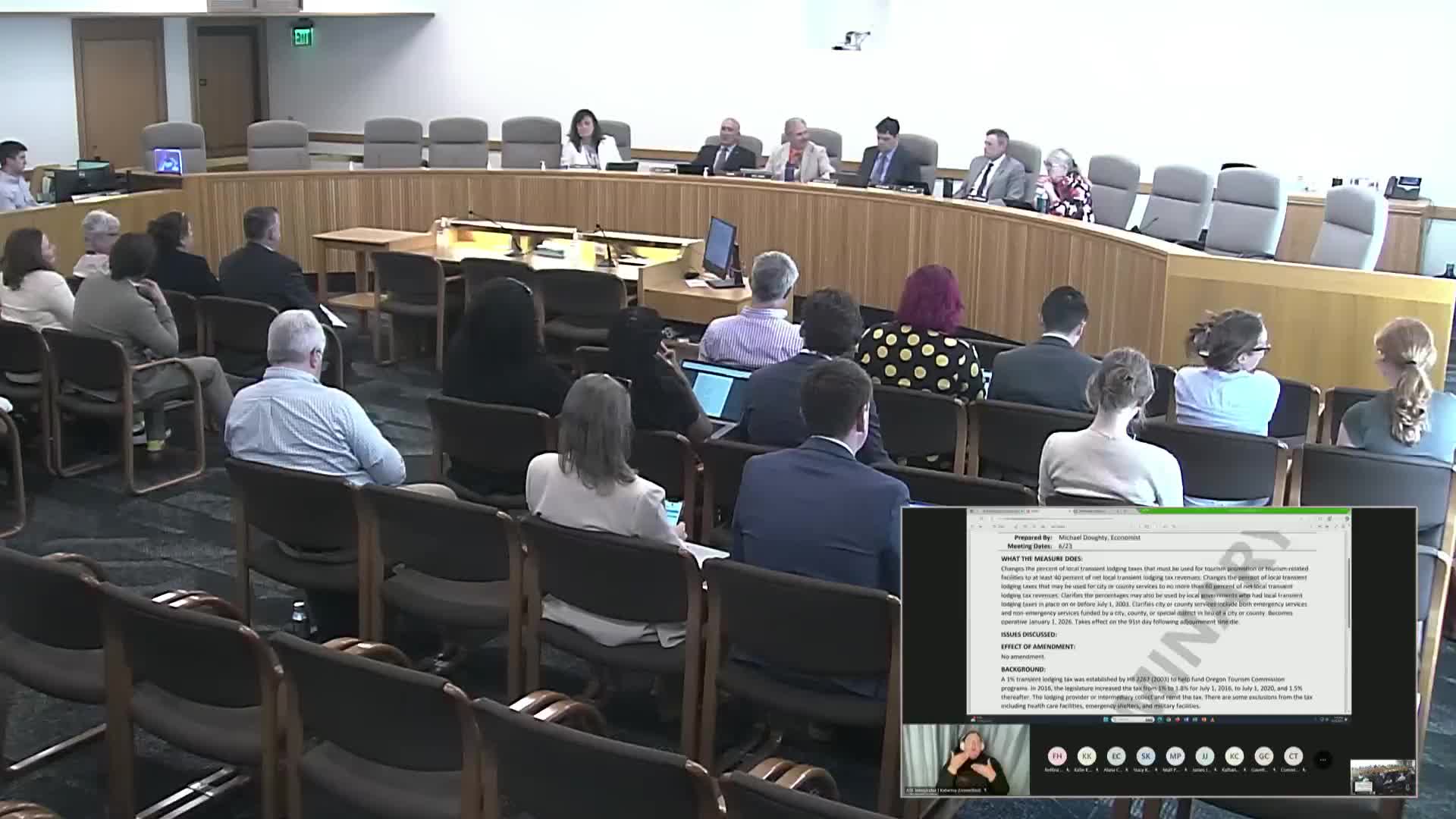
The Senate Committee on Finance and Revenue held extended testimony June 23 on House Bill 3962A, which would alter how local governments may use transient lodging tax revenue by lowering the required minimum for tourism promotion from 70% to 40%.
The Senate Committee on Finance and Revenue heard hours of testimony June 23 on House Bill 3962A, which would change how local transient lodging tax (TLT) revenues may be allocated. The bill would require at least 40% of net TLT revenue be used for tourism promotion or tourism-related facilities and allow up to 60% to be used for city or county services, including emergency and nonemergency services.
Nut graf: Sponsors said the 2003-era requirement that a minimum of 70% be used for tourism promotion no longer fits communities where visitor populations can swell many times local resident counts; proponents argued flexibility would let local governments fund roads, public safety and restrooms that sustain the visitor experience. Opponents—lodging associations and many destination marketing organizations—warned the change would reduce marketing budgets that attract visitors and could shrink the tourism economy that supports local jobs.
Sen. Suzanne Weber (District 16) and Rep. Cyrus Javidy (House District 32) described coastal and resort communities where weekend or event crowds dwarf resident populations and where police, fire and sanitation systems can be overwhelmed. Weber said the bill “maintains a floor for tourism funding” while giving communities the ability to use TLT revenue for public services that directly affect both residents and visitors.
Local elected officials from coastal and mountain destinations gave mixed testimony. Bend City Manager Eric King and Seaside Mayor Steve Wright supported the bill, saying their cities need flexibility to fund roads and public safety because tourism can increase daily population by tens of thousands. Coos Bay Mayor Joe Benetti and other coastal officials opposed the change, saying much TLT-funded infrastructure is already paid by sewer rates, gas tax, or other dedicated sources and that cutting promotion could hurt occupancy and visitation; Benetti cited occupancy statistics showing varying seasonal demand and urged more promotion, not less.
The Oregon Restaurant and Lodging Association and hotel operators warned the committee the change would be “devastating” for destination marketing organizations (DMOs) and could cost industry jobs. Lodging witnesses pointed to jurisdictions with longstanding pre-2003 distribution ratios locked in and warned the uniform change across 117 jurisdictions would be complex and potentially harmful without more stakeholder work.
Process and next steps: Chair Meek recessed the hearing due to time and scheduled continuation the following day; no committee vote was taken on HB 3962A during this session. Sponsors asked for more stakeholder negotiation and emphasized the bill does not prevent communities from spending 100% on tourism promotion if they choose. Several committee members urged careful follow-up and local engagement.
Ending: The hearing closed with the chair noting the session would reconvene after a Senate floor call; sponsors and opponents were asked to continue stakeholder discussions before the committee reconvenes.