Get Full Government Meeting Transcripts, Videos, & Alerts Forever!
Get email alerts on the Veterans Property Tax topic
No spam. Unsubscribe anytime.
Mass. lawmakers weigh multiple proposals to expand property tax relief for veterans and survivors
Summary
A joint hearing of the Massachusetts Joint Committee on Revenue on multiple bills proposed raising caps for veteran work-off programs, expanding exemptions for fully disabled veterans, clarifying survivor exemptions for police and fire personnel, and removing annual filing requirements for veteran property tax exemptions.
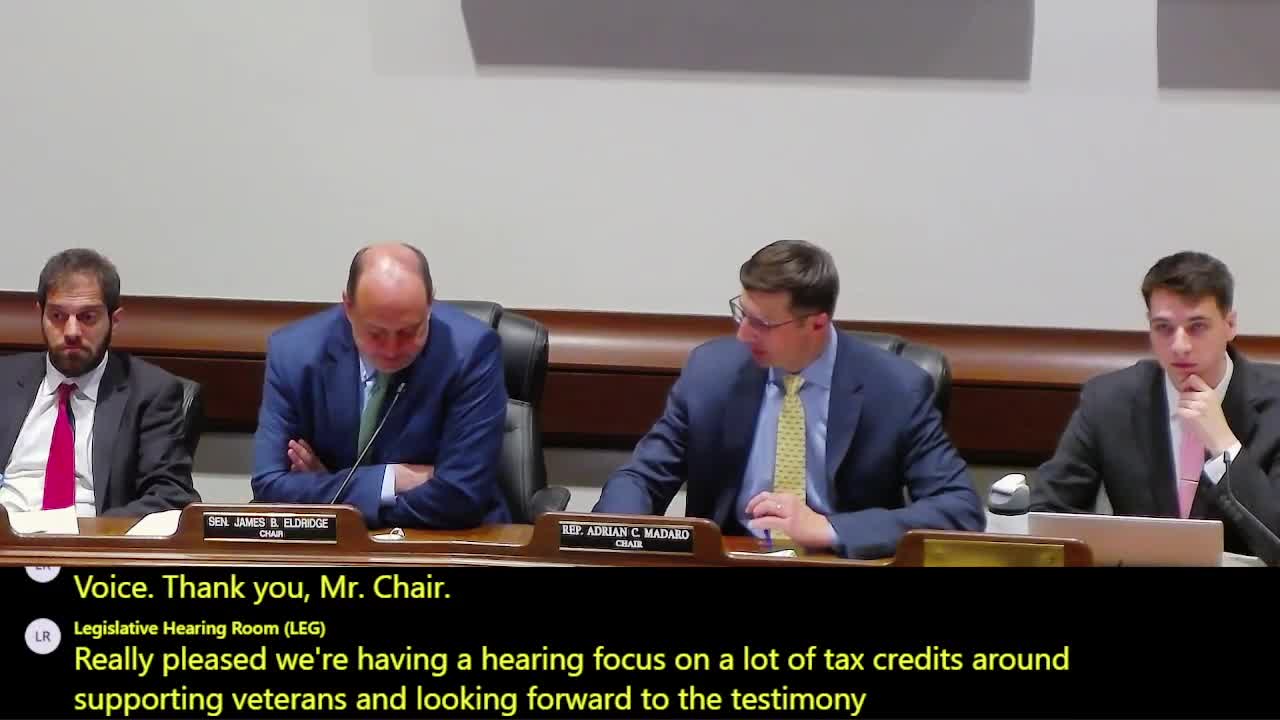
The Joint Committee on Revenue convened a hybrid hearing to take testimony on more than two dozen bills related to property tax relief for veterans, surviving spouses and certain public safety employees, and to consider a mix of modest fixes and broader exemption proposals. Chair (Joint Committee on Revenue) opened the hearing saying, “So today, we'll be hearing testimony on 32 bills concerning veterans.”
The most immediate measures before the committee would raise or equalize existing program caps and reduce paperwork. Representative Sylvia, sponsor of House bill H.3255, said the bill would “raise that cap for veterans to $2,000 to bring equity and balance between the two programs,” referring to a $2,000 ceiling recently set for the senior property tax work-off program and the current $1,500 cap for the veterans program.
Nut graf: Lawmakers and municipal officials urged the committee to fix what they described as an oversight that left the veterans property-tax work-off benefit lower than the senior counterpart, and they also heard distinct proposals that would grant broader exemptions — including full or proportional relief for 100% service‑connected disabled veterans and a state reimbursement scheme to protect municipal budgets.
Representative Soder urged passage of H.3245, “an act relative [to] property tax relief for a 100% disabled veterans,” saying current Massachusetts relief is limited compared with neighboring states. Soder testified that “a 100% disabled veteran in Massachusetts currently qualifies for just a thousand dollar exemption,” and cited examples in New York, Vermont and Connecticut where larger or full exemptions exist. Senator Moore, sponsor of S.2046, described a broader plan that would grant property tax relief proportional to a veteran’s VA disability rating and said municipalities would be reimbursed by the Commonwealth for foregone revenue. “Senate 20 46 provides disabled veterans a property tax exemption equal to the percentage of the veteran's permanent service connected disability as determined by the US Department of Veterans Affairs,” Moore testified.
Several speakers described how small administrative changes could prevent veterans from losing benefits. Representative McGregor backed H.3175 to eliminate an annual filing requirement for veteran exemptions, calling the current rule “an unnecessary burden” and saying the change would let veterans file once unless their exemption status changes.
Surviving-spouse and line-of-duty issues came up during testimony on H.3188. Mary Ann Carty, who identified herself as the widow of police officer William Canal, urged the committee to amend Clause 42 so that surviving spouses of “police and fire personnel who are killed or die in the line of duty would be eligible for the exemption.” “This language change would make sure that all line of duty deaths are included,” Carty said.
Local officials and municipal leaders urged parity and flexibility. Councilor Chris Clark and Councilor Benny Lutke (Barnstable) described the work-off program as a local option they want available and comparable to the senior program. Clark recounted that municipal officials view the two programs as “twins” and that raising only the senior cap created confusion and a local disincentive to act. “There's less incentive for a veteran to sign up for the veterans tax work off program if the veteran also happens to be a senior over 60 years of age,” Clark testified.
Committee members and testifiers noted context from prior legislation. The hearing referenced the HERO Act of 2024 as recent legislative work on veterans’ tax relief, and witnesses compared Massachusetts proposals with out‑of‑state examples, including Connecticut’s Public Act 24‑46. Testimony also included population figures offered by speakers: one witness said Massachusetts is home to “well over 300,000 veterans,” with “approximately 60,000” living with a service‑connected disability and “20,000” having a disability rating above 70 percent.
No formal committee votes or motions were recorded during the hearing. Multiple legislators urged the committee to “favorably report” their bills so municipalities could implement changes in time for upcoming observances and tax cycles.
Ending: The committee closed the session after taking the scheduled testimony, with no recorded votes or referrals during the hearing. Materials and written testimony are slated to be made available on the Legislature’s website at the chairs’ discretion.