Lifetime Citizen Portal Access — AI Briefings, Alerts & Unlimited Follows
Department of Defense backs bills to ease moves, juvenile jurisdiction and military protective orders for military families
Loading...
Summary
Chairman Joe McGonigal, House chair of the Joint Committee on Veterans and Federal Affairs, opened the committee’s first public hearing of the 2025–26 legislative session and recognized testimony supporting S.2503 and H.3886 from the Department of Defense and bill sponsors.
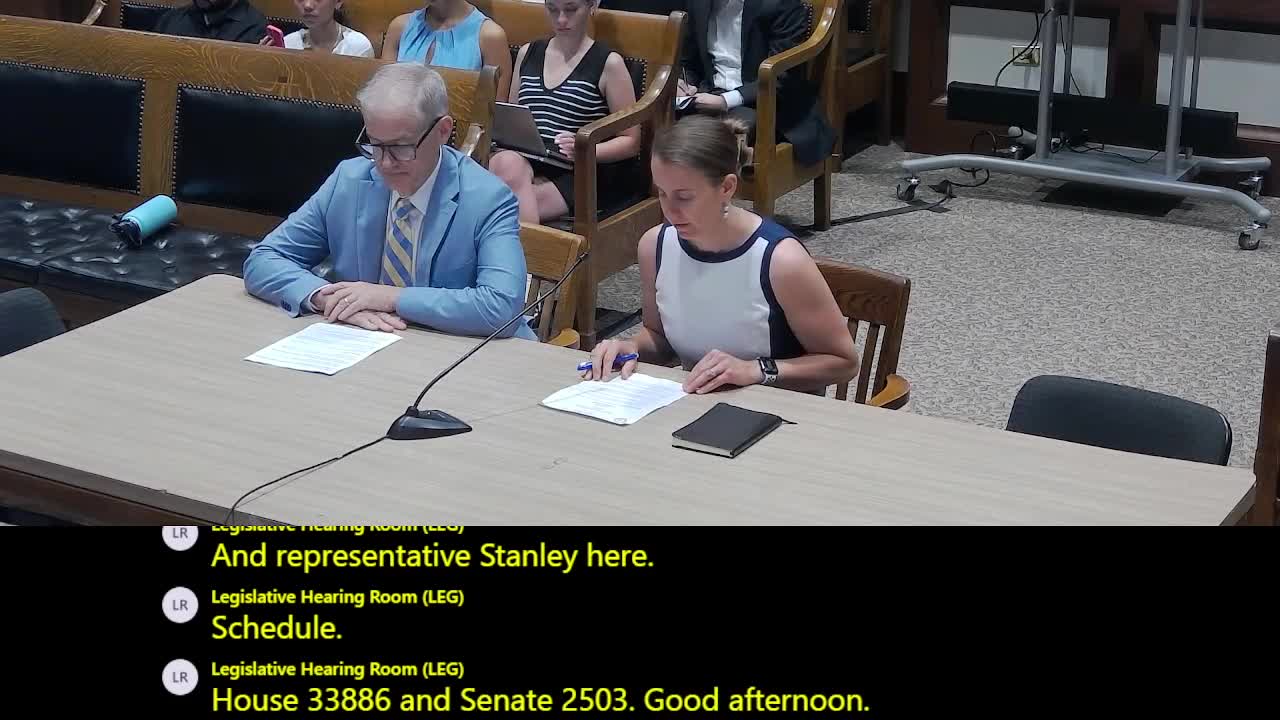
Chairman Joe McGonigal, House chair of the Joint Committee on Veterans and Federal Affairs, opened the committee’s first public hearing of the 2025–26 legislative session and recognized testimony supporting S.2503 and H.3886 from the Department of Defense and bill sponsors. "The Department of Defense is grateful for the opportunity to support the policies reflected in S.2503 and H.3886," Melissa Willette, New England region liaison for the Department of Defense State Liaison Office, told the committee.
The bills would (1) improve education continuity for military-connected children who relocate, (2) provide a mechanism for concurrent juvenile jurisdiction on federal installations so certain juvenile matters can be adjudicated in state family courts, and (3) enable civilian courts to consider military protective orders as evidence in applications for temporary protection from abuse, Willette said. "You recruit the service member, but you retain the family," she added.
Why it matters: committee testimony emphasized practical effects on military families who move frequently. Willette said about 3,600 active-duty children attend Massachusetts schools and cited a 2020 study that found 51 percent of active-duty families with a child in special education had trouble transferring individualized education plans (IEPs) after a move. Supporters told the committee that concurrent jurisdiction—already enacted in Connecticut, Maine, New Hampshire and Rhode Island—can allow juvenile cases that originate on installations to be handled in state juvenile courts that have child-focused resources and case management.
Proponents said the changes are voluntary for state courts. "The local family court does not have to assume the case if they do not have the bandwidth," Willette said, describing the bills’ mechanism as creating an option rather than forcing a transfer.
Committee members asked clarifying questions about scope and safeguards. One member asked whether the change would ask the Department of Defense to "give up" law-enforcement authority on military property; Willette and Representative Stanley, the House sponsor, said the bills provide for concurrent jurisdiction—meaning federal and state authorities could both have jurisdiction and the family court would decide whether to assume a case. A committee member pressed whether such transfers would be case-by-case; Willette said the provision would create a mechanism for concurrent jurisdiction and that individual courts would determine whether to take specific cases.
The hearing also addressed military protective orders. Willette explained that issuance of a military protective order is a commander’s discretionary decision and "there is no standard" comparable to the civil court standard for temporary protection from abuse. For that reason, the bills seek to allow military protective orders to be admitted as evidence when a civilian temporary protection from abuse order is sought, to support coordinated responses to reports of violence.
Representative Stanley, one of the bill sponsors, framed the measures as building on Massachusetts’ previous work for military families, noting prior laws to speed school enrollment and assist military spouses with professional licensing. "This legislation builds on our already strong record of support for our military families," Stanley said, and asked the committee for a favorable report.
The testimony included an offer to provide the committee with a memorandum from a former Secretary of the Army that supporters said recommended the jurisdictional change. A committee member requested that memo and a copy of the law references cited.
No formal committee action was recorded at the hearing; testimony and written comments were accepted until the committee takes up the bills.
Less-critical details: witnesses noted the bills use approaches adopted in other New England states, and supporters described the changes as intended to improve educational continuity, juvenile case outcomes and information-sharing between military and civilian authorities.