Get Full Government Meeting Transcripts, Videos, & Alerts Forever!
Get email alerts on the Drug Checking Surveillance topic
No spam. Unsubscribe anytime.
Massachusetts drug‑checking network shows Xylazine emergence in 2020–2022 then decline; metetomidine rising — MADS urges expanded, funded testing hubs
Summary
State drug‑checking researchers told the commission that Xylazine was first detected in Massachusetts in 2020, appeared in toxicology data in 2022, and that 2025 MADS surveillance shows a decline in Xylazine with an increase in metetomidine detections.
Researchers from the Massachusetts Drug Supply Data Stream (MADS) described how community drug‑checking and laboratory confirmatory testing provide near‑real‑time intelligence on an evolving unregulated drug supply and inform public‑health action.
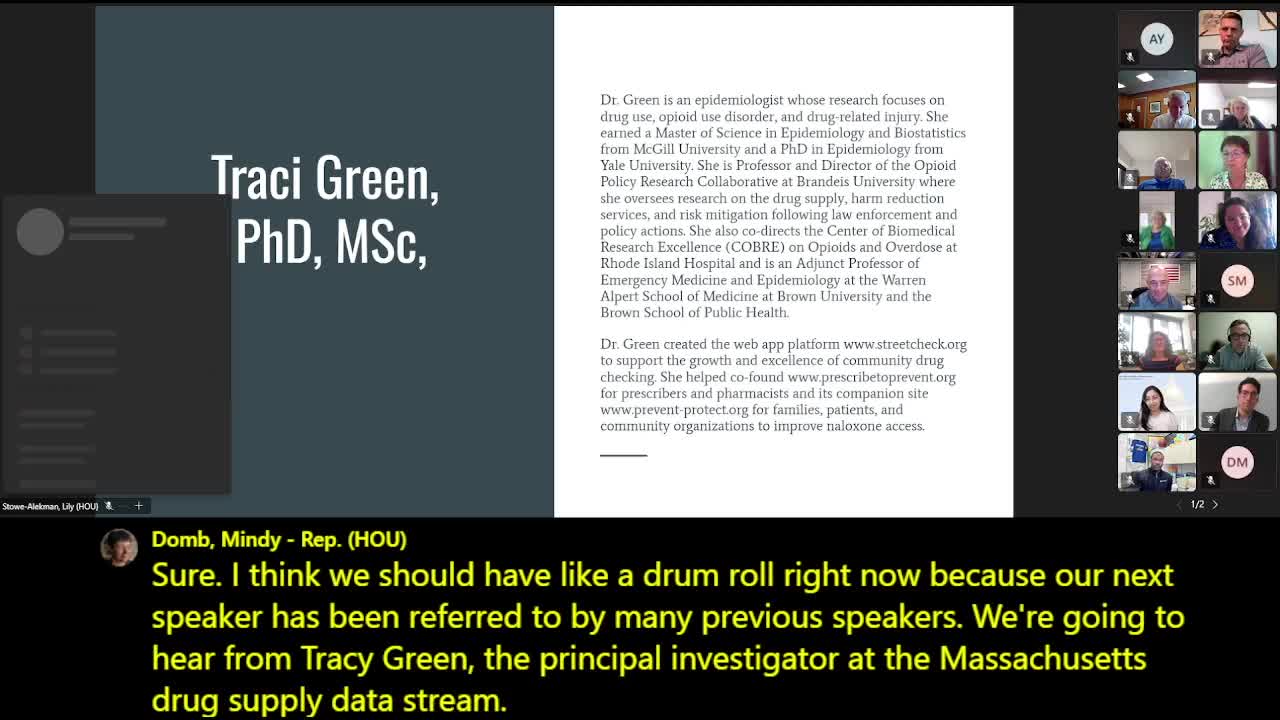
Tracy Green, principal investigator for MADS, summarized the tools used by community partners: technician‑run Fourier transform infrared (FTIR) spectrometers for on‑site scans, immunoassay test strips (including Xylazine and fentanyl strips) and confirmatory laboratory testing (GC‑MS/LC‑QTOF). Green told the commission that MADS began detecting Xylazine in the state’s drug supply in 2020 and that routine toxicology detection by the medical examiner followed in 2022. MADS surveillance, Green said, now shows a measurable decline in Xylazine‑positive samples in 2025 and a concurrent rise in metetomidine detections in many localities.
Green explained how drug‑checking affects behavior: people who use drugs often change behavior after learning a sample contains a contaminant (discarding the sample, using less, changing administration route or not using alone) and community suppliers sometimes adjust or recall product when testing shows unexpected adulterants. She also reported preliminary survey data indicating approximately 35 percent of people who use drugs in the state have accessed a drug‑checking service; that figure, Green said, is “not enough” but the law and funding changes have increased pre‑use testing in some programs.
Presenters said drug‑checking programs require sustained investments: trained technicians, FTIR units and secondary lab capacity. Green recommended at least one fully functional regional hub per EOHHS region, ongoing training, and funding for laboratory confirmatory testing. Multiple presenters told the commission the state’s recent statutory changes improving legal protections for drug checking were an important step but that operational funding and workforce development are critical to expand access.
Commission members heard that drug‑checking data have already been used to issue public alerts (BSAS and Brandeis fact sheets), inform clinical guidance, and support harm‑reduction outreach. Speakers urged the commission to recommend continued legal protections and stable funding to scale drug‑checking infrastructure across the Commonwealth.