Get Full Government Meeting Transcripts, Videos, & Alerts Forever!
Get email alerts on the Alzheimers And Dementia topic
No spam. Unsubscribe anytime.
Lawmakers, advocates push updated Alzheimer’s bill to expand training, statewide coordination
Summary
Legislators and health, public‑safety and advocacy groups urged support for H.769/S.468, which would expand dementia training to first responders, create a dementia services coordinator, strengthen hospital discharge protections and add dementia care coordination benefits to certain plans.
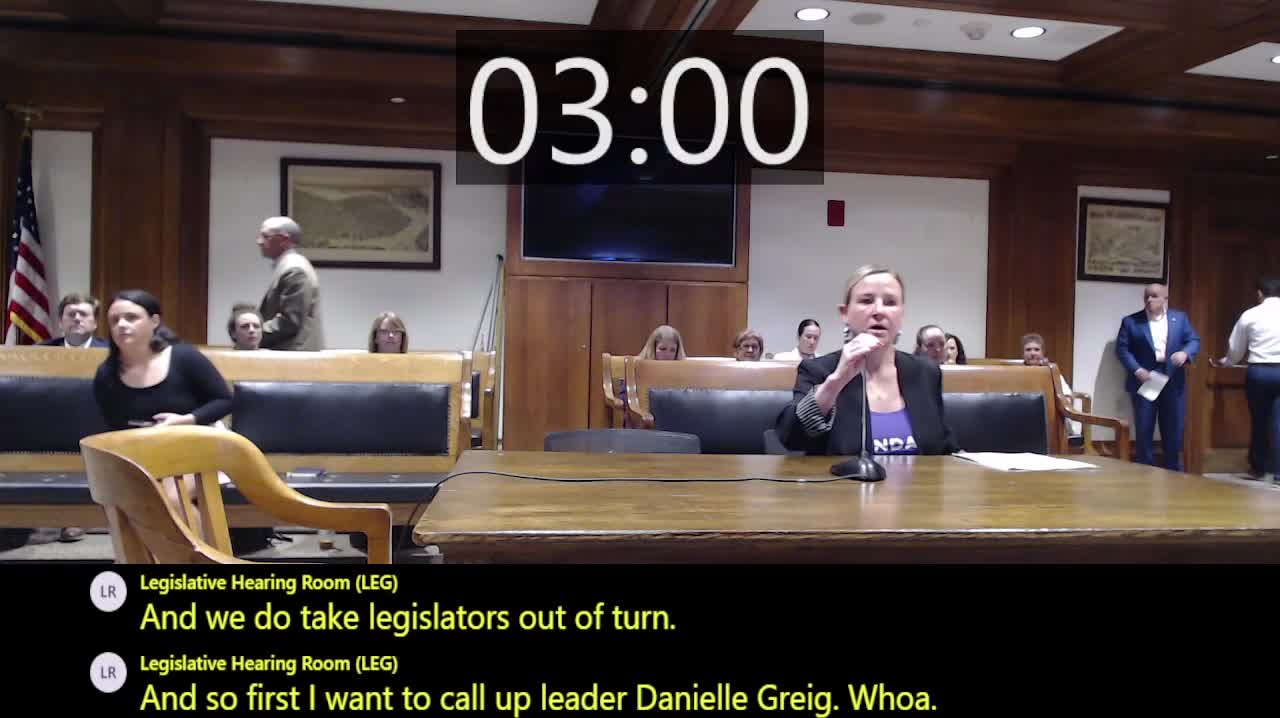
State lawmakers and a coalition of health and aging organizations urged the Joint Committee on Elder Affairs on Tuesday to advance H.769 and S.468, “an act to improve care and prepare for the new era of Alzheimer’s and dementia,” arguing the measures update Massachusetts policy to address rising case counts and new treatment options.
Representative Danielle Gregoire, sponsor of earlier 2018 Alzheimer’s legislation, told the committee she returned “to the table with a new proposal” after identifying gaps in care that persist since the 2018 Omnibus Alzheimer’s and Related Dementias Act. “We decided… it was time to include fire, police and EMTs in that training,” Gregoire said, describing provisions that would expand required dementia training beyond health professionals to first responders and establish a statewide dementia services coordinator.
The bill would also require improved discharge planning for patients with dementia and expand patient and caregiver rights in hospital settings, proponents said. “Caregivers are not visitors. Caregivers are actually a part of the care team,” Dr. Maura Kennedy, division chief of geriatric emergency medicine at Mass General Brigham, said, describing a case in which a patient’s granddaughter on speaker phone calmed a distressed patient and likely prevented an unnecessary intubation.
Advocacy groups emphasized the public‑health and cost rationale for the bill. Susan Ann Koviak, vice president of programs and services at the Alzheimer’s Association Massachusetts/New Hampshire chapter, said more than 135,000 people currently live with Alzheimer’s in Massachusetts and noted projections that prevalence will rise. Catherine O’Malley, a senior policy analyst at Boston University School of Public Health, said earlier diagnosis and public awareness can lower costs and improve treatment outcomes because some new therapies are effective only in early disease stages.
Specific proposals discussed by witnesses included: - Mandatory dementia training for law enforcement and other first responders (testimony described a model of at least two hours in recruit training and one hour of biennial in‑service training). - Creation of a dementia services coordinator position in the Executive Office of Health and Human Services to centralize strategy and data collection. - A statewide public‑awareness campaign led by the Department of Public Health and enhanced dementia‑specific data reporting, including racial and ethnic disparities. - Expansion of dementia care coordination as a benefit available through Senior Care Options (SCO) plans and One Care for dually eligible and disabled beneficiaries. - Incentives to expand the geriatrics workforce, including loan repayment for geriatricians and geriatric psychiatrists.
Law enforcement and public‑safety representatives endorsed the training requirement. Tim King, in‑house counsel for the Massachusetts Coalition of Police, said standardized training would equip officers with de‑escalation techniques, communication tools and local caregiver protocols and could reduce unnecessary use of force. John Nelson, first vice for the police dispatch union, added that training is also an officer safety measure.
Family advocates delivered personal testimony about the stakes of the hospital‑visitation and discharge provisions. Judy Johansen and Leslie Doyle recounted episodes in which restrictive visiting rules or lack of a caregiver at the bedside led to traumatic restraint, medication administration without family consent, or preventable complications. “Caregivers give voice to those who have lost theirs and actually improve care,” Johansen said.
Speakers acknowledged implementation questions remain. Witnesses said some training curricula already exist and are offered at no cost by the Alzheimer’s Association; funding sources for new positions and program expansion were “to be worked out,” and HIPAA and other confidentiality rules will need careful handling in discharge and caregiver‑access provisions.
No formal committee vote or directive was recorded during the hearing; most witnesses urged the committee to report the bills favorably so stakeholder negotiations and technical drafting can continue.
Supporters asked the legislature to build on the 2018 law and to prepare the Commonwealth for “a new era” of Alzheimer’s care as treatments and diagnostic approaches evolve.