Get Full Government Meeting Transcripts, Videos, & Alerts Forever!
Get email alerts on the Health Impacts Wounds Overdose topic
No spam. Unsubscribe anytime.
Clinicians and harm‑reduction providers: Xylazine linked to deep wounds, prolonged sedation; low‑barrier wound care and overdose training urged
Summary
State and community clinicians described Xylazine’s association with large, hard‑to‑heal skin wounds, extended sedation and harder‑to‑manage withdrawal. Presenters urged expanded low‑barrier wound care, updated hospital protocols and more clinician and first‑responder training.
State public‑health officials, infectious‑disease and addiction clinicians, harm‑reduction providers and people with lived experience described the health harms linked to Xylazine and urged expanded wound care and provider training.
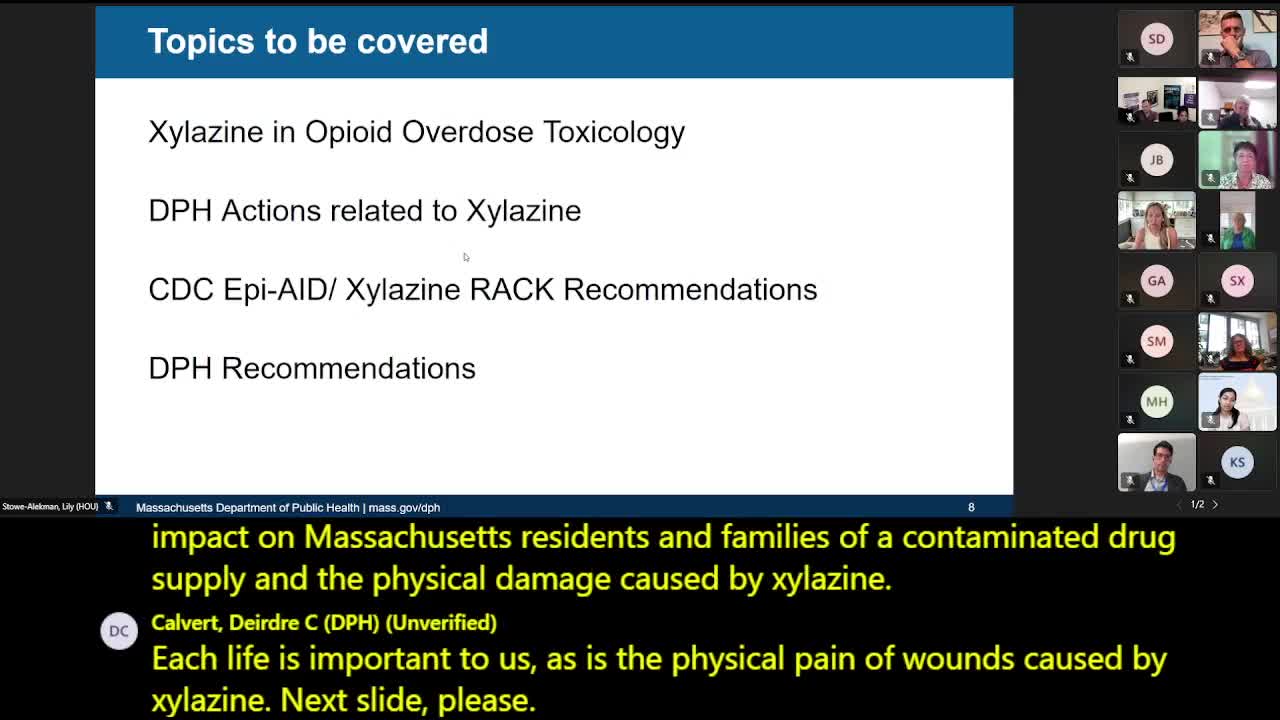
Deirdre Calvert, director of the Bureau of Substance Addiction Services (BSAS) at the Massachusetts Department of Public Health, told the commission that “xylazine was first detected in the Massachusetts drug supply in 2020, and we see it begin to be present in the opioid overdose toxicology data in 2022,” after the medical examiner began routine testing. Calvert summarized BSAS recommendations from a joint CDC Epi Aid and Brandeis investigation: reduce stigma in health systems, expand self‑directed wound‑care supports (including billing and supply coverage), expand drug‑checking, and support low‑barrier care such as mobile vans and clinics.
In clinical testimony, Raghini Jawa, an infectious‑disease and addiction clinician who has worked in areas with high Xylazine prevalence, said evidence and clinical experience show Xylazine has “shifted from being just an adulterant to a common component in our unregulated opioid supply,” and that many patients do not want Xylazine in their drugs but learn of exposure only after harm occurs.
Clinicians reported three recurring clinical problems associated with Xylazine:
- Deep, necrotic skin wounds: Presenters described wounds that can arise away from injection sites and resemble burns more than simple abscesses. Tracy Green’s MADS‑linked Epi Aid interviews found about half of people whose samples showed Xylazine reported Xylazine‑associated wounds in the prior six months; many had multiple wounds and most still had wounds at the time of interview.
- Prolonged sedation: Providers and first responders described heavy, prolonged sedation that may not respond fully to naloxone because Xylazine is a non‑opioid sedative; naloxone still reverses the opioid component and should be administered when respiratory depression is present, but patients may remain deeply sedated longer and require extended monitoring and oxygenation.
- Withdrawal and care barriers: Clinicians said withdrawal after Xylazine exposure can be distinct from opioid withdrawal and may require coordinated clinical protocols; some patients reported being denied placement in detox or rehab because programs lacked wound‑care capacity.
Multiple presenters urged bolstering low‑barrier wound care in community settings. Dr. Sarah Wakeman (Mass General Brigham) and several harm‑reduction speakers said community syringe‑services programs and mobile clinics have been providing much of the wound care and that early, daily dressing changes at low‑barrier sites can avert worse outcomes. Alan Young, a recovery coach, described how wounds often begin as “little pimples” for people who inject and can progress rapidly when people are unable to seek care because they are avoiding withdrawal.
Speakers recommended concrete steps: expand and fund mobile wound‑care and low‑threshold clinics; standardize hospital and detox withdrawal and wound‑care protocols; ensure wound‑care supplies and billing paths so community programs are not subsidizing supplies; and include wound‑care training in clinical education and harm‑reduction training for first responders.
Several presenters emphasized that the drug supply is evolving and that Xylazine is one of multiple contaminants; providers requested funding and technical assistance to scale wound care and integrate it into substance‑use services.