Get Full Government Meeting Transcripts, Videos, & Alerts Forever!
Get email alerts on the National Guard Governance topic
No spam. Unsubscribe anytime.
Sponsors, Guard association push bill to make Massachusetts National Guard a governor-level cabinet office
Summary
Senators and Guard advocates told the committee that elevating the Adjutant General to a cabinet‑level secretary reporting directly to the governor would streamline communication and planning for state emergencies; witnesses urged clarifying the interaction between state and federal activation rules (Title 10/32).
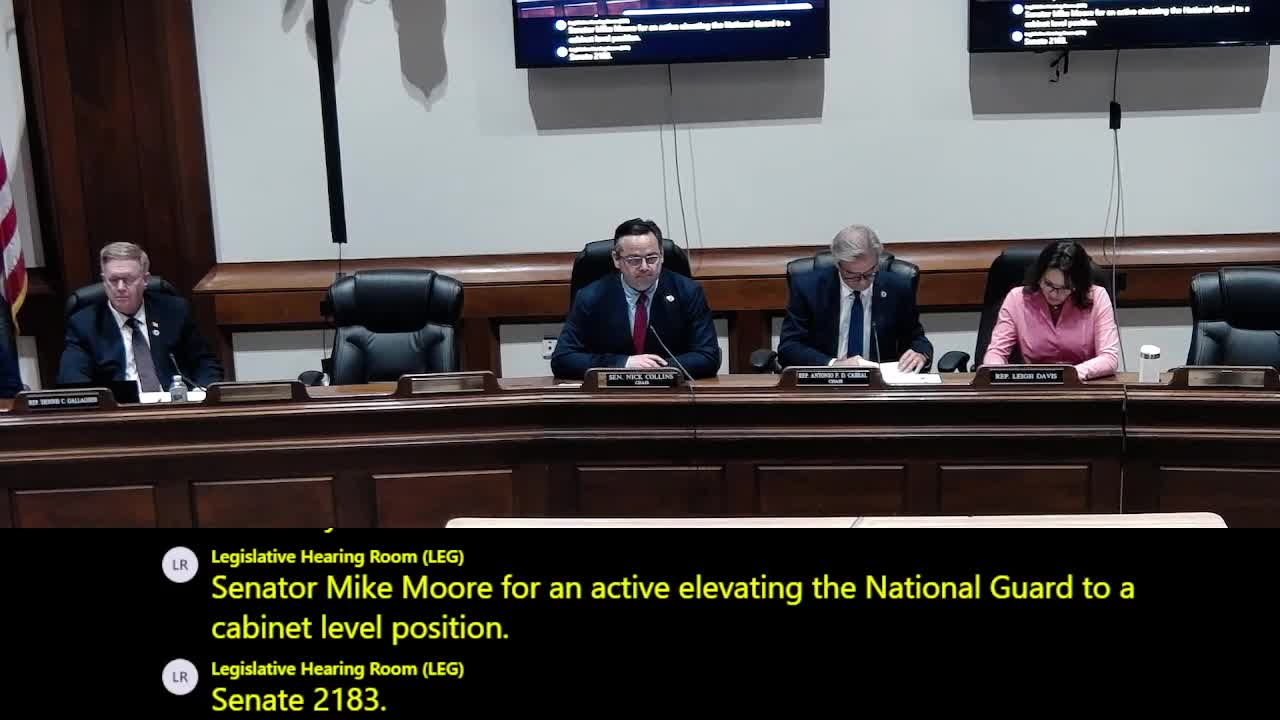
Senators Mike Moore and John Vilas, together with advocates from the National Guard Association of Massachusetts, urged the Joint Committee on June 24 to report S.2183 favorably to elevate the Massachusetts National Guard to a cabinet‑level office reporting directly to the governor.
What sponsors said: Senator Mike Moore said the Guard’s mission spans domestic emergencies, overseas deployments and public‑safety work, and argued that direct reporting to the governor reduces bureaucracy in urgent events. "Out of 50 states, Massachusetts is sadly the only state that doesn't have the National Guard as a direct report to the governor," Moore said during his testimony.
Operational rationale and legal nuance: Senator John Vilas, who also serves in the Guard, recounted a failure of requests during the soldiers’ homes crisis and said a direct line to the governor would reduce delays: “We never got that request,” he said of a plea for Guard assistance during the soldiers' homes emergency, describing a breakdown in the chain of communication that followed. Vilas and other supporters emphasized the Guard’s broad domestic mission and urged smoother, timelier decision-making.
National Guard Association perspective: Matthew McKenna, executive director of the National Guard Association of Massachusetts, told the committee that 52 of the 54 U.S. National Guard organizations (including territories) report directly to governors; Massachusetts and Virginia are outliers. He said the current reporting structure places the Adjutant General under the executive office of public safety and security (EOPS), several layers removed from the governor.
Federalization and limits: Committee members raised how federalization works in practice. Witnesses flagged Title 10 vs. Title 32 distinctions — federal activation can supersede state control — and members asked for further briefings from the Governor’s Office and the Guards' command to clarify operational consequences. Senator Vilas and others told the committee they want a seat at the table for Guard leadership to ensure timely responses to civil emergencies and public safety events.
Committee action: Chairs said the committee will continue the conversation and request briefings from the Governor’s Office and Guard command and review court opinions and federal/state activation rules. No vote was taken at the hearing.