Get Full Government Meeting Transcripts, Videos, & Alerts Forever!
Get email alerts on the Commission Organization topic
No spam. Unsubscribe anytime.
Massachusetts special commission on Xylazine convenes to study contaminated drug supply; report deadline moved to March 30, 2026
Summary
Legislative co-chairs opened the first public meeting of the Special Commission on Xylazine to study public-health risks from the drug's presence in the unregulated supply. The commission’s statutory charge, planned hearings and a staff‑driven schedule were presented; the final report deadline was extended to March 30, 2026.
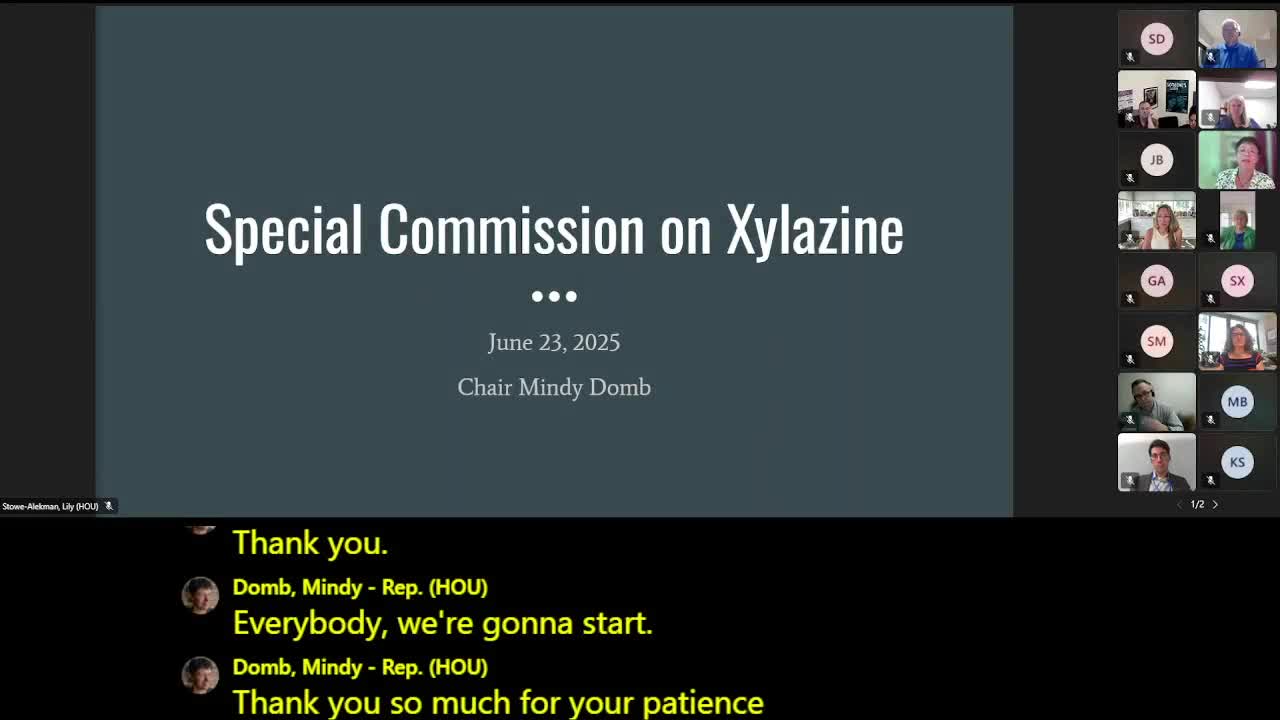
The Special Commission on Xylazine, convened by the Joint Committee on Mental Health, Substance Use and Recovery, held its first public meeting remotely, with House chair Mindy Dom and Senate co‑chair Sen. John Vilas presiding.
The commission is charged to “study and make recommendations on ways to address the public health and safety concerns posed by the proliferation of Xylazine as an additive to illicit drugs, including, but not limited to, fentanyl,” Dom said. The commission will examine three core areas listed in its charge: best practices to regulate and oversee Xylazine production and distribution; whether Xylazine should be classified as a controlled substance and what penalties, if any, should apply; and gaps in outreach and treatment services for people exposed to Xylazine and related contaminants.
Dom told members that the original report deadline of June 30, 2025, has been extended to March 30, 2026, giving the commission more time for public hearings and working‑group work. Staff outlined a proposed schedule that includes a second public hearing in early fall 2025 to receive public testimony, working‑group deliberations in late 2025, a third hearing to review preliminary findings, and a final public hearing in March 2026 when the draft report will be finalized and submitted to the clerks.
Commission staff (including committee counsel Jess Bressler) walked members through the packet materials made available to participants: the statute that created the commission, the commission’s specific charge, background memos and a proposed schedule. Dom said work groups would be organized around the themes in the legislative charge and that staff will circulate the membership and meeting dates by email; members will be asked to rank their work‑group preferences.
No formal votes were taken at the first meeting. The chairs repeatedly emphasized that the commission will hear from subject‑matter experts and community partners during its public hearings and that members should submit written materials to staff for distribution to the full commission.
Looking ahead, Dom said staff would compile member preferences for work‑group assignments and circulate meeting dates and materials. The commission's next steps are procedural: organizing work groups, scheduling the fall public hearing and collecting written submissions from stakeholders.