Get Full Government Meeting Transcripts, Videos, & Alerts Forever!
Get email alerts on the Combined Sewer Overflow topic
No spam. Unsubscribe anytime.
Lowell officials seek Article 97 easements to move forward with $160M sewer separation project
Summary
City officials and consultants told the committee Article 97 approval and state SRF support are required for the multi‑phase Merrimack River watershed sewer separation project; proponents said the work will reduce combined sewer overflows and benefit environmental justice neighborhoods downstream in Lawrence and Haverhill.
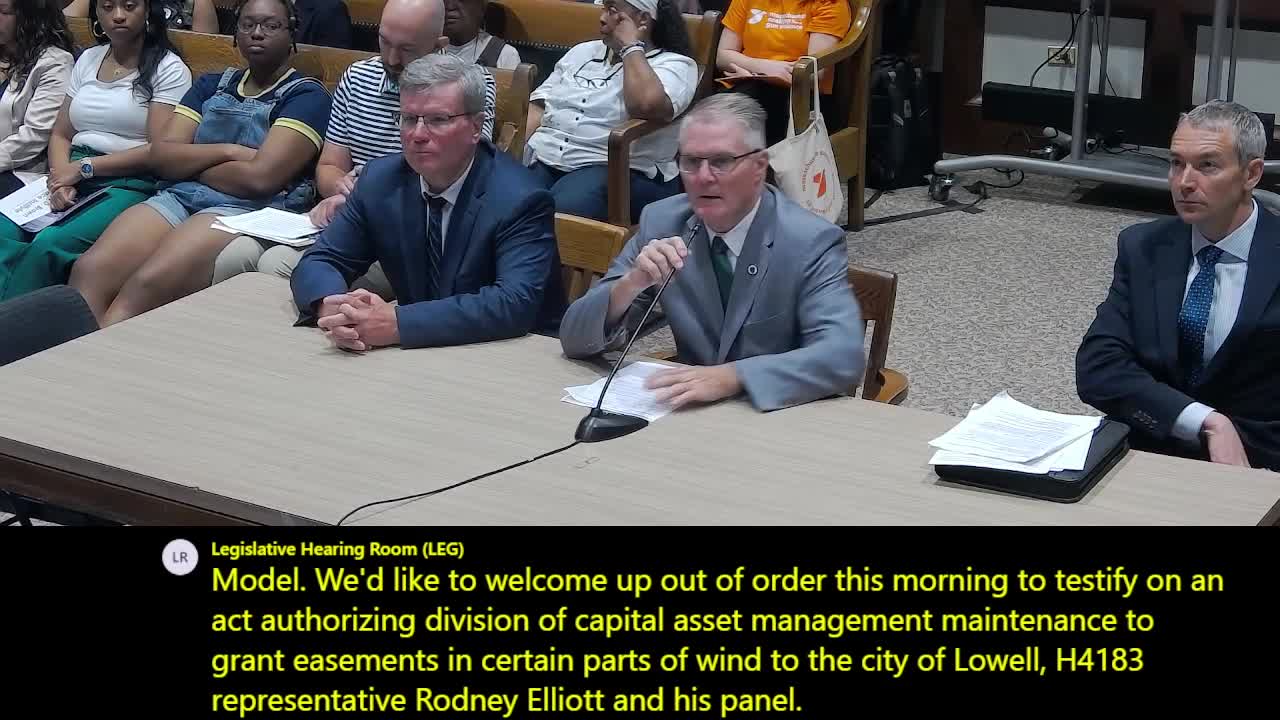
Representative Rodney Elliott and City of Lowell witnesses appeared before the Joint Committee on June 24 to request support for H.4183, legislation authorizing the Division of Capital Asset Management and Maintenance (DCAMM) to grant easements over state land under Article 97 of the Massachusetts Constitution so Lowell can construct an outfall for a Centerville sewer separation project.
Project purpose and scale: Aaron Fox, director of the Lowell Regional Wastewater Treatment Utility, described the Centerville sewer separation as part of a larger combined‑sewer‑overflow (CSO) abatement program that "will reduce CSOs... with an estimated reduction in CSOs of 59,000,000 gallons per year." Fox testified that the total project was a $160,000,000 initiative and said Article 97 approval is a necessary statutory step to obtain or finalize State Revolving Fund (SRF) financing and meet consent decree timelines with federal and state regulators.
Legal and environmental context: Assistant city solicitor John McKenna explained that the outfall easement would be granted pursuant to Article 97 and that the project is required by agreements tied to the Clean Water Act and related consent decrees. McKenna and Fox described coordination with the Executive Office of Energy and Environmental Affairs (EEA), the Department of Conservation and Recreation (DCR) and the Department of Environmental Protection (DEP) to site the outfall and limit impacts to the river walk and parkland.
Community, equity and contracting: Vice Chair Tyler and other lawmakers pressed the city on minority and small‑business participation. Lowell officials said the project will be bid under Chapter 30B procurement rules and that the city prioritizes minority, women and small business outreach for subcontracts. Witnesses said contract-level details for subcontracts remain to be negotiated after SRF funding is secured. Representative Elliott and city witnesses also cited downstream benefits to Lawrence, Methuen and other Merrimack River communities.
Costs and schedule: Witnesses cited a peak first‑phase spending estimate of about $6,000,000 and emphasized that missing Article 97 approvals or delaying the easement would jeopardize SRF timelines, federal consent‑decree deadlines and the city’s ability to access low‑cost financing. Representative Elliott initially referenced a $60,000,000 figure for a portion of work in his district; city witnesses clarified total program costs at $160,000,000.
Committee action: Committee members expressed sympathy for the project’s environmental and public‑health goals and said they would consider the Article 97 legislation as written and in light of the city’s commitments to outreach and riverwalk improvements. No committee vote occurred at the hearing.