Get Full Government Meeting Transcripts, Videos, & Alerts Forever!
Get email alerts on the Patient Safety Chaperones topic
No spam. Unsubscribe anytime.
Committee hears survivors, doctors and advocates urging requirement that chaperones be offered for sensitive medical exams
Summary
House and Senate members of the Joint Committee on Public Health heard testimony urging them to require health care providers to offer trained chaperones during sensitive medical exams, with survivors, researchers and physicians saying the change would increase patient safety and accountability.
House and Senate members of the Joint Committee on Public Health heard more than three hours of testimony on bills including H.2362 and S.1491 that would require health care providers to offer trained chaperones for sensitive medical exams.
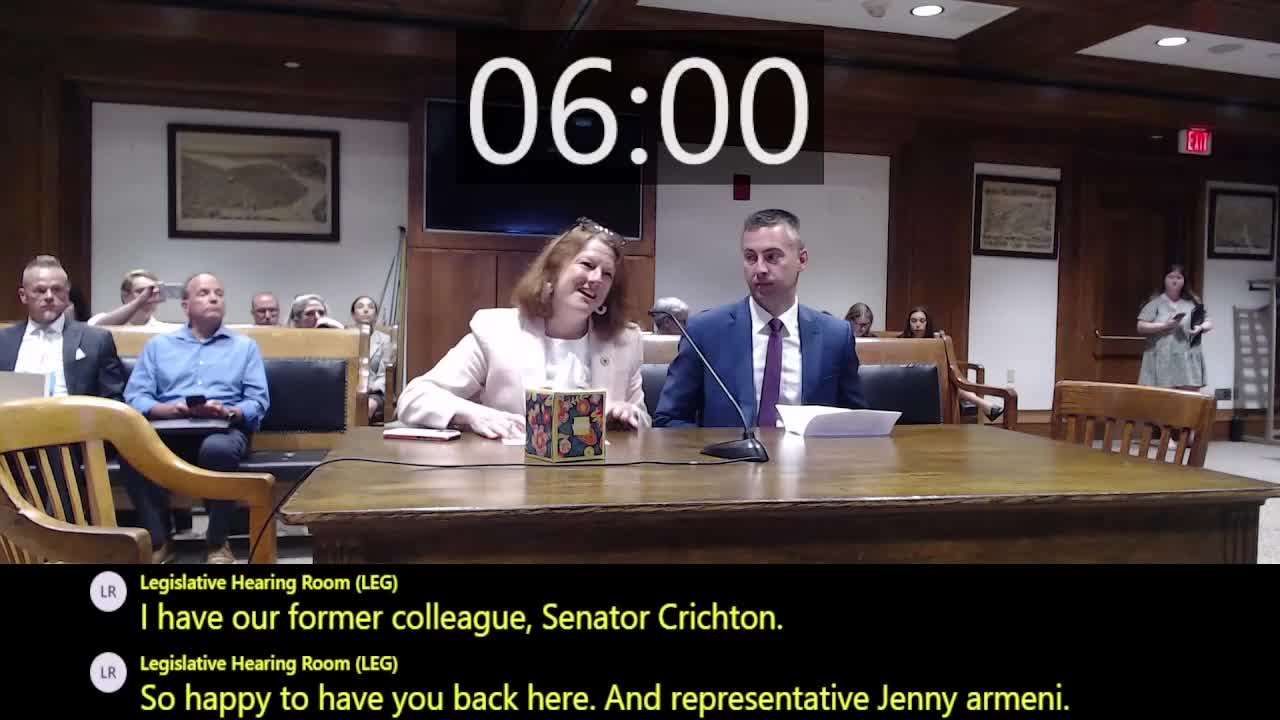
Representative Marjorie Decker, House chair of the joint committee, opened the hybrid hearing and invited testimony from legislators, survivors and experts about practices and proposed legal requirements.
The bill’s sponsors and supporters told the committee that the requirement would be offered to patients and that patients could accept or decline a chaperone. Representative Armini said the intent is “very simple: require health care providers to offer a trained chaperone to be physically present for all sensitive medical exams including genital, rectal, and breast examinations,” and that a patient would retain the choice to accept or decline the chaperone.
Survivors described how isolated, unchaperoned exams created opportunities for abuse. Rory McCarthy, a survivor who testified in person, said: "I am one of over 250 survivors of sexual violence committed over a 10 year period by Derek Todd, a top rheumatologist that saw medically vulnerable patients in one of the best hospital systems in the world." She told the committee the lack of chaperones allowed alleged abuse to occur during early-morning and late-evening visits when staff were not present.
Health policy and survivor-advocacy groups urged the committee to move the bills. Azza Abudaga, a health services researcher with Public Citizen’s Health Research Group, told the committee her group's review of the National Practitioner Data Bank found no indication that chaperones were present in narratives describing reported physician sexual misconduct, and recommended offering “the right to a trained chaperone” during sensitive exams and other encounters when requested.
Physicians and clinicians at the hearing framed the proposal as a patient-safety and provider-protection measure. Dr. Moli Jha, a practicing primary care physician, testified that requiring the offer of a chaperone, recording the patient's choice, and training chaperones would reduce ambiguity about norms and strengthen accountability: "Offering a chaperone and honoring the patient's choice to accept or decline is a concrete expression" of consent, she said.
Members discussed details of statutory and professional scope. Representative Kane asked committee staff to review whether the bill’s language should be broadened to specify that chaperones may be “any trained professional within the practice,” and not only a board‑certified clinician; she noted that certain therapists (PTs/OTs) are housed under different licensing chapters (she referenced chapter 112 and chapter 111 during questioning) and said the committee should clarify which licensed professions would qualify as chaperones.
Witnesses cited national and state precedents. Testimony referenced the American Medical Association and the American College of Obstetricians and Gynecologists' guidance on chaperones, the Oregon Medical Board’s July 2023 requirement, and state-level bills in other states requiring explicit consent for educational pelvic exams. Survivors also cited recent Massachusetts litigation and criminal cases: more than 200 people filed a civil suit in Suffolk County against Dr. Derek Todd and associated practices, and the committee heard that Dr. Todd was indicted on two counts in Middlesex County.
No formal vote or amendment was recorded at the hearing; witnesses and legislators requested that staff prepare clarifying language and that the committee consider coordinating H.2362 and S.1491 with related bills such as H.2401/S.1485 addressing consensual sensitive exams.
The committee accepted written testimony from many organizations and invited additional submissions.
Less immediately consequential details include repeated survivor accounts about the timing of appointments (early morning or late evening), survivors’ descriptions of post‑traumatic symptoms, and references to national cases (e.g., Larry Nassar) as context for why chaperone rules matter.
The committee did not announce an immediate vote; sponsors asked members for a favorable report and for staff to draft clarifying language about which professionals may serve as a trained chaperone and how the choice and presence would be documented.