Get Full Government Meeting Transcripts, Videos, & Alerts Forever!
Get email alerts on the Unsolved Homicides topic
No spam. Unsubscribe anytime.
Survivors and advocates press for statewide office and task force to review unsolved homicides
Summary
Lawmakers and survivor groups told the Joint Committee on State Administration and Regulatory Oversight that bills to create an Office of Unsolved Homicides and a statewide task force would give families a formal path to case review, increase transparency and address racial disparities in clearance rates.
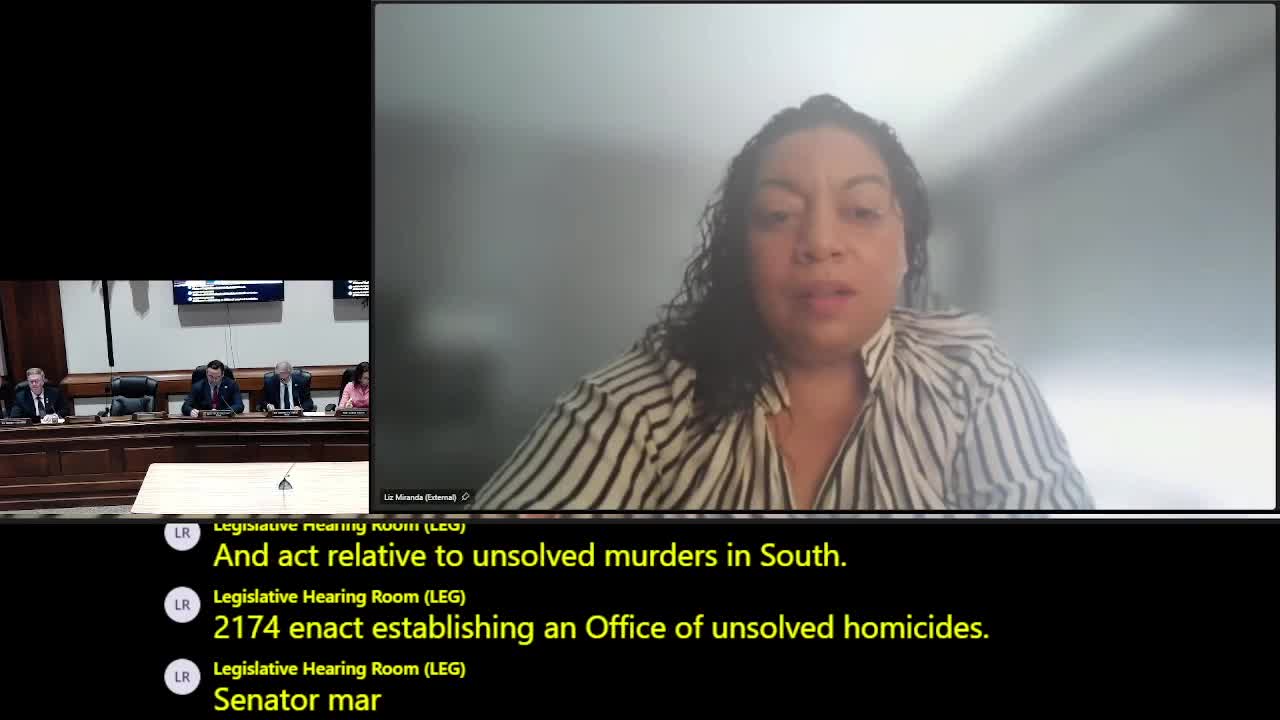
Senator Liz Miranda, chair of the committee hearing, told lawmakers and advocates on June 24 that she supports S.2174 and S.2177, bills to create a centralized Office of Unsolved Homicides and a statewide Unsolved Homicides Task Force to review long-unsolved cases and give families a formal path to petition for reinvestigation.
The bills would place an office within the Attorney General’s Office, allow families to request a formal review of cases unsolved for three years, and require a written response within 90 days that “identif[ies] missed investigative steps” and reexamines forensic evidence, testimony and records, proponents said.
Why it matters: Testimony from the Lewis D. Brown Peace Institute, Northeastern University researchers and survivor-advocates emphasized scale and disparity. Pace McConkie Jr., policy manager at the Peace Institute, noted the statewide backlog; Northeastern students’ research and the Peace Institute highlighted roughly 1,700–1,800 unsolved cases in Boston and an estimated nearly 2,000 unsolved homicides statewide going back to 2000. The testimony also cited racial gaps: according to witnesses, homicides of Black victims are cleared at far lower rates than those of white victims.
Survivors described emotional and procedural harms from years without answers. Senator Miranda said the proposals are “long overdue. They’re critical steps toward justice for families whose loved ones were taken and whose cases remain unresolved.” Alexandra Sherry Durellis, co-executive director of the Peace Institute and sibling survivor, told the committee that “The dead cannot cry out for justice. It is the duty of the living to do so.”
Researchers and advocates said the bills would also create regional teams, a toll-free anonymous tip line, and a public-facing database of unsolved cases. The legislation creates a dedicated fund for the work; proponents requested an initial $10 million appropriation to staff reviews, regional investigations and the public tools described in the bills.
Law-enforcement perspective and practical issues: Joseph Rowland, who maintains a public Boston homicide map, testified that the Boston unsolved homicide squad is largely silent and prioritized forensic/DNA cases. He said families often receive no follow-up after an initial meeting: “If a family makes an inquiry, it's very common for them to not hear back after that initial meeting. They're supposed to take silence as an answer.” Northeastern students' report, cited at the hearing, recommended uniform survivor communication practices and stronger city–state collaboration.
What the committee did: The hearing included survivors, nonprofit advocates, law‑students, and researchers; chairs said they will take additional panels and follow-up briefings with prosecutors and law enforcement to examine resources, prosecutorial thresholds and costs. No formal vote was taken at the June 24 hearing.
Discussion vs. decision: Witnesses were urging a favorable report and legislative action; the committee asked for additional briefings from prosecutors and the attorney general’s office before advancing the bills.
Ending note: Proponents framed the bills as accountability and public‑safety measures — both to give families answers and to improve solvability of cases statewide through coordinated resources, data, and public outreach.