Get Full Government Meeting Transcripts, Videos, & Alerts Forever!
Get email alerts on the Vmt Mileage Based User Fees topic
No spam. Unsubscribe anytime.
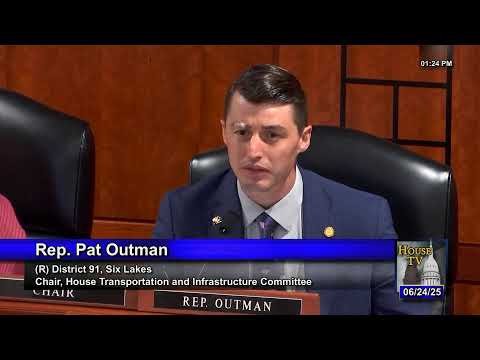
House Transportation committee hears presentations on mileage‑based user fees; experts urge pilots to test privacy, equity and costs
Summary
Experts from the Reason Foundation, Geotol and the County Road Association briefed the House Transportation and Infrastructure Committee on mileage‑based user fees and urged a voluntary, multi‑option pilot to test privacy, equity and collection costs.
The Michigan House Transportation and Infrastructure Committee heard multiple presentations on mileage‑based user fees — commonly called road usage charges, vehicle‑miles‑traveled (VMT) charges or mileage‑based user fees (MBUF) — and questions from committee members focused on privacy, collection cost, payments timing and impacts on rural and agricultural users.
Baruch Feigenbaum, senior managing director of transportation policy at the Reason Foundation, told the committee the fuel tax is losing purchasing power because of rising vehicle fuel efficiency and growing electric vehicle (EV) use. “The fuel tax is like a rock star on his farewell tour,” Feigenbaum said, arguing states need a long‑term replacement for fuel‑tax revenue. He recommended voluntary pilots that test multiple collection options — high‑tech GPS, medium‑tech mileage‑only devices and low‑tech odometer verification — and suggested an initial state rate equivalent of roughly 2¢ to 3¢ per mile for passenger vehicles, with higher rates for heavy trucks.
Feigenbaum listed five policy advantages he said favor mileage‑based charging: fairness, proportionality, self‑limiting revenue, predictability and clearer investment signals. He urged Michigan to use a pilot to answer state‑specific questions — cross‑border travel with Canada and between the Upper and Lower Peninsulas, data collection choices, fuel‑tax refund mechanisms to avoid double taxation, and the mechanics of transitioning a pilot into a permanent program. He estimated a well‑designed pilot at about $6.9 million and recommended a technical advisory committee including MDOT, privacy experts, rural representatives and legislative members.
Ankur Agarwal, chief executive officer of Geotol, described practical collection technologies used in other states: a low‑tech odometer photo upload, direct telematics integrations with original equipment manufacturers (he named Stellantis and Tesla and said integrations with other makers were in progress), and GPS‑based mobile apps that extract miles while removing location logs from users’ devices. “Privacy concerns were there in the earlier times, but with the recent technology that has been rolled out, the privacy concerns have been completely addressed,” Agarwal said. He said odometer‑photo systems and OEM odometer reporting can keep consumer burden low and cited that odometer‑capture mobile apps can cost about $1 per participant per reporting period in some implementations.
Agarwal and Tom Gustafson of Geotol addressed payment models and double taxation: all presenters emphasized that MBUF pilots and permanent programs to date have been implemented as a replacement for, not a supplement to, fuel taxes; states issue refunds or credits to prevent drivers from paying both taxes for the same miles. Collection costs in existing pilots run broadly in the 5–10% range today, presenters said, with the potential to fall as programs scale and vendors compete.
Representatives of the County Road Association — Chief Deputy Ed Noyola and CEO Denise Donahue — told the committee county road agencies view a pilot as necessary education and planning. The association presented estimates from economic analysis projecting an annual shortfall to the Michigan Transportation Fund as EV adoption grows: about $90 million per year by 2030 and a cumulative shortfall approaching $470 million under certain scenarios. Noyola said the association favors a phased transition and public outreach tools, including an online calculator that would let motorists compare what they now pay at the pump to what they'd owe under a mileage fee.
Committee members asked how to handle out‑of‑state drivers (the need for interstate compacts), how to limit privacy risks, whether rural drivers would pay more, the timing or frequency of bills for households that prefer payments spread over time, and exemptions or treatment for agricultural and off‑road vehicles. Presenters recommended optional payment schedules (monthly, quarterly, prepay) and multiple reporting choices so participants can pick a method that fits their privacy and cost preferences. On out‑of‑state concerns, Feigenbaum said reciprocal arrangements among states — similar to tolling and existing Eastern Transportation Coalition cooperation — are feasible but require legislative agreements.
The committee did not take formal policy action during the presentations; members asked questions and received technical responses. Presenters urged the committee to authorize a voluntary pilot with broad representation from urban, suburban and rural Michigan to test collection methods, privacy safeguards, payment options and vendor competition before any state‑wide rollout.
During the hearing, members also raised operational questions: how to treat dyed agricultural fuel that currently does not contribute at the pump, whether program caps or monthly maximums should be considered, and how program rules would assign different rates by vehicle weight class. Presenters said those are policy choices for Michigan to address in designing a pilot.
The committee scheduled no follow‑up votes on mileage fees in this transcript; presenters offered to return for further briefings and to provide a written pilot plan. One presenter noted a vendor‑led explanation session and invited legislators to a separate briefing and lunch.