Get Full Government Meeting Transcripts, Videos, & Alerts Forever!
Get email alerts on the Airport Infrastructure topic
No spam. Unsubscribe anytime.
McPherson Airport officials seek funding to replace deteriorated underground fuel tanks; $1 million project proposed with small local match
Summary
McPherson Airport Authority presented its 2026 budget and urged the county to support replacing aging underground fuel tanks with new above-ground tanks for Avgas, Jet A and mogas. Staffers said the combined FAA, KDOT and Build Kansas funding could make the roughly $1 million project affordable with a local match under $50,000.
McPherson Airport representatives told the county commissioners on June 23 that aging underground fuel tanks have taken on water and are hurting aircraft fueling and revenue, and asked the county to support a project to replace the system with new above-ground tanks.
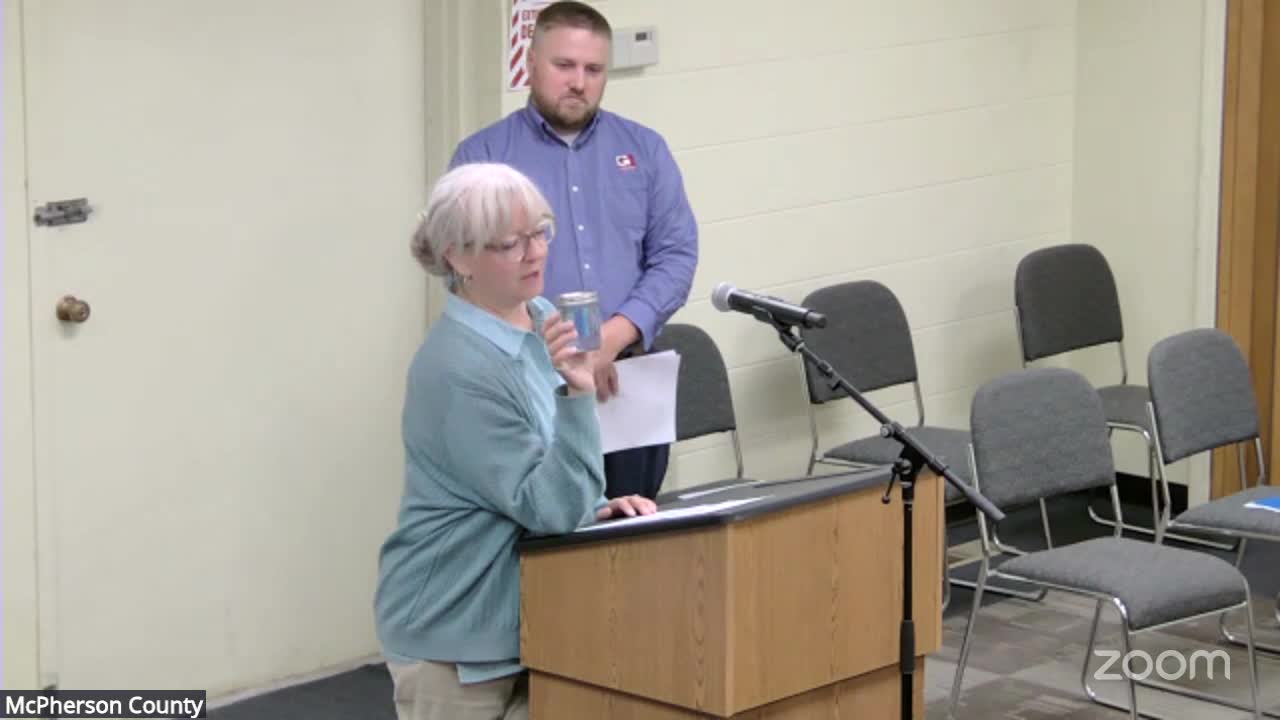
The airport presenter said filters removed from a tank showed “ugly” contamination and that the last inspection found about 3 inches of dirty water in the bottom of one tank. The airport is requesting a 10% increase to its budget as part of longer-term plans to replace fuel infrastructure.
Airport staff outlined a funding strategy that combines federal Airport Improvement Program (AIP) grants, KDOT (Kansas Department of Transportation) aviation funds and Build Kansas apportionments to reduce the local share. Staff estimated a total project cost of about $1 million to remove existing underground tanks and install new above-ground tanks for Avgas, Jet A and mogas. They told the board the local airport match could be less than $50,000 if the three funding streams are combined.
Staff explained the operational problems with the current underground tanks: water intrusion, extensive filter changes, nonfunctional credit-card readers that limit after-hours fuel sales and decades-old tank infrastructure (one tank described as nearly 70 years old). Above-ground double-walled tanks on concrete pads would be easier to inspect and maintain, staff said, and could be installed with a design phase this fall, bidding in spring and construction next summer.
Board members asked about tank capacity and revenue implications; airport staff said they would likely downsize capacity relative to the historical levels in order to keep fuel fresher while still buying economically sized deliveries. Officials also confirmed runway and lighting maintenance projects are planned through FAA funding and that some hangar improvements were funded in part with ARPA dollars.
Airport staff urged commissioners to consider the timing advantage: for the upcoming funding cycle FAA local match requirements drop to 5% (from a typical 10%), additional Build Kansas funds could cover part of that local match, and KDOT aviation funds could be layered to allow a single-phase project instead of phasing over multiple years. Staff cited a recently bid project in Eureka at about $700,000 as a comparable.