Get Full Government Meeting Transcripts, Videos, & Alerts Forever!
Get email alerts on the Housing Zoning Affordability topic
No spam. Unsubscribe anytime.
Public commenters press council to expand housing capacity, bonuses and remove parking mandates
Summary
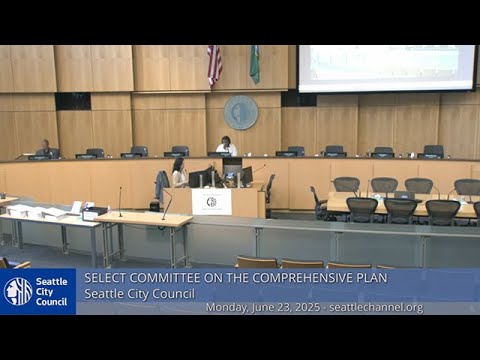
At a June 23 Seattle select-committee public hearing, dozens of residents, housing advocates and business representatives urged the council to expand zoning capacity citywide, expand affordable-housing bonuses (including for stacked flats), and reduce or remove parking mandates to increase housing supply and affordability.
A broad coalition of residents, housing advocates and business groups urged the Seattle City Council's select committee on the comprehensive plan on June 23 to substantially increase the city’s zoning capacity, expand affordable-housing bonuses and eliminate parking requirements to address the region’s housing shortage.
Tiffany McCoy, co-executive director of the nonprofit House Our Neighbors, told the committee that the mayor’s proposal should be changed so that “affordable and social housing can be sited in every neighborhood in Seattle” and that the city should make an affordable- and social-housing bonus available citywide, remove parking mandates for affordable and social housing and increase the bonus level to “maximize the impact of affordable and social housing.”
Why it matters: Commenters said current limits on where denser housing can be built lock in scarcity and contribute to rising rents and homelessness. Several speakers argued that expanding capacity and bonuses would create more options for families, young renters and workers and reduce displacement pressures.
Support for bigger zoning and bonuses came from stakeholders across sectors. Sarah Clark, who testified for the Seattle Metropolitan Chamber of Commerce, called the proposed plan “a big step forward” but urged council members to “strengthen the plan, not water it down” by expanding the affordable-housing density bonus citywide and increasing stacked-flat bonuses. Nathan Winch, speaking for AI Seattle (architects, planners and advocates), urged the council to eliminate unnecessary lot-size minimums and lower or remove parking requirements to make projects feasible on typical Seattle lots.
Individual residents described how lack of housing affected their families and careers. A 25-year-old renter identified as Nick said, “Every extra setback or floor area ratio or lot coverage requirement is another unit that we don't build and a family that's forced to either leave the city.” Connor Stein, a renter in Fremont, and multiple other callers asked the council to allow stacked flats on all lots and to expand neighborhood centers so more people can live near transit, schools and jobs.
Several speakers tied housing expansion to climate and equity goals. Mark Holz, a Roosevelt homeowner, said denser neighborhoods reduce commute miles and carbon emissions, while a registered nurse at Harborview, Ryan Talen, urged the city to provide housing that can serve people seeking refuge from hostile policies elsewhere.
Not all callers asked for uniform changes; some recommended specific drafting adjustments (for example, increasing FAR or revising where bonuses apply), and several urged retention of exemptions such as Mandatory Housing Affordability (MHA) and design-review waivers for certain small-scale affordable projects.
What the hearing did not decide: This was a public comment session; no committee votes or amendments were recorded during the June 23 morning session. The council continued to collect written comments and said additional public testimony would be accepted in subsequent meetings.
Ending note: Speakers repeatedly asked the committee to pair density increases with policy changes that preserve affordability, such as expanding the affordable-housing density bonus, allowing stacked flats citywide and eliminating parking mandates in many zones. The committee recessed the morning session until the 3 p.m. in-person session to hear remaining commenters.