Get Full Government Meeting Transcripts, Videos, & Alerts Forever!
Get email alerts on the Climate Element topic
No spam. Unsubscribe anytime.
Sedro‑Woolley planners review climate‑element revisions, flag implementation and evacuation language
Summary
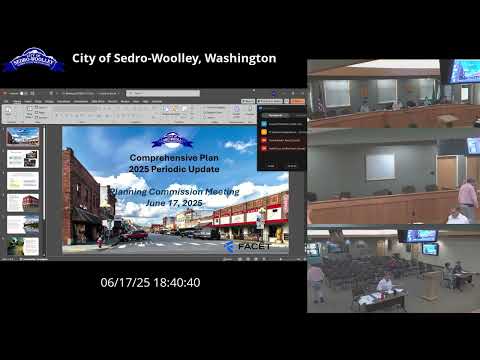
The Sedro‑Woolley Planning Commission on June 17 reviewed revisions to the draft climate element, including new greenhouse‑gas policies and an implementation plan and requested clearer evacuation language tied to the city’s comprehensive emergency management plan.
The Sedro‑Woolley Planning Commission on June 17 reviewed revisions to the draft climate element of the comprehensive plan, including newly proposed greenhouse‑gas (GHG) policies, an implementation plan and specific language on fire prevention, recycling and food security. Commission staff and consultants said the document is intended to align with Department of Commerce guidance and the city’s existing emergency management plan.
Commissioners and consultants said the changes add policies promoting electric‑vehicle infrastructure, prioritizing permitting for transit‑oriented development, boosting recycling and composting education, and preserving urban tree canopy to maintain carbon sequestration. Donna Keeler, the consultant presenting the draft changes, said the team had also added a policy “to highlight and promote the efforts of helping enhance food bank to enhance local food security through its community pantry.”
The draft implementation plan was presented as a separate product intended to guide staff on carrying out goals and policies. Heidi Roos, a consultant, told the commission that Commerce guidance stresses that “meeting your obligation to reduce GHG emissions will require implementation of tangible actions. A set of policies limited to study or consideration will not reduce GHG emissions.” She also said Commerce recommends updating the local emissions inventory about every five years to track progress against targets identified in the plan.
Commission discussion focused on three recurring concerns: (1) specificity for emergency evacuation and higher‑ground staging in response to river and flood risk, (2) clarification of several wording and numbering errors in the draft, and (3) practical implementation steps and measurable community outreach. One commissioner pressed for language linking the land‑use plan to the city’s comprehensive emergency management plan for evacuation routes and staging areas uphill from flood plains; staff responded that the emergency plan contains the operational details and the comprehensive plan should state that land‑use planning will align with that emergency plan.
On technical points, commissioners and consultants corrected a numerical formatting error in the annual vehicle‑miles traveled (VMT) figure (presented as 115,359,970 annual miles, and the per‑capita VMT calculated at 9,251 miles with a population cited as roughly 12,470). They also proposed edits to clarify a policy described as “avoid conversion of carbon rich ecosystems,” recommending phrasing that focuses on avoiding loss of carbon‑rich ecosystems and increasing sequestration through urban canopy preservation.
Commission members asked staff to clarify language in several policies (for example, whether “energy performance” should read “energy efficiency,” and whether a draft policy that urges coordination with DNR and other resource agencies explained who would provide outreach to private landowners). Staff and consultants agreed to clarify wording, correct numbering and link the policy language to existing operational documents where appropriate.
The commission did not take formal action on the climate element at the June 17 meeting; consultants said further revisions and coordination with the city council and Department of Commerce would follow. Staff indicated the implementation plan and revised goals/policies would be circulated again, and that outstanding wording and citation issues would be corrected before the next review.
Ending: Staff and consultants asked commissioners to submit any additional text edits and promised to return with corrected language. The climate‑element review concluded when the meeting moved to the transportation element.