Get Full Government Meeting Transcripts, Videos, & Alerts Forever!
Get email alerts on the Water Infrastructure topic
No spam. Unsubscribe anytime.
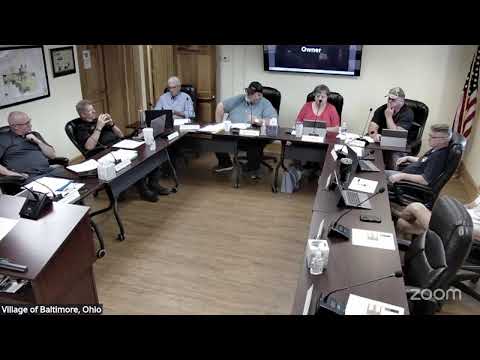
Baltimore Village Council discusses water fund shortfalls, moves to create well-replacement fund
Summary
Councilors held a lengthy discussion about water-fund cash flows, a pending OWDA loan and a canceled OPWC grant; they advanced first readings to create a well-replacement fund and to authorize a short-term advance to pay engineering bills while loan proceeds are pending.
Baltimore Village councilors spent the largest portion of their July meeting discussing the village water system’s finances, a consultant study of distribution vulnerabilities and a loan to pay for well rehabilitation and water-main replacement.
The council heard staff describe tight cash balances in the water fund and steps to apply for a loan to replace aging mains and bring a new well online. Councilors introduced two measures on first reading to reflect that work in the village budget: an ordinance to create a dedicated OWDA well-replacement fund and an accompanying resolution to authorize an advance from the water debt-service fund so engineers’ invoices can be paid while OWDA reimbursement is pending. Both measures were introduced as first readings and will return for later council action.
Why it matters: Village staff said the water fund’s current cash position limits immediate capital work and that the village previously removed a budgeted local match after notification that an OPWC grant would not be awarded. Council and staff framed the OWDA loan — and the near-term decision to advance engineering costs — as a way to move projects forward while preserving compliance with fund-accounting rules.
Most important facts - Staff reported the village did not receive an expected OPWC grant and removed the project match from the budget. Council members said the village had previously budgeted approximately $250,000 as its share for a roughly $1 million project (a roughly 25–26% match) and that money was eliminated when the grant was not awarded. - Engineers and staff described a water-modeling and vulnerability study being completed by consultant V3 within a month to two months; that study will be used to prioritize distribution-line replacements before bringing a new well online. - Village staff said they will apply for an OWDA (Ohio Water Development Authority) loan; meeting remarks referenced an OWDA approval amount in staff materials and described typical loan terms discussed with staff: roughly 30-year term and first payment due one year after project completion. The council introduced an ordinance (25-21) to create a well-replacement fund to account for OWDA activity and a resolution (25-22) to permit an advance from the debt-service fund so the consultant (V3) can be paid before OWDA pays construction invoices. - Staff reported the water operating fund’s immediate cash balance was low (a figure of about $15,000 in the water operating fund was stated during discussion), while the overall municipal bank balance includes many restricted or earmarked sums. One invoice for a water-tower payment of $26,900 was discussed as a recent outlay that affected short-term cash. - Council and staff discussed staffing and operations: the water/wastewater group has added a second operator and councilmembers asked that staff fully account for operator time and productivity given the increased workload. - Council discussed meter replacement work and said a contractor quote to install meters was under $85,000; councilors asked staff to continue evaluation of whether in-house crews could perform installation.
Discussion, directions and next steps - Discussion: Councilors and staff debated which streets to prioritize (Main/Market vs. Elmwood/Jefferson loop) and noted the risk of tearing up a street that would not be repaved for years. They also reviewed how prior budget anticipations changed when a grant was not awarded and how restricted funds limit transfers between water, streets and other accounts. - Direction to staff: Council agreed to proceed with the OWDA loan application process, to continue the V3 water-distribution vulnerability study and to bring back necessary ordinance/resolution language for subsequent readings. Staff also said they will seek quotes and report back on meter-installation options. - Formal action at the meeting: both the ordinance to create the OWDA well-replacement fund (Ordinance 25-21) and the resolution to authorize an advance from the water debt-service fund (Resolution 25-22) were introduced on first reading. No final adoption occurred; both items will return for subsequent readings and votes.
Context and background The council’s discussion tied together several threads: (1) a modeling study intended to target line replacements before a new well is put online; (2) cleanup of prior budget anticipations after an OPWC grant did not materialize; and (3) an OWDA loan application and the short-term need to advance engineering invoices until OWDA pays construction contractors directly. Staff emphasized that OWDA and similar programs reimburse engineering and construction through formal claims and that local accounting must reflect that activity in a dedicated fund.
What remains unresolved Councilors and staff flagged several follow-ups: precise loan terms from OWDA when formalized; the V3 vulnerability study’s final recommendations (expected in roughly 1–2 months); the final decision on whether meter installation will be completed by village crews or a contractor; and the village’s longer-term plan for funding and sequencing line replacements once modeling prioritizes segments.
Taper/Next report Councilors instructed staff to return the OWDA fund ordinance and the advance-resolution for second reading and to bring pricing and timeline details for meter replacement and the prioritized distribution-line list after the V3 report is complete.