Get Full Government Meeting Transcripts, Videos, & Alerts Forever!
Get email alerts on the Rezoning topic
No spam. Unsubscribe anytime.
Dickson County commission sends Tennessee Steel Buildings rezoning to July after contested public hearing
Summary
After a lengthy public hearing with residents raising safety, runoff and land‑use concerns, the Dickson County Commission voted to send a request to rezone land used by Tennessee Steel Buildings from A‑1 agricultural to C‑1 rural center to the July meeting for final consideration.
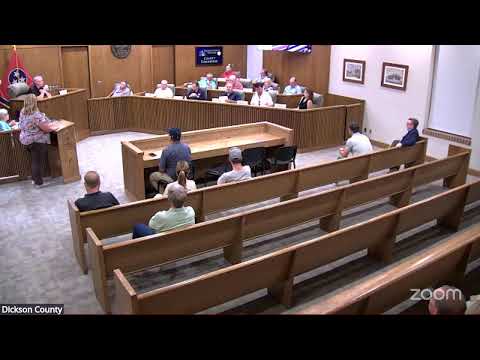
The Dickson County Commission voted June 23 to send a rezoning request for Tennessee Steel Buildings to the commission’s July meeting for a final, binding vote after a lengthy public hearing that drew nearly two dozen speakers.
The request would rezone roughly 0.3 acres (tax map references provided in the application) at 2271 Nubbin Ridge Road from A‑1 agricultural to C‑1 Rural Center District to accommodate the existing metal fabrication operation. "This is step 1 in their corrective action plan," said Brian Mills, attorney for the county planning and zoning office, describing the rezoning as the first remedy after a county notice of violation last November.
The public hearing drew a split crowd. Supporters said the business provides local jobs and has been part of the area for years. "They've been paying commercial taxes as a business. They've been helpful in our community," said Scott Beller, who identified his residence and said he has done significant business with the firm. Opponents—including nearby residents and an attorney representing neighboring landowners—raised safety and land‑use concerns, including heavy truck traffic at a nearby curved intersection, nighttime lighting, runoff and the precedent a commercial rezoning would set in a largely agricultural area.
Attorney Jody O'Brien, speaking on behalf of a nearby property owner, told commissioners that spot zoning and contract zoning are illegal in Tennessee and urged denial. "Spot zoning is illegal in Tennessee," O'Brien said, and she argued the county should consider planned development tools instead. Several residents described trucks that sometimes back up at the bridge and said the guardrail there has been struck repeatedly; Gary Baker, who said his property borders the site, said the guardrail makes it hard to see incoming traffic.
Planning staff told the commission the property was first cited in November and that the applicant reduced the rezoning area and offered "self‑imposed conditions" limiting some C‑1 permitted uses after an initial planning commission hearing. The planning commission later issued an unfavorable recommendation after earlier procedures missed notice to some adjoining owners; staff then said the applicant complied with the notice requirement and the matter was returned to the commission for the public hearing.
Commission discussion emphasized the choice before the county as a legislative act. Mills noted that C‑1 was selected as "the least intensive" zoning that would accommodate the current activities and that additional steps—platting, site plans, building permits and a traffic impact study—would be required if the rezoning is ultimately approved. "There are a number of steps that would happen after this," Mills said.
Commissioner John Petty moved to approve sending the rezoning request to the July meeting for a final vote; Commissioner Dawson seconded. The chair read a statement clarifying that the June vote would not be binding and that any commissioner could change their vote at the July meeting. The clerk called the roll; the motion passed and the item was scheduled for the July 21 regular session.
The public record of the hearing includes dozens of residents on both sides of the issue. Several speakers urged alternatives such as planned developments or improvements to infrastructure instead of a spot rezoning; supporters emphasized the business’s employees and local economic ties. The county’s corrective action plan, staff guidance and the planning commission’s prior unfavorable recommendation were central elements of the discussion.
The matter will return to the commission on July 21 for a final, binding rezoning vote; if approved then, the property would still need a site plan, permits and any required road improvements identified by a future traffic impact study.