Get Full Government Meeting Transcripts, Videos, & Alerts Forever!
Get email alerts on the Opioid Settlement topic
No spam. Unsubscribe anytime.
Las Cruces officials outline goals, priority populations for opioid-settlement spending
Summary
City staff and the opioid settlement advisory council recommended four core strategies, eight goals and priority settings to guide nearly $10 million in settlement funds; council asked staff to return with funding details and RFP timeline in August.
City of Las Cruces staff and members of the city'county opioid settlement advisory council on June 23 laid out a framework of strategies, goals, settings and target populations intended to guide spending of opioid settlement funds the city expects through 2038.
The advisory council recommended focusing initial funding on four core strategies selected at a March joint city'county session: medication-assisted treatment (MOUD); warm handoffs and recovery services; prevention programs; and data collection and reporting. Barbara Bancomo, the city's opioid settlement project lead, told the council the city is expected to receive nearly $10 million through 2038 and has received about $3.6 million so far.
Why it matters: Council members said they want the first round of spending to concentrate where it can save lives and avoid duplicating statewide efforts. The advisory council'backed goals include expanding access to MOUD, improving naloxone availability, universal screening in clinical settings and stronger transitions of care for people leaving hospitals or the criminal justice system.
At the June work session, Bancomo described the process used to reach recommendations: a needs assessment by NMSU Crimson Research, stakeholder workshops, advisory-council expertise and allowable uses in the settlement agreement'referred to as Exhibit E. Based on that work, the council narrowed allowable settings (from 10 in the settlement) to five to prioritize for initial funding: emergency departments, residential treatment and inpatient programs, first-responder/community response, primary care and obstetrics/pediatrics, and child-welfare settings. The advisory council also noted school-based prevention as a setting to consider, at the chiefs' recommendation.
Councilors and advisory members repeatedly emphasized two themes: (1) match programs to local needs identified in the NMSU assessment and (2) coordinate with state and regional efforts to avoid duplication. Bancomo said the state has allocated settlement funds to a range of items (including treatment, facility capacity and prevention) and is establishing a trust that will spend via legislative appropriation; she said the state is expected to receive roughly $391 million from settlements overall and is setting aside much of it for future use.
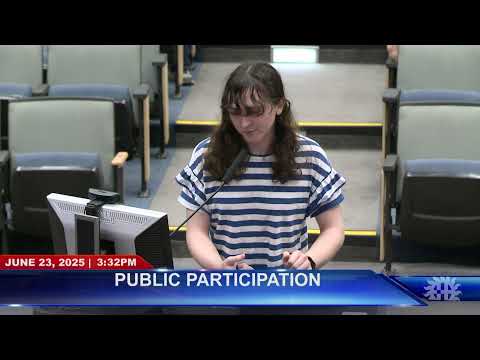
Public-health and treatment providers who sat on the advisory council and spoke during public comment urged a balanced approach. Chief Story of the Las Cruces Police Department said the department wants to return to evidence-backed school prevention programs and supported piloting newer DARE models and Operation Prevention from the DEA. Tanika Sosa Gonzalez, a psychiatric mental health nurse and advisory-council alternate, urged attention to workforce shortages and to follow-up services after overdose reversals, citing a Tucson program that provides two-hour post-naloxone follow-up visits.
County Health and Human Services representative Sherra Thorpe said her agency already provides evidence-based programming in Las Cruces Public Schools and that omission of schools from initial recommendations did not signal a permanent exclusion.
Public commenters, including healthcare worker Trent Scribner, urged universal screening coupled with reliable counseling and referral capacity. "If you want them to stop doing drugs, you gotta feed them first," Scribner said, urging coordinated social services with treatment access.
Next steps and staff direction: Bancomo said staff will return with recommended activities, logic models, scopes of work and an evaluation framework. The city plans a roughly two-year initial funding cycle, will use a mix of direct allocations (for example, Narcan to public safety) and RFPs for community providers, and hopes to return in August with details in time for a fall RFP. Bancomo also asked for better lines of communication with the state'she said the city currently lacks a clear state point person for settlement coordination.
Bancomo noted recent news on a separate, national Purdue Pharma bankruptcy settlement that could add a larger revenue stream; opting into that settlement will require coordination with the state attorneys general and decisions this fall.
No formal council vote occurred on June 23. Councilors asked staff for more detail on how Narcan acquisition would be budgeted, how the city and county would coordinate RFPs and selection processes, and how the advisory council will be used for monitoring versus procurement to avoid conflicts of interest.
The council also asked staff to track state allocations and Albuquerque/Bernalillo County approaches (which allocated large shares to treatment and to a school prevention program called Crossroads) and to return with more concrete guidance on evaluation and distribution processes in August.