Get Full Government Meeting Transcripts, Videos, & Alerts Forever!
Get email alerts on the Outdoor Lighting topic
No spam. Unsubscribe anytime.
Board adopts updated outdoor-lighting standards aimed at protecting dark skies; vote 4-1
Summary
After extensive public comment, the Board of Supervisors approved an updated outdoor-lighting ordinance that tightens lumen and shielding standards, adds a definition for 'eve' and formally replaces the county's light-pollution control code; the measure passed 4-1.
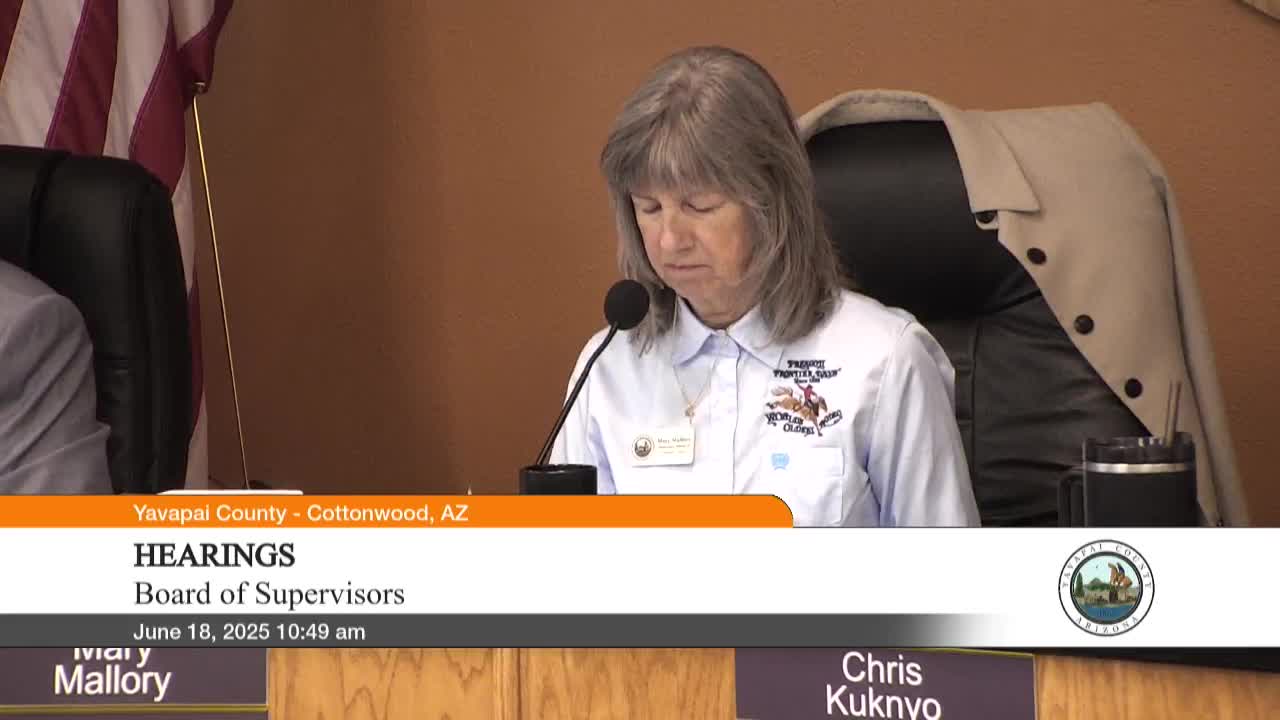
The Yavapai County Board of Supervisors voted 4-1 on Wednesday to adopt a revised outdoor-lighting ordinance designed to reduce light pollution and protect dark skies across the county.
Development Services planner Susan Hebert said the rewrite replaces Section 603 of the planning and zoning ordinance with new outdoor-lighting standards and adds a definition for "eve." The update reduces allowable lumen counts for many uses, requires fully shielded, downward-directed fixtures and creates clearer requirements for businesses and new development. The draft drew heavy participation from astronomy groups, dark-sky advocates and residents.
Hebert told the board the draft sets a correlated color temperature limit aimed at limiting blue-rich LED lighting that increases sky glow; staff used 2,700 kelvins in the recommended draft but discussed alternatives. The Planning and Zoning Commission recommended approval by an 8-1 vote after debating string lighting and color-temperature thresholds.
Public commenters included representatives of the Prescott Astronomy Club and the Astronomers of the Verde Valley, who urged stricter limits and recommended an education and outreach program to bring businesses and property owners into compliance. Speakers highlighted effects on nocturnal wildlife, human sleep cycles and the regional recreation economy tied to dark-sky tourism.
Board members raised enforcement questions and nonconforming-use issues. Development Services and County legal staff explained that typical land-use law does not permit retroactive removal of previously installed fixtures; new rules generally apply prospectively and existing nonconforming lighting would be handled through standard code-enforcement steps. Staff said the county will pursue education and voluntary compliance while enforcing the code on a complaint basis.
Vice Chair Compton voted against the measure, citing concerns about enforcement practicality and the lack of a retroactive compliance date. Other supervisors said the ordinance is a necessary first step and can be refined as part of the broader zoning-code update.
Ending: The board approved the new outdoor-lighting standards as presented, instructing staff to proceed with outreach and to incorporate further changes as needed during the county's ongoing zoning-code modernization effort.