Get Full Government Meeting Transcripts, Videos, & Alerts Forever!
Council staff briefed on stock assessment basics, uncertainty, and how outputs feed catch limits
Summary
At a Pacific Fishery Management Council briefing, staff outlined how stock assessment models use data and assumptions to estimate fish population health, described key parameters such as steepness, and explained how control rules and the p* (p‑star) approach are used to set catch limits amid uncertainty.
A staff member for the Pacific Fishery Management Council explained how stock assessment models combine data and assumptions to estimate fish population health and inform catch limits.
The presentation matters because stock assessments are the scientific foundation for management decisions such as Acceptable Biological Catch (ABC) and annual catch limits; the presenter emphasized how data quality, model parameters and quantified uncertainty change assessment outputs and therefore affect management recommendations.
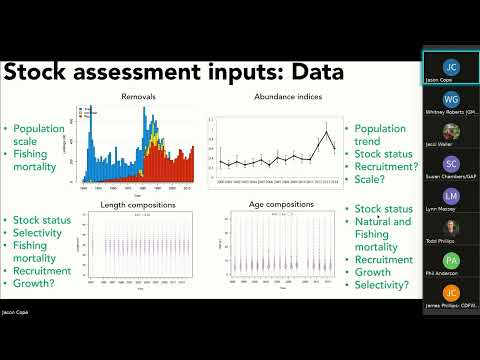
The presenter said, “Stock assessments are a tool using evidence data, insight to help us understand the health of the fish population.” He described the main data inputs — removals (landings and discards), indices of abundance, length compositions and age compositions — and explained what each type contributes to a model’s ability to estimate scale (how many fish exist), status (stock size…
Already have an account? Log in
Subscribe to keep reading
Unlock the rest of this article — and every article on Citizen Portal.
- Unlimited articles
- AI-powered breakdowns of topics, speakers, decisions, and budgets
- Instant alerts when your location has a new meeting
- Follow topics and more locations
- 1,000 AI Insights / month, plus AI Chat