Get Full Government Meeting Transcripts, Videos, & Alerts Forever!
Get email alerts on the State Legislature 2025 topic
No spam. Unsubscribe anytime.
Renton staff outline gains and losses from 2025 Washington legislative session
Summary
Eric Perry, government affairs manager for the City of Renton, and David Foster, the city’s contract lobbyist in Olympia, briefed the Renton City Council on the outcomes of the 2025 Washington state legislative session and what those results mean for city projects and budgets.
Eric Perry, government affairs manager for the City of Renton, and David Foster, the city’s contract lobbyist in Olympia, briefed the Renton City Council on the outcomes of the 2025 Washington state legislative session and what those results mean for city projects and budgets.
"We are here to present a post session update on the 2025 state legislative session," Perry said, opening the presentation. The update summarized changes to legislative membership, the three state budgets, and legislation Renton staff tracked or supported.
The nut graf: The session produced a mix of targeted capital funding that protects existing projects and broader policy changes that will affect local planning. For Renton, officials highlighted capital allocations that preserve construction timelines, new local options for public safety funding, and statewide policy changes on housing, parking and transportation that reduce some local control.
Most immediately tangible for the city were capital wins and losses. Renton received the full $1.5 million requested for Legacy Square from legislators in the 11th District. City presenters also said state funding continues for ongoing construction on the I‑405 widening work near Renton and for State Route 167 corridor improvements; Perry described those as roughly "90 some million dollars" and "94,000,000 and some change," respectively, for current work. At the same time, city staff said the legislature removed $2 million that Renton had sought for a Practical Solutions study tied to the North Eighth Street direct access ramp — funding for preliminary cost‑saving design work rather than the main construction pot.
Public safety and local option funding: House Bill 2015
Perry and Foster flagged House Bill 2015 as a major policy development. HB 2015 authorizes a council‑level local sales tax option — a one‑tenth of one percent councilmanic sales tax — that jurisdictions could use for officer recruitment and retention, public defenders, domestic violence programs, behavioral health, alternative response and associated programs. The bill also creates a statewide grant program administered by the Criminal Justice Training Commission (referred to in the presentation as the Criminal Justice Training Center/Commission) with about $100 million available to cities and counties.
Perry noted details of the grant program cited in the bill: the state grant can fund up to 75% of a sworn officer salary for up to three years with a $125,000 cap per position. Perry said the commission will publish guidance and eligibility details, and Foster added that the guidance will "take a little bit of time to come out" and that staff expect to return to council with recommendations once state rules are released.
Transportation, connectivity and other budget items
To help close a multi‑year shortfall in the transportation budget, the legislature approved a 6‑cent per gallon gas tax increase; Foster said cities should see increased revenue share from that change. The operating and capital budgets remain sensitive: Renton staff said the state entered the session facing a multiyear operating shortfall that reached roughly $16 billion on a four‑year outlook and an approximately $8 billion shortfall in the transportation six‑year outlook, driving a mix of new taxes and cuts in the final package.
Behavioral health and human services
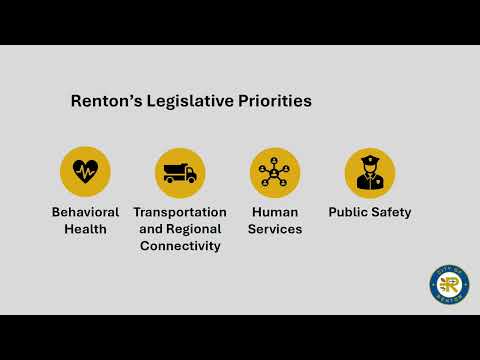
Perry grouped HB 2015 within behavioral health and human services because its allowable uses include co‑responder teams and behavioral health personnel. Renton also won a portion of Office of Refugee and Immigrant Assistance (ORIA) funding — $25 million statewide for one year — short of the $60 million the city and other jurisdictions had requested but identified by staff as important near‑term support.
Housing, planning and local control
Session legislation will change local planning and code in several ways Renton staff flagged. House Bill 1491 includes provisions on transit‑oriented development (TOD) density that cities must plan for. Senate Bill 5184 limits local parking requirements for many housing projects to roughly one half‑space per unit (or one space per two units) with complete exemptions for affordable housing, which staff described as a significant reduction in previous local discretion on parking. Foster summarized the trend as the legislature taking a more proactive role on zoning to increase housing supply and reduce development costs.
Other notable laws and policy changes
Renton staff also noted passage of the RAP Act extension of producer responsibility (a step staff said could enable broader recycling programs), changes to the Clean Buildings performance pathways and an extension of paid family and medical leave. The legislature approved limited allowances for "libation zones" (outdoor areas where patrons can carry drinks) tied in part to planning for the 2026 FIFA World Cup; attendees asked staff about sunset dates, and presenters said the outdoor authorizations run through Dec. 31, 2026, while certain civic campus permissions run through Dec. 31, 2027. Foster and Perry emphasized that staff will return with implementation options and that many of the new authorities and grants will require further guidance from state agencies.
What happens next
Perry reminded the council that the enacted two‑year budgets take effect July 1, 2025, and that statutory effective dates for many bills are typically about three months after the session ends. Foster said several items — especially HB 2015 guidance, grant rules and details on implementation — will arrive later and that city departments are already reviewing which programs and projects could use the new authorities or grants. He added, "a lot of education that had to take place," on the session itself as many legislators were newly assigned to committees and leadership roles.
Council members asked for follow‑up details on how Renton could use HB 2015 revenue, how safe‑routes and shared‑street grants would be distributed, and whether Renton Airport would be exempt from certain parking statutes; presenters said staff would follow up with specific briefings and legal review. Foster and Perry also reminded the council that unresolved items — notably a proposed property tax cap — did not pass and could return in future sessions.
Why it matters locally: Renton faces a mix of preserved construction funding, narrower local policy control on housing and parking, new local revenue tools for public safety, and grant opportunities that may offset some state fiscal pressures. City staff framed the session as a difficult one for legislators and local governments — heavy on transition, shortfalls and consequential policy choices — and said more implementation details are coming back to the council for policy decisions.
Ending: Staff committed to bringing recommendations to council on both how to pursue the new grant and sales tax options under HB 2015 and on projects that may apply for safe‑routes and transportation grants. Foster said staff will track special elections and initiative activity that could change the landscape further in 2026.