Get Full Government Meeting Transcripts, Videos, & Alerts Forever!
Get email alerts on the Housing Policy topic
No spam. Unsubscribe anytime.
Researcher to Flagstaff: housing supply is central to affordability and to climate goals
Summary
UCLA researcher and author Shane Phillips told Flagstaff attendees that increasing housing supply—coupled with location and building type choices—reduces upward pressure on prices, improves mobility and can yield climate benefits if it supports denser, infill development.
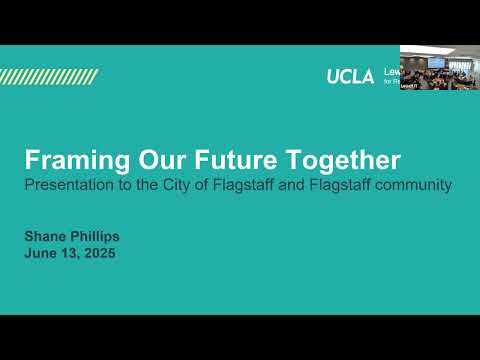
Shane Phillips, a researcher who manages the Randall Lewis Housing Initiative at UCLA and author of The Affordable City, delivered the workshop keynote and argued that supply is the most powerful local lever for affordability and has strong ties to climate outcomes when paired with infill and smaller housing types.
Phillips summarized national research showing that in regions with more permissive land‑use policy, housing supply responds to rising demand and moderates price growth; in restrictive markets, demand instead pushes up prices, displacing lower‑income households. He described “moving‑chain” research that tracks how new market‑rate units can create vacancies in older, lower‑cost units, and cited empirical results that a 100‑unit project can lead to tens of vacated lower‑cost units through chain effects.
On climate, Phillips said denser infill reduces vehicle miles traveled and lowers per‑household emissions, and that smaller housing types have lower energy needs for heating and cooling. He emphasized that local debate should focus on how to accommodate demand to protect access to economic opportunity and reduce environmental impacts rather than trying to prevent change entirely.
Audience members asked about second homes and short‑term rentals and water capacity. Phillips said second homes and STRs are real issues in resort towns like Flagstaff and that some states limit local controls; he recommended early protections (regulatory or policy) to avoid large investor conversions of housing stock, and said multifamily housing typically uses less water than an equivalent number of single‑family homes because of smaller private landscaping areas.
Why it matters: Phillips’ presentation framed the policy conversation: whether by making more housing available—especially near transit and in varied formats—Flagstaff can tackle affordability while meeting its climate goals. The workshop used that framing to test specific zoning and street design proposals.
Ending: Phillips urged attendees to act sooner rather than later, saying “change is inevitable,” and to avoid treating neighborhood character as static if it comes at the cost of access to housing and opportunity.