Get Full Government Meeting Transcripts, Videos, & Alerts Forever!
Get email alerts on the Safety Net Programs topic
No spam. Unsubscribe anytime.
Department of Family Services briefs committee on TANF, SNAP, energy assistance and child support; SNAP-waiver questions surface
Summary
Department of Family Services officials briefed the interim committee on TANF cash assistance, SNAP food benefits, energy assistance, food-bank programs and child support, and responded to committee interest in a potential SNAP waiver to restrict purchases of sugary beverages and candy.
The Wyoming Department of Family Services told the Joint Labor, Health & Social Services Committee about its economic-security programs — cash assistance, food benefits, utility help, homelessness prevention and child support — and responded to several committee questions about program reach and potential policy changes.
Why it matters: These programs provide basic supports to low-income families, affect county-level providers and food banks, and interact with workforce and child-welfare policy. Committee members asked for data on program penetration, annual unduplicated counts and the mechanics of SNAP waivers that limit purchases of sugary or low-nutrition items.
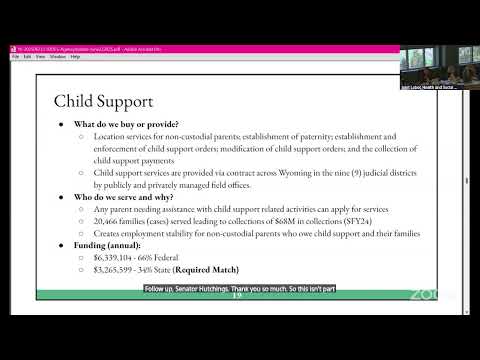
Key details - TANF/POWER: The state’s cash-assistance program (POWER) averaged 479 households per month (about 1,000 individuals), including some 800 children. TANF-related federal funding referenced was about $18 million annually with a state maintenance-of-effort (MOE) of roughly $9 million required to draw that federal grant. - SNAP (food assistance): SNAP serves around 14,000 households monthly (about 16,000 adults and 13,000 children). The average SNAP household benefit cited was $383 per month. The federal government pays the benefit amounts directly; state and federal funds split SNAP administrative costs (about 50/50). - SNAP education and employment & training: SNAP-Ed (Sensible Nutrition through University of Wyoming Extension) and SNAP E&T contractors reported modest participation; SNAP-Ed served 887 adults and 2,012 youth and SNAP E&T reported serving 226 individuals in the last year. - Local food programs: The state administers CSFP (commodity supp. food program) for seniors (223 participants — program-limited) and TFAP/TFAP channels that reach approximately 9,000 households through local food banks. - LIEAP and weatherization: Low Income Energy Assistance Program (LIEAP) funds primary-heating assistance and weatherization funds improve household energy efficiency; LIEAP and weatherization totals were described in testimony. - Child support: The state child-support program is largely performance-driven; staff said Wyoming collects about 76% of current support on average and collected about $68 million in state fiscal year 2024. The child-support program serves more than 20,000 families and is financed approximately 66% federal and 34% state.
SNAP-waiver discussion Committee members raised the prospect of submitting a federal SNAP-waiver to limit purchases of sugary drinks, candy and other foods commonly described as “junk food.” Staff said six states had obtained such waivers and the department and vendors are watching the implementation logistics, including how grocery-store point-of-sale systems would block disallowed items. The department said it would support a waiver if the Legislature directed or requested it, and recommended monitoring early adopters for lessons learned.
Quotes - "If it has a food label, it is defined as food," said a department official explaining current SNAP rules and why states seek waivers to limit purchase categories.
Follow-up and data requests Committee members asked for unduplicated annual caseload counts, county-by-county participation rates, and vendor-level data that could show the share of SNAP purchases spent on sugary drinks or candy. The department said it could pull national or vendor data where available and is ready to work with lawmakers on waiver logistics or legislation.
Ending Committee members encouraged follow-up on program penetration rates and more granular, county-level data on SNAP, TFAP and TANF recipients so lawmakers can evaluate policy options.