Get Full Government Meeting Transcripts, Videos, & Alerts Forever!
Get email alerts on the Wildfire Funding topic
No spam. Unsubscribe anytime.
Lawmakers review $176.9 million in recent wildfire appropriations and limits of emergency fire suppression account
Summary
Legislative staff and the Wyoming State Forestry Division told the Joint Appropriations Committee that the 2024 fire season drove large, ad‑hoc appropriations and exposed limits in the Emergency Fire Suppression Account (EFSA), borrowing authority and contingency funds used to pay suppression costs.
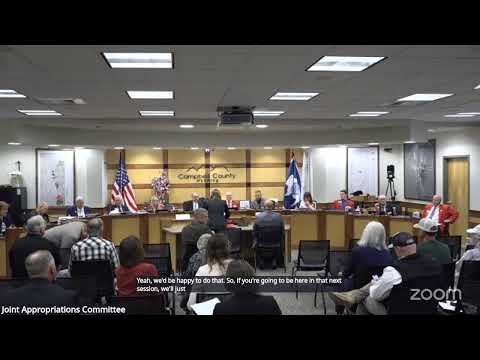
Legislators on the Joint Appropriations Committee were briefed on state wildfire spending and the Emergency Fire Suppression Account on June 12, 2025, in Gillette, where analysts and agency leaders described a patchwork of accounts, recent supplemental appropriations and limits to rapid funding for large seasons.
The discussion matters because large, multi‑jurisdiction wildfires can exhaust the dedicated accounts the state relies on — forcing delayed reimbursements and use of borrowing authority. Elizabeth Martineau, senior fiscal analyst with the Legislative Service Office, told the committee the legislature authorized about $176,900,000 for wildfire suppression, mitigation and recovery for the 2025–26 biennium and that those totals include a mix of direct appropriations, contingency funding, grants and borrowing authority.
Martineau outlined how the state uses multiple mechanisms: two dedicated state accounts (including the Emergency Fire Suppression Account, or EFSA), direct appropriations, borrowing authority, governor transfer authority (the “B‑11” process), and contingency funds in the governor’s office and the Office of Homeland Security. She said the 2024 session and subsequent actions added targeted sums: recovery grants, $20 million to repay prior borrowing, $20 million to replenish the emergency fire suppression account, and $30 million in new borrowing authority tied to Senate File 152.
“Wildfires in Wyoming is largely a decentralized operation,” Martineau said, adding that local governments retain operational independence for suppression, billing and incident response and that the Office of State Lands and Investments and the State Forestry Division provide support, aviation and financial assistance within statutory authority.
Martineau told the committee that the EFSA has several revenue sources — county assessments, legislative appropriations, investment earnings and reversions — and noted that as of April 30, 2025 she was reporting a cash balance for that account of $5,052,500,000; she cautioned that because of multi‑jurisdictional incidents and reimbursement timing the reported balance may not reflect incoming reimbursements or outstanding obligations. She also told members that 23 counties currently participate in the EFSA annual assessment.
Committee members and agency witnesses discussed how some EFSA rules can delay reimbursements when funds appear insufficient. Kelly Norris, Wyoming state forester, and county fire wardens said that operational leaders must fight fires first and resolve the reimbursement and cost‑allocation questions afterward — a model that preserves life and property but raises questions about short‑term liquidity and the need for pre‑positioned resources in high‑risk weather.
The committee asked for follow‑up detail: a five‑year average EFSA ending balance, a list of counties that have not historically drawn on EFSA despite paying assessments, and a breakdown of non‑wildfire uses for contingency funds. Martineau agreed to provide the requested tables and historic balances.
The briefing also noted related statutory and budget actions: Senate File 152 (2025) increased gubernatorial borrowing authority for suppression and removed a prior sequencing requirement for accessing that borrowing; House Bill 150 (2021) established an automatic $10 million annual appropriation for emergency response drawn from the Legislative Stabilization Reserve Account (LSRA). Martineau and witnesses said those authorities provide stopgap capacity but do not remove the need for clearer rules about prepositioning and timely reimbursements.
Committee staff and agency witnesses said the next steps are: (1) provide the historic EFSA balances and a five‑year average; (2) supply county‑level EFSA use data; and (3) present proposed EFSA rule changes and, if needed, emergency rules to allow limited prepositioning during high‑risk periods. Those rule changes were described as intended to “modernize the rules to reflect current wildfire suppression management standards,” including prepositioning and clarified reimbursement standards.
The committee scheduled additional briefings and requested an update on how funds allocated to the Wyoming Wildlife and Natural Resource Trust are being spent on invasive‑grass mitigation and post‑fire recovery.