Get Full Government Meeting Transcripts, Videos, & Alerts Forever!
Get email alerts on the Maternal Health topic
No spam. Unsubscribe anytime.
Health officials warn of 'maternal deserts'; Blue Cross to roll out maternity program with prenatal vitamins and remote monitoring
Summary
State health staff told lawmakers some Wyoming counties lack local labor‑and‑delivery services; Blue Cross Blue Shield of Wyoming described a new "Special Delivery" maternity program offering enhanced first‑trimester payments for providers, prescription prenatal vitamins delivery, remote monitoring and 24/7 lactation support.
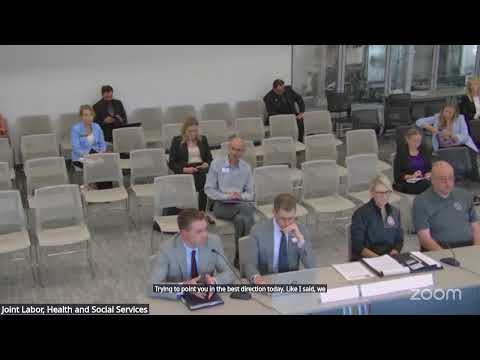
State health officials told the joint committee that several Wyoming county subdivisions no longer host labor‑and‑delivery services and that closures have left new maternal health “deserts” in parts of the state. Deputy director Franz Fuchs said the department used the March of Dimes definition and its own mapping to mark communities that never had services, places that recently lost services and counties that show warning signs of service loss.
The issue matters because many rural communities have no nearby labor‑and‑delivery capacity and because Medicaid covers a significant share of births. Fuchs noted that hospital viability — staffing, low delivery volumes and tighter nursing labor markets — is the primary driver of closures. "Labor and delivery closures are really a symptom … of a broader financial stress on the hospitals," he said. He also told the committee Wyoming lacks a level‑3 neonatal intensive‑care unit; Casper and Cheyenne operate level‑2 NICUs and families sometimes travel out of state for higher‑acuity care.
Private insurer Blue Cross Blue Shield of Wyoming described a new package of services intended to improve early prenatal engagement and support postpartum care. The company said it will open a "Special Delivery" program July 7 that increases reimbursement for a first‑trimester visit, ships prenatal vitamins at no cost to members, offers a vendor‑provided remote maternal monitoring system and provides 24/7 telehealth lactation support. Amy Skaswak, Blue Cross's director of population health, said the carrier will also expand postpartum screening and telehealth counseling.
Doctors and community providers who testified told the committee the state also needs to strengthen graduate medical education and family‑medicine obstetric tracks to recruit clinicians to rural Wyoming. Several speakers — including OB‑GYNs who train family practice residents — described a plan to add an OB track at the University of Wyoming family practice residency in Cheyenne. Doctor Jacques Beveridge, an OB‑GYN in Cheyenne, said the residency track should help produce clinicians willing to practice rural obstetrics.
Community providers described on‑the‑ground barriers. A Cheyenne birth‑center co‑owner said her facility struggles to obtain sustainable facility‑fee reimbursement from Medicaid and private payers; she said Wyoming's Medicaid enrollment forms did not initially include the federal taxonomy code for birth‑centers because the state had no birth‑center before. A Casper pregnancy center director and several residents urged lawmakers to preserve and expand access to comprehensive reproductive care, including telehealth and local family‑medicine capacity.
Lawmakers asked the department for county‑level maps, potential policy levers that could be taken in the coming session and cost estimates for options such as targeted Medicaid rate increases, temporary cost‑based reimbursements for critical access hospitals that maintain labor‑and‑delivery services, and graduate‑medical‑education investments. Blue Cross and the University of Wyoming representatives said they would work with the department on pilot options and on provider training.
No formal action was taken; agencies were directed to return with more detailed cost estimates and model bill text if the committee chooses to pursue legislative remedies.