Get Full Government Meeting Transcripts, Videos, & Alerts Forever!
Get email alerts on the Emergency Medical Services topic
No spam. Unsubscribe anytime.
Wyoming officials, advocates propose consolidated billing and targeted subsidies to shore up rural EMS
Summary
State health officials and local leaders described a fractured emergency-medical-services system and recommended a mix of consolidated billing, targeted public subsidies and local partnerships with hospitals and fire departments to keep ambulances ready in low‑volume areas.
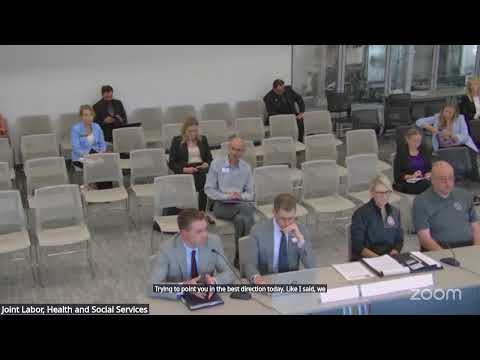
State health officials and local leaders urged the Joint Judiciary and Labor, Health & Social Services committees on Monday to pursue practical fixes — including a statewide consolidated billing contract and targeted subsidies — to address declining volunteerism and a growing gap between the fixed costs of ambulance readiness and the revenue small services can bill. "The prioritized concepts include consolidated billing," Curtis Biggs of the governor's office told the committee as the report's sponsors outlined options.
The matter matters because ambulance readiness is expensive and most calls are low‑reimbursement, local patient contacts rather than high‑profile highway rescues. Department of Health deputy director Franz Fuchs told the committee there are about 78,000 EMS calls in the state each year, of which roughly 51,000 are reimbursable and about 34 percent are not billable because they do not result in a transport. He and other witnesses said that mismatch leaves a recurring subsidy gap: the report estimates roughly $67 million in reasonable annual system costs against about $37 million of billable revenue and calculates a roughly $30 million shortfall that communities and other payers now fill in a variety of ways.
Witnesses stressed two overlapping remedies. One is to pursue a centralized, opt‑in billing contractor that would convert the data ambulance providers already submit to the state into claims, submit them to payers and return collections to providers. The department says that could reduce administrative burden for small services, improve data quality and create a more competitive contract price by aggregating volume. The second is to reframe local subsidies to be more sustainable — for example, aligning ambulance services with taxed fire districts or with hospitals that can receive cost‑based reimbursement as a critical‑access provider. Fuchs summarized the problem: "This is really the mismatch between fixed cost and variable service volume."
Local officials and associations backed the ideas but urged caution and local flexibility. Mayor Mara Juarez of Mills described a municipal fire/EMS that struggles with contractual restrictions and Medicare/insurer payments; she and other local leaders emphasized that some services require tax support while others might be folded into county fire districts or hospitals. AARP Wyoming presented statewide polling showing broad public support for treating EMS as an essential government service and a willingness by many residents to pay a small annual amount to shore up local coverage. The report and witnesses also noted that Medicare policy — which the state cannot change — drives much of the revenue problem because Medicare pays a fixed amount for many ambulance runs and does not reimburse many non‑transport calls.
Committee members asked for more detail on how a consolidated billing contract would work, whether the state should start with health‑department workloads to create volume and how to sequence incentives so that smaller communities do not lose control of local response. Fuchs said the department has issued requests for information and can run a pilot without statutory changes but that larger changes (for example, changing Medicaid reimbursement formulas or authorizing cost‑based ambulance reimbursement tied to hospitals) would require appropriation or legislative action.
The discussion concluded with a request from several lawmakers for follow‑up: provide county‑level maps of response time and a draft of options the committee could take up in the session, from promoting municipal or district levies to enabling local hospitals to operate ambulance services with enhanced Medicaid or state support. The department and local officials agreed to provide more granular cost, billing and service‑area data for the committee to review.
Because these were informational briefings, the committee did not adopt policy at the meeting; staff and agencies were directed to supply additional data and to return with more detailed bill concepts for legislative consideration.