Get Full Government Meeting Transcripts, Videos, & Alerts Forever!
Get email alerts on the Municipal Debt topic
No spam. Unsubscribe anytime.
Oak Harbor outlines municipal debt and remaining general‑obligation capacity
Summary
In a February 2025 city presentation, Oak Harbor summarized its outstanding debt, remaining legal borrowing capacity under Washington state limits, and a city policy requiring a debt-affordability analysis before new borrowing.
In a February 2025 "Let's Talk Finance" presentation, David Goldman, presenter for the City of Oak Harbor, summarized the city's municipal debt portfolio and remaining borrowing capacity under Washington state limits, saying the city had about $75.8 million of remaining capacity under the primary 2.5% assessed-value general‑obligation limit and a $50.2 million councilmanic (city-council) limit.
Goldman said the city carries three general‑obligation issues and three revenue debt issues as of February 2025 and described how state rules and local policy affect future borrowing. He told viewers that Washington state allows three separate 2.5% assessed‑value general‑obligation limits — for general governmental purposes; for lights, water and sewer; and for open space, parks and economic development — for a combined 7.5% statutory ceiling. He said up to 1.5% of the first 2.5% can be issued by a city council vote (commonly called "councilmanic" authority); other GO borrowing beyond that requires voter approval, with a 60% approval threshold and minimum turnout requirements under state law.
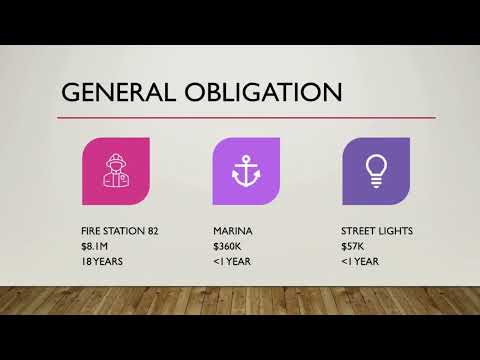
Goldman summarized the city's outstanding general‑obligation issues. He said a voter‑approved 2022 bond for construction of a second fire station has $8.1 million outstanding and about 18 years remaining; a council‑approved 2021 refinancing for marina dredging has $360,000 outstanding and is expected to be paid off within a year; and a council‑approved loan for streetlight upgrades was listed in the presentation with $57,000 outstanding and a payoff within the year. (The presentation lists the streetlight approval year as "2026," which is after February 2025 and appears to be a transcription or typographical error in the source material.)
On revenue debt, Goldman said the city uses revenue bonds and loans to finance self‑supporting utilities. He said a 2024 council action restructured earlier borrowing for the clean‑water facility, producing a 19% reduction in sewer rates; that loan was listed with $76.7 million outstanding and about 24 years left. He said a 2016 bond tied to construction of the clean‑water facility has $25.7 million outstanding and about 21 years remaining. He also said the city has three loans from the state Public Works Trust Fund issued between 2007 and 2015 with a combined $490,000 outstanding; the presentation lists the last loan's payoff date as "02/1931," which appears to be a transcription error in the presentation.
Goldman explained that revenue debt is repaid from user fees generated by the facilities they finance and is not backed by the city's full faith and credit; because of that, such debt can be seen as somewhat less secure and may carry higher interest rates. He said there is no state quantitative limit on revenue debt, but warned that markets will not buy unsupported borrowing. He noted that the city has a policy requiring a debt‑affordability analysis before issuing new debt; that analysis focuses on identifying revenues available to service the proposed annual debt. For additional guidance, Goldman pointed viewers to the Municipal Research and Services Center (MRSC) and provided the city's finance email for questions.
The presentation is informational and did not include new council actions during the recording; the historic approvals Goldman cited (voter‑approved 2022 bond, council approvals in 2021 and 2016, and the 2024 restructuring) were described as prior actions rather than current votes. Goldman also identified specific dollar amounts and payoff horizons as summarized above.