
Committee backs constitutional amendment to raise Florida’s budget-stabilization cap to 25% with $750 million annual deposits
Get AI-powered insights, summaries, and transcripts
Subscribe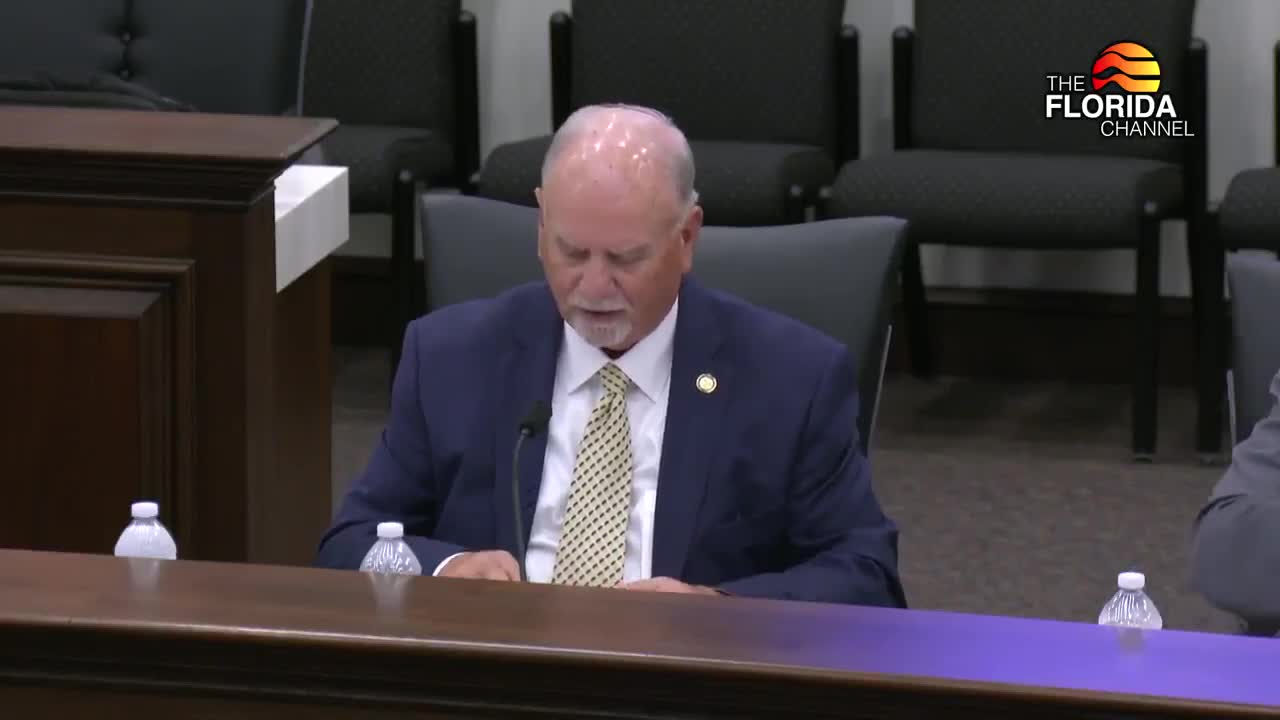
Summary
The Senate Committee on Appropriations on Oct. 11 reported favorably on SJR 1908, a proposed constitutional amendment to raise the state budget-stabilization cap from 10% to 25% and require annual deposits of $750,000,000 until the cap is reached.
The Senate Committee on Appropriations reported favorably on SJR 1908, a joint resolution that would place a constitutional amendment before voters to raise Florida’s budget-stabilization fund cap from 10% of general revenue collections to a maximum of 25% and to require annual transfers of $750,000,000 until the cap is reached.
Senator Hooper, explaining the resolution, told the committee the change would raise the cap “from the current 10% of general revenue collections to a maximum of 25% of collections. Based on current numbers, that would be about $12,200,000,000.” He said that, if approved by voters in 2026, the constitutional provision would take effect on Jan. 5, 2027, and that the proposed language would supply a withdrawal mechanism to provide nonrecurring funding for a “critical state need” when a separate two‑thirds vote of the Legislature authorized the transfer.
Members pressed the sponsor on access and definitions. Senator Guillermo Smith and Senator Polsky asked how the fund could be used to respond to federal cuts or heightened needs such as Medicaid shortfalls, school funding, or disaster recovery. Hooper said two paths exist to access the funds: suspending the annual $750,000,000 allocation during a revenue shortfall, or authorizing a withdrawal for a legislatively defined “critical state need.” He also told senators the Legislature would have to repay any withdrawal under the present repayment rules and that the language under discussion would allow up to five years for repayment when a withdrawal occurs.
Opponents during public comment urged rejection. Karen Woodall of the Florida Center for Fiscal and Economic Policy warned the committee that the state already had roughly $4.4 billion in the stabilization fund and other large trust funds and argued the proposal would remove recurring revenue from near-term use. Woodall said access would be difficult under the bill’s mechanisms and urged senators to vote no. Dr. Rich Templin, representing the Florida AFL-CIO, told the committee “budgets are a statement of our values,” and said taking $750,000,000 off the table annually could prevent funding for teacher pay, health-care access and other needs.
Committee members voiced differing views. Senator Polsky and Senator Guillermo Smith both questioned whether the state needs a larger locked fund while unmet needs remain. Leader Berman asked whether a definition of “critical state need” would be included; Senator Hooper and committee staff said the definition would be resolved in final language and that the governor and Legislature each have roles in declaring or authorizing emergency withdrawals. The sponsor also acknowledged negotiations with the House remained ongoing and that the version considered in committee was not final.
Committee members raised timing questions: Senator Guillermo Smith noted the first two $750,000,000 deposits could be set aside before voters decide the amendment, and Senator Hooper responded that in that case the money would be held in reserve until voter approval and that, if voters later rejected the amendment, the reserve could be applied to other needs.
After debate, the committee reported SJR 1908 favorably. The roll call recorded several recorded no votes in the transcript (including Senators Pizzo, Polsky and Smith). If approved by voters in 2026, the amendment would take effect Jan. 5, 2027.