
Appropriations committee advances $17.26 billion draft budget after hours of debate on Medicaid, public safety and education
Get AI-powered insights, summaries, and transcripts
Subscribe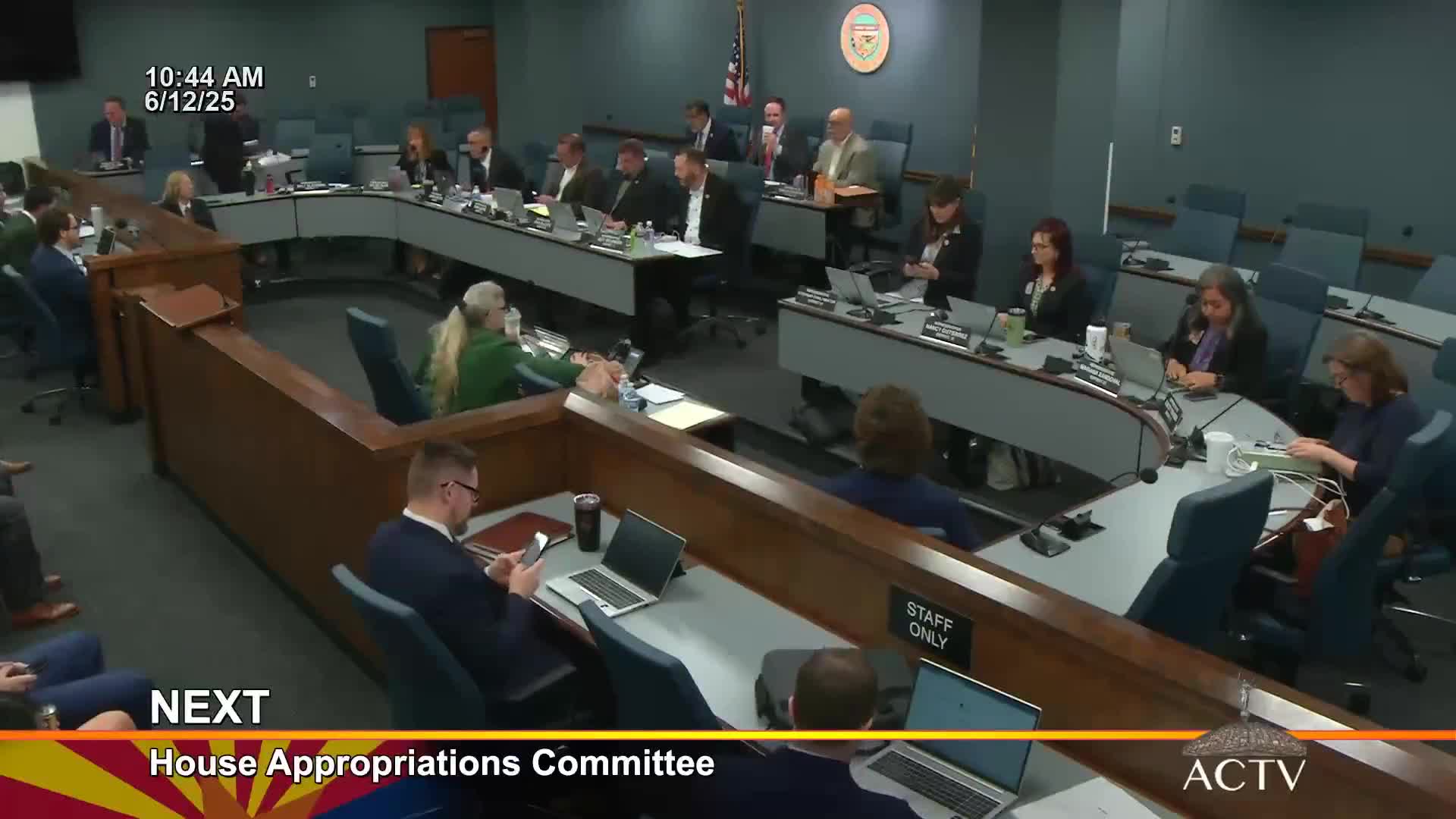
Summary
The Arizona House Appropriations Committee advanced the fiscal year 2026 General Appropriations Act on Wednesday, recommending the $17.26 billion draft budget despite sharp testimony over Medicaid increases, a proposed hospital assessment and underfunded adult-education programs.
The Arizona House Appropriations Committee moved the fiscal year 2026 General Appropriations Act (House Bill 2,947) out of committee Wednesday after an hours-long session that included staff briefings and public testimony from law enforcement, education and water-infrastructure groups.
Committee Chairman Ben Livingston opened the session with a reminder of the central focus for the majority: “Law enforcement is our number 1 priority,” and outlined the draft plan as a middle-ground proposal while acknowledging it had not yet been negotiated with the governor or the Senate. The committee voted 11–7 to recommend HB 2,947 for passage from committee.
Why it matters: The FEED bill in the draft appropriates roughly $17.26 billion for fiscal year 2026 and includes multi-year commitments that would affect Medicaid enrollment and provider payments, compensation for state safety and corrections personnel, capital renewal funding and targeted one-time grants. Committee discussion touched on funds that would be shifted from special accounts, changes to hospital assessments and how state-level revenue forecasts were applied — all items that will shape final negotiations.
Most important details first. Staff explained the largest general-fund changes in HB 2,947, including credits from an enhanced federal medical assistance percentage and transfers from special funds. Among the specific line items observers highlighted during testimony:
• Medicaid and human services: The bill includes about $600 million in ongoing spending across fiscal years 2026–2028 for Medicaid program capitation rate increases and related Department of Economic Security items. The draft also funds High Cost Developmental Disability (DD) program clients with $14.8 million ongoing for FY2026–28 and a $32.3 million one-time appropriation to backfill prior-year DD actuarial losses. Witnesses representing disability families thanked the committee for DD funding but urged coordination with the Senate and governor so appropriations can become law rather than only chamber messaging.
• Public safety and corrections: The package includes an ongoing $95.1 million to provide a 5% salary increase for state sworn officers and correctional officers and a 15% increase for state firefighters in the Department of Forestry and Fire Management. The Arizona State Troopers Association testified in support, citing hundreds of vacancies and retention challenges, and asked for continued conversation on civilian staff recruitment such as dispatchers.
• Hospitals and the hospital assessment: The bill continues a hospital assessment program and uses transfers and assessment-based mechanisms in the package; that drew sharp opposition from the Health Systems Alliance of Arizona. Tom Farley of the alliance said the proposal effectively makes a prior $100 million sweep permanent and risks losing federal matching dollars; he warned that the tax “is punitive” and could force reductions in services if sustained and paired with federal Medicaid cuts.
• Education and workforce: The FEED bill directs roughly $900 million and additional supplements for K–12 education in the draft, funding formula components and some member priorities. Community college and adult-education advocates told the committee the proposal underfunds adult education: Maricopa Community Colleges requested $6 million to maintain statewide adult education programs but said the draft provides $1 million, a gap the district and coordinating council said would suspend services for thousands of students.
• Water and long-term augmentation: Judah Waxelbaum of the Water Infrastructure Finance Authority of Arizona (WIFA) testified in respectful opposition to a $60 million sweep identified in the draft from WIFA’s Long-Term Water Augmentation Fund. He said the fund — built to support projects and solicitations to deliver new supplies — had roughly $450 million available and that taking monies now would undercut project development and partnerships the agency is pursuing.
Other testimony and committee exchanges addressed detailed line items: kinship stipends for foster families, pharmacy board FTEs, state fleet charges moved to ADOT, and a request for clarifying footnote language on livestock brand inspector positions. Committee members asked staff to prepare amendments or footnotes where program details (for example, position classifications and timing of one-time funds) needed tightening.
Votes at a glance: The committee recorded due-pass recommendations on the general appropriations bill and a package of related FY2026 budget bills. (All roll-call tallies and outcomes below are committee-level recommendations; final passage requires follow-up action by the full House, the Senate and the governor.)
• House Bill 2947 (General Appropriations Act, FY2026) — due pass recommendation; committee vote 11–7. • House Bill 2948 (department/regulatory fee change) — due pass recommendation; committee vote 11–6; 1 not voting. • House Bill 2949 (capital outlay appropriation elements) — due pass recommendation; committee vote 11–7. • House Bill 2950 (trade/commerce reporting) — due pass recommendation; committee vote 11–7. • House Bill 2951 (criminal justice budget provisions) — due pass recommendation; committee vote 11–7. • House Bill 2952 (environment/water and augmentation pilot & other items) — due pass recommendation; committee vote 11–7. • House Bill 2953 (health care budget provisions and eligibility terms) — due pass recommendation; committee vote 11–7. • House Bill 2954 (higher education provisions including tuition language) — due pass recommendation; committee vote 11–7. • House Bill 2955 (human services budget items including SNAP verification) — due pass recommendation; committee vote 11–7. • House Bill 2956 (K–12 education budget provisions) — due pass recommendation; committee vote 11–7. • House Bill 2957 (auditor authority/county treasurer reviews and county flexibility) — due pass recommendation; committee vote 11–7. • House Bill 2958 (ADOA capital outlay stabilization rental rates) — due pass recommendation; committee vote 11–7. • House Bill 2959 (IT modernization fee/caps and other limits) — due pass recommendation; committee vote 11–7. • House Bill 2960 (federal funds and rainy-day fund language) — due pass recommendation; committee vote 11–7. • House Bill 2961 (tax exemptions, property and adoption-expense changes) — due pass recommendation; committee vote 11–7.
What the committee did not decide: Multiple members and witnesses noted the draft is not final: leadership said the House plan is a framework intended for negotiation with the governor and the Senate, and multiple members urged further collaboration. Several members described the process — and the absence of a returned governor’s counterproposal — as the reason for timing and for keeping options open for amendments (colloquially “cow amendments”).
Voices from the public: Law-enforcement representatives urged passage because of staffing and facility needs; community-college groups and adult-education providers warned that lower-than-requested appropriations would force program cuts and waiting lists; WIFA cautioned against sweeping long-term water funds now; hospitals warned a permanent assessment or tax would reduce federal match and pressure hospital operations; disability advocates said DD funding in the bill is welcome but that a one‑chamber bill without interbranch agreement risks leaving families without help.
Next steps: Committee members instructed staff to draft clarifying footnotes and (where suggested) amendment language. Chair Livingston said the House leadership remains open to member requests and promised the committee would accept member-submitted amendments while the bill proceeds through the process. The draft will be negotiated with the Senate and the governor’s office before any final appropriation is enacted.
Ending note: The committee’s due-pass recommendation starts the formal path for these budget bills, but several members and witnesses emphasized that funding in the draft will not become law without further negotiation; some members signaled they plan to prioritize specific amendments or to press negotiators on key program-level details in the coming days.