
JLBC outlines House Republican FY26 budget plan; members raise concerns about Medicaid cuts, hospital assessment and employee costs
Get AI-powered insights, summaries, and transcripts
Subscribe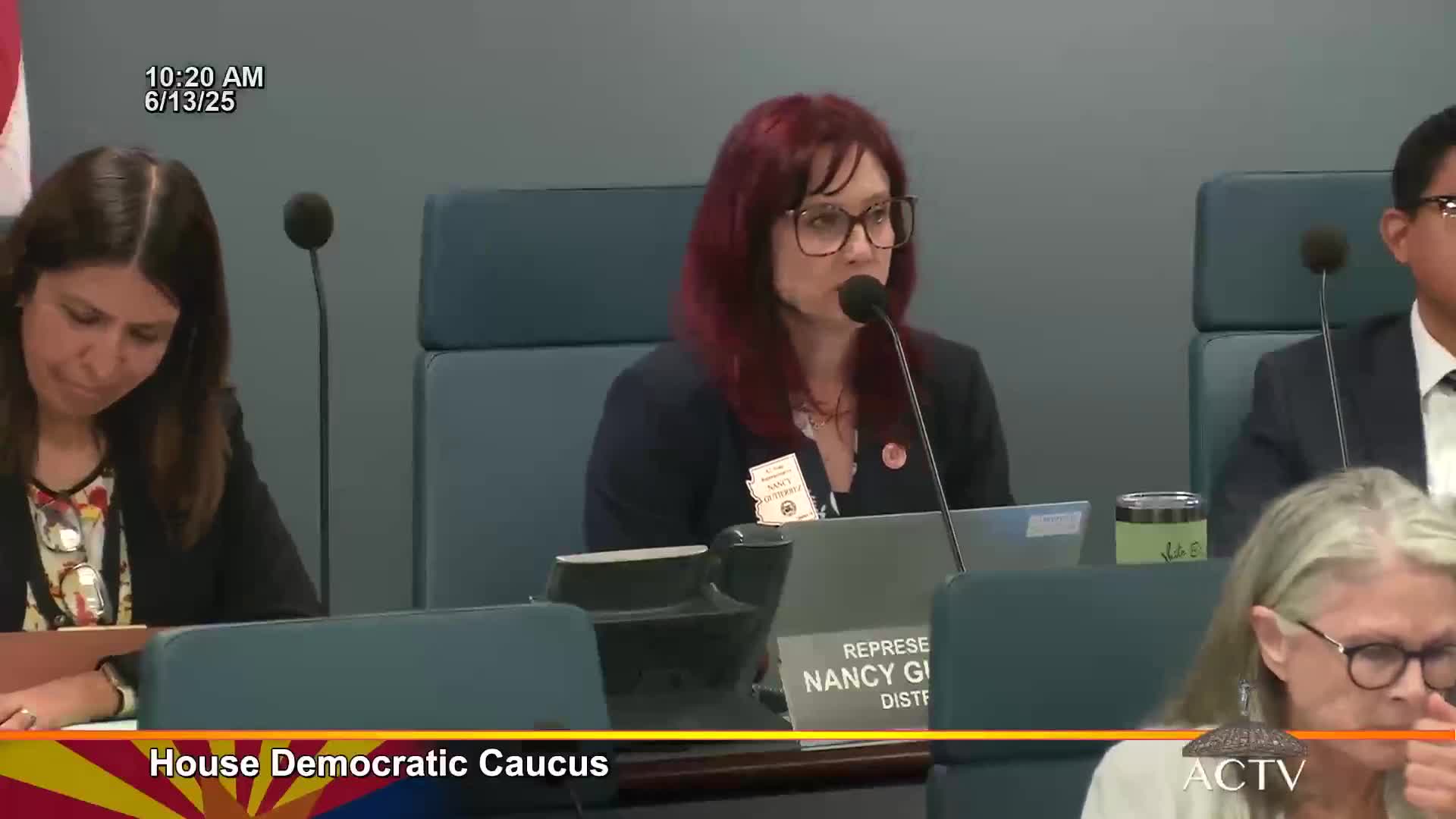
Summary
Patrick Moran of the Joint Legislative Budget Committee presented an overview of the House Republican FY26 budget plan and the committee’s packet summarizing the plan.
Patrick Moran of the Joint Legislative Budget Committee presented an overview of the House Republican FY26 budget plan and the committee’s packet summarizing the plan.
Moran said the revenue baseline matches the April 2 forecast from the Finance Advisory Committee and assumes 3.5% ongoing general fund growth in FY26, 4.1% in FY27 and 4.6% in FY28. He reviewed large components of the plan: a $325 million increase in university bonding authority staggered across three years; multiple AHCCCS (ACCESS) adjustments including mid‑year capitation increases and a prescription drug rebate fund swap; a proposal to quarter eligibility redeterminations for non‑disabled ACCESS members; making a hospital assessment ongoing that would charge hospitals about $100 million for behavioral health costs; and program and capital adjustments in DCS, DD services, ADE programs and ADOT projects.
Key figures and policy points Moran presented include:
- University speed bond authority: $325,000,000 increase; the House plan staggers authorization so Arizona State University would realize bonding authority in FY27, Northern Arizona University in FY28 and the University of Arizona in FY29. The stagger delays a roughly $16,000,000 general‑fund revenue impact until after the three‑year window.
- ACCESS (AHCCCS) caseload and capitation: The packet notes about 232,000 members have left ACCESS since June of last year. Remaining members are, according to AHCCCS actuaries, on average higher‑cost; the plan reflects a roughly $20,000,000 mid‑year capitation adjustment (a 6% adjustment retroactive to April 1 is cited in the briefing). Moran also described a policy assumption that would increase eligibility redetermination frequency; the Republican plan assumes larger enrollment declines from more frequent redeterminations (the packet references quarterly redeterminations for non‑disabled ACCESS members).
- Prescription drug rebate fund: The Republican plan takes a $125,000,000 general‑fund reduction in FY26 for ACCESS, replacing that general‑fund share with prescription‑drug‑rebate fund revenues (reduced to $100,000,000 in FY27 and FY28 in the plan).
- Hospital assessment: A policy enacted during the FY25 actions allowed the state to assess hospitals roughly $100,000,000 to cover behavioral‑health costs for the Medicaid expansion population. The House Republican plan makes that provision ongoing, producing net savings in FY27 and FY28 that were not in last year’s enacted baseline.
- Department of Child Safety (DCS): The executive requested $23,000,000 ongoing to backfill lost federal funds for congregate care. The Republican plan funds congregate care ongoing at $23,000,000 but, after netting other line changes and TANF block grant reallocations, the net ongoing increase is about $19,300,000.
- Developmental Disabilities (DD): The packet reflects a mid‑year April 12.9% capitation adjustment on top of an earlier 11% adjustment from October; Moran said the net cost annualization is roughly $160,000,000 across the relevant lines. The plan also includes $14,800,000 ongoing for “DD high cost clients” that previously received one‑time funding.
- Education and workforce items: The plan makes the one‑time school meals co‑pay elimination ongoing ($3,800,000) and funds a teacher retention study at $100,000 using certification monies. The plan also includes a tuition‑reduction requirement for universities of a 2.5% cut for in‑state undergraduate tuition, with a freeze through 2028; JLBC estimated about $9,000,000 impact per 1% reduction across the three universities.
- State employee health insurance and pay: The plan assumes $140,000,000 for state employee health insurance (the executive requested $195,000,000) and assumes additional unspecified employee cost‑sharing or premium increases that JLBC said are not specified in the budget language and would be set later by DOA/actuaries. Moran said roughly 60,000 subscribers hold state employee coverage and about 130,000–140,000 total people (including dependents) are covered.
- Capital and transportation: Local distributions of about $23,000,000 for city/county projects; roughly $40,000,000 in capital projects from the executive; and approximately $87,000,000 in ADOT projects highlighted by advancing funding for the I‑10 segment between State Route 85 and Citrus Road ($25,000,000) and the State Route 347 Riggs Road overpass ($41,000,000).
Caucus members reacted during the briefing. A member identified in the transcript as “Leader” called the process “disgusting” and said, “People could die because of this,” referencing cuts to ACCESS; the Leader summarized the ACCESS reductions in the spreadsheet as $50,000,000 in FY26, $85,000,000 in FY27 and $85,000,000 in FY28 (a total the Leader described as $220,000,000). Other members warned the ongoing hospital assessment could “cripple and even close hospitals, especially in rural Arizona, on tribal nations” and said the plan shifts costs onto hospitals and public servants. Several members pressed JLBC for clarifications about unspecified assumptions (for example, what forms of employee cost‑sharing would be used to hit the lower health‑insurance appropriation).
No formal motions or votes occurred in the caucus briefing. Moran and JLBC staff provided the packet to caucus members and answered procedural and technical questions; caucus members were advised to expect further materials and a closed caucus meeting later.