
Arizona appropriations committee reviews FY2026 budget package, hears timelines for I‑10 work and debates mental‑health consent language
Get AI-powered insights, summaries, and transcripts
Subscribe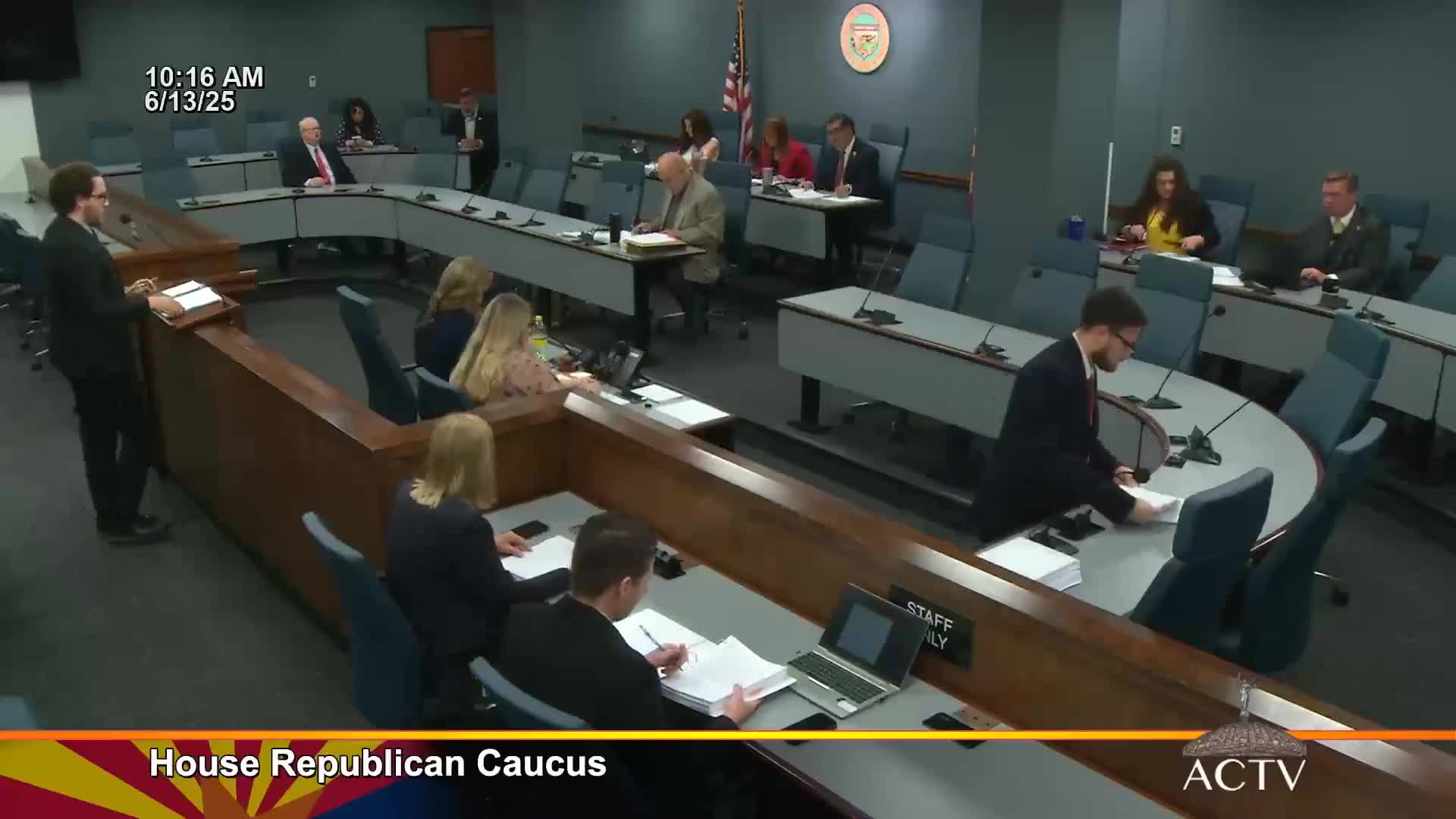
Summary
House members on the Arizona House Appropriations Committee spent a meeting reviewing the FY2026 General Appropriations (FEED) package and related implementation bills, receiving bill summaries and asking staff detailed questions about timelines, program eligibility and funding mechanics.
House members on the Arizona House Appropriations Committee spent a meeting reviewing the FY2026 General Appropriations (FEED) package and related implementation bills, receiving bill summaries and asking staff detailed questions about timelines, program eligibility and funding mechanics.
The committee heard from staff that "the overall budget package appropriates $17,260,000,000 in fiscal year 2026. Of this amount, around 732,200,000 is one time," and reviewed companion bills for capital projects, education, health and tax changes. (Staff member, Appropriations Committee.)
Why it matters: The FEED bill bundles appropriations and policy provisions that set spending and administration for the coming year. The committee’s review covered multi‑year program changes, one‑time capital spending and operational funding that affect state agencies, counties and schools across Arizona.
Summary of major items
- FEED / General Appropriations (House Bill 2947): Appropriations staff summarized the package as totaling $17.26 billion for FY2026, with roughly $732.2 million classified as one‑time money. Chairman Ben Livingston described the FEED bill as "always the biggest bill, the most difficult bill, the most complicated bill" and said leadership has worked to fold policies and other bills into the package.
- Capital outlay (House Bill 2949) and I‑10 project timing: Staff told members the capital outlay bill provides approximately $703 million in specified fiscal years, including about $458.8 million from the State Highway Fund in FY2026 for ADOT planning and construction. Representative Ben Livingston said the I‑10 project work is ready to advertise for bids and that construction would begin "in December or January," adding he expects a build‑out under 18 months and that the project adds lanes and safety features.
- Higher education (House Bill 2954): The bill includes several provisions, including a directive to reduce resident undergraduate tuition and a temporary tuition freeze. Representative Livingston summarized the intent: "what this bill does is it requires, in exchange for getting taxpayer money to continue their operations, that state universities reduce tuition by 2.5% and then freeze that tuition for 3 years to give some relief to the families of the state."
- K‑12 (House Bill 2956): The K‑12 budget bill raises base funding levels by 2% for inflation, requires automated external defibrillators at high schools that sponsor athletics, and establishes a ninth‑grade on‑track grant program that terminates Jan. 1, 2031. Staff noted the increase represents the largest baseline investment in K‑12 in state history.
- Health and criminal‑justice implementation (House Bill 2953 and related provisions): The health budget contains reforms to eligibility tracking and programs such as dementia awareness and a court‑ordered stabilization process for impaired persons. During discussion Representative Carter asked a pointed question about consent in the court‑ordered stabilization provision: "If the person is impaired, how can they consent?" Staff and members acknowledged the concern and said policy staff will follow up; members asked for further clarification and possible amendment language.
- Human services and SNAP: The human services bill makes the extended foster care model permanent and adds eligibility verification provisions for SNAP. Members warned that forthcoming federal changes could push states to share new costs and that Arizona is preparing accountability measures.
- Auditor General funding and fraud response: Members discussed funding increases for the Auditor General to review county treasurer offices. Jeremy (staff) told the committee the proposal includes $2,400,000 over the window and 15 FTEs for procedural reviews. Committee members cited past misappropriation in a southern Arizona case as a rationale for stronger auditing.
- Integrated tax system modernization and revenue practices: The Department of Revenue’s integrated tax modernization project was discussed as an ongoing multi‑year effort to replace software and hardware. Committee staff also explained a provision continuing the practice of depositing unrestricted federal funds into the state general fund and preserving the rainy‑day fund cap through FY2028.
- Tax changes (House Bill 2961): Staff described a package of relatively small technical and tax adjustments; Chairman Livingston said combined tax changes in the bill were modest, estimating the “combination tax cut is under $10,000,000.”
Discussion vs. decisions
The session was focused on staff presentations and member questions. No formal roll‑call votes or final actions on the bills were recorded in the transcript excerpt provided. Multiple members requested follow‑ups or clarifications, and staff agreed to provide additional information on specific items (for example, implementation of court‑ordered stabilization provisions, county audit details, and detailed rainy‑day fund interest/earnings figures).
Quotations (selected)
- "The Judge of Appropriation Bill is also called the FEED Bridal and this is where when we put all the policies and different things and all the other bills, we accumulate it, we wrap it all together, we put it in this bill," Chairman Ben Livingston (Committee Chair) said as he introduced the FEED bill discussion.
- "The overall budget package appropriates $17,260,000,000 in fiscal year 2026. Of this amount, around 732,200,000 is one time," a committee staff member summarized.
- "If the person is impaired, how can they consent?" Representative Carter asked about a court‑ordered stabilization provision that requires consent to be offered; staff said they would follow up with policy details.
- "We're putting a lot of new money into the Auditor General to audit counties and treasurers," Representative Livingston said, noting the appropriations include funding for additional auditors after recent fraud concerns.
Clarifying details (as stated in committee)
- FEED bill total: $17,260,000,000 (FY2026); roughly $732,200,000 one‑time. - Capital outlay total (approximate): $703,000,000 across specified fiscal years; ~ $458,800,000 from State Highway Fund in FY2026 for ADOT. - I‑10 project: staff said bids would be advertised immediately after budget passage, with construction starting in December or January and an expected build‑out under 18 months (committee comments). - Auditor General resources: $2,400,000 over the multi‑year window and 15 FTEs for procedural reviews (staff figure cited by Jeremy). - K‑12 baseline increase: a 2% adjustment for inflation; committee members described it as the largest baseline K‑12 investment in state history. - Higher education tuition change described by Representative Livingston as a 2.5% reduction in resident undergraduate tuition with a three‑year freeze tied to receipt of state funding. - Conflicting interest/earnings figures for the Budget Stabilization Fund were discussed in committee: staff initially referenced an FY2025 estimate “about a million and a half” but later corrected an interest‑earnings figure to $48,000; the committee requested staff follow up with exact figures and a full accounting.
What members asked staff to follow up on
- Detailed implementation language and consent standards for the court‑ordered stabilization provision (mental‑health related). - A one‑page primer explaining the FEED bill and how it relates to other budget bills (requested by a member to help new members and veterans). - Exact interest and balance figures for the Budget Stabilization (rainy‑day) Fund and confirmation that large balances are earning appropriate returns. - Clarification on counties eligible for certain program provisions (population thresholds were cited as rationale for directing implementation to counties with staffing capacity).
Ending
Committee members did not take final votes during the excerpted discussion. Staff and leadership pledged to provide follow up materials and numeric clarifications; members noted several items likely will be the subject of amendments later in the process when the bills reach floor or conference stages.