Get AI Briefings, Transcripts & Alerts on Local & National Government Meetings — Forever.
Appropriations committee advances competing measures to lock Prop 123 distribution and direct funds to teacher pay; educators warn of exclusions
Loading...
Summary
Chairman Livingston’s strike‑everything amendments to HCR 2031 and HCR 2058 would lock the Permanent State School Fund distribution rate at 6.9% through FY2036 and require increased expendable earnings be directed to teacher compensation; the committee advanced both measures amid objections from school leaders, teachers and parents who said many educators and support staff were excluded.
The Arizona House Appropriations Committee on June 17 advanced two related strike‑everything amendments that would preserve a higher Permanent State School Fund distribution rate and channel increased expendable earnings to teacher compensation.
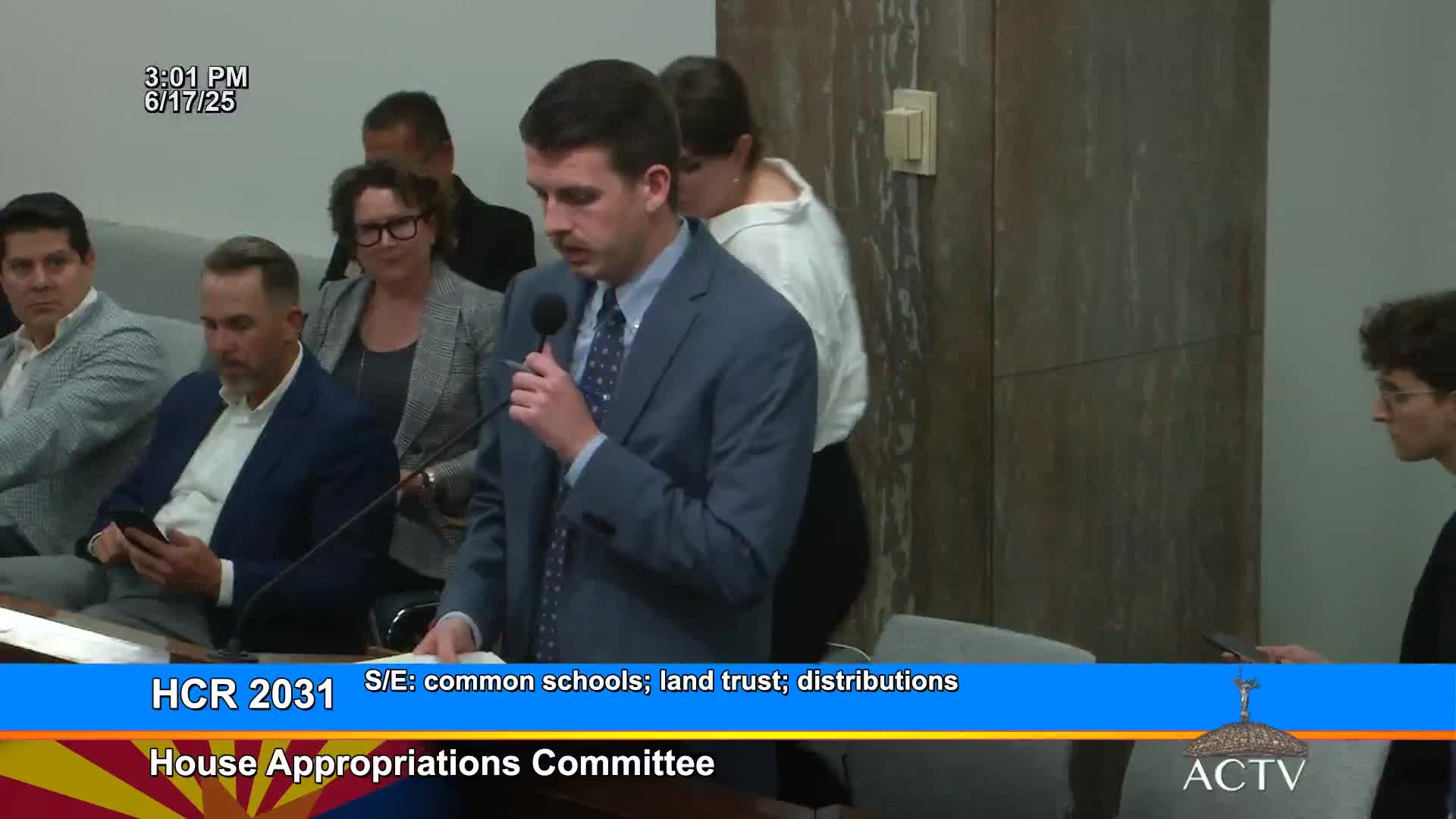
Chairman Livingston’s amendment to HCR 2031 would prohibit the state or any state officer from reducing the annual distribution rate from the Permanent State School Fund below 6.9% on the effective date through fiscal year 2036, with mechanisms to reduce the rate only under existing constitutional language or a three‑fourths legislative vote. The amendment instructs that, until fiscal year 2037, any increased expendable earnings above a 2.5% distribution be appropriated for a statewide teacher compensation program to increase base salaries for eligible teachers.
A companion Livingston amendment to HCR 2058 would, if voters approve the change, require districts and charters to revise salary schedules to raise base salaries, create a teacher pay fund administered by the Arizona Department of Education (ADE), set per‑teacher amounts, and require reporting and compliance reviews by ADE and the Auditor General.
Why supporters said yes: Chairman Livingston and backers said locking a higher distribution rate and directing funds to teacher pay will increase classroom teacher salaries and help recruit and retain educators. "Teacher pay. I'm for it. I think we need to do whatever we can to work on paying teachers more," Livingston told the committee.
Concerns raised by educators and districts: witnesses representing the Arizona School Superintendents Association, the Arizona Education Association, the Vail School District and classroom teachers warned the amendments as drafted exclude many staff and could limit local flexibility. Rebecca Beebe of the Arizona School Superintendents Association said the group was "signed in opposed to this bill because of the underlying strike everything amendment." Marisol Garcia, an eighth‑grade teacher and president of the Arizona Education Association, said the draft's approach — which relies on evaluation‑linked bonuses rather than built‑in salary increases — "will not necessarily move the needle as needed than if it went directly to salaries."
Parents and special‑education advocates also testified that the proposals would de‑prioritize paraprofessionals, counselors, nurses and other education support personnel (ESPs) who provide essential services to students with disabilities. Parent and paraprofessional Amanda Lugo told the committee that prioritizing general‑education teacher pay "is going to ignore the needs of special education staff and support personal[sic]" and could reduce school choice for disabled students.
Formal action: both Livingston strike‑everything amendments were adopted in committee and each resolution was returned with a due‑pass recommendation. The committee recorded HCR 2031 as returned with a due‑pass recommendation (tally reported in committee: 10 yeses, 7 noes, 1 not voting). The companion HCR 2058 also passed the committee (tally reported in committee: 10 yeses, 7 noes, 1 not voting), and both measures direct the secretary of state to place the proposed constitutional change before voters.
Next steps and open issues: lawmakers asked for further stakeholder work, including clarifying who qualifies as an eligible "teacher," how raises would interact with local salary schedules, and how evaluation systems would determine eligibility. Several legislators said they support higher teacher pay but want amendments to address exclusions of ESPs, special‑education staffing pressures, wage‑compression and local flexibility before final passage.
Ending note: the committee advanced the measures to the next stage but testimony shows significant technical concerns remain; sponsors and opponents said they will pursue edits before floor action or the voter referral.