
Panel advances bill banning 'foreign adversaries' from owning land near Arizona military sites, mandates reports to federal agencies
Get AI-powered insights, summaries, and transcripts
Subscribe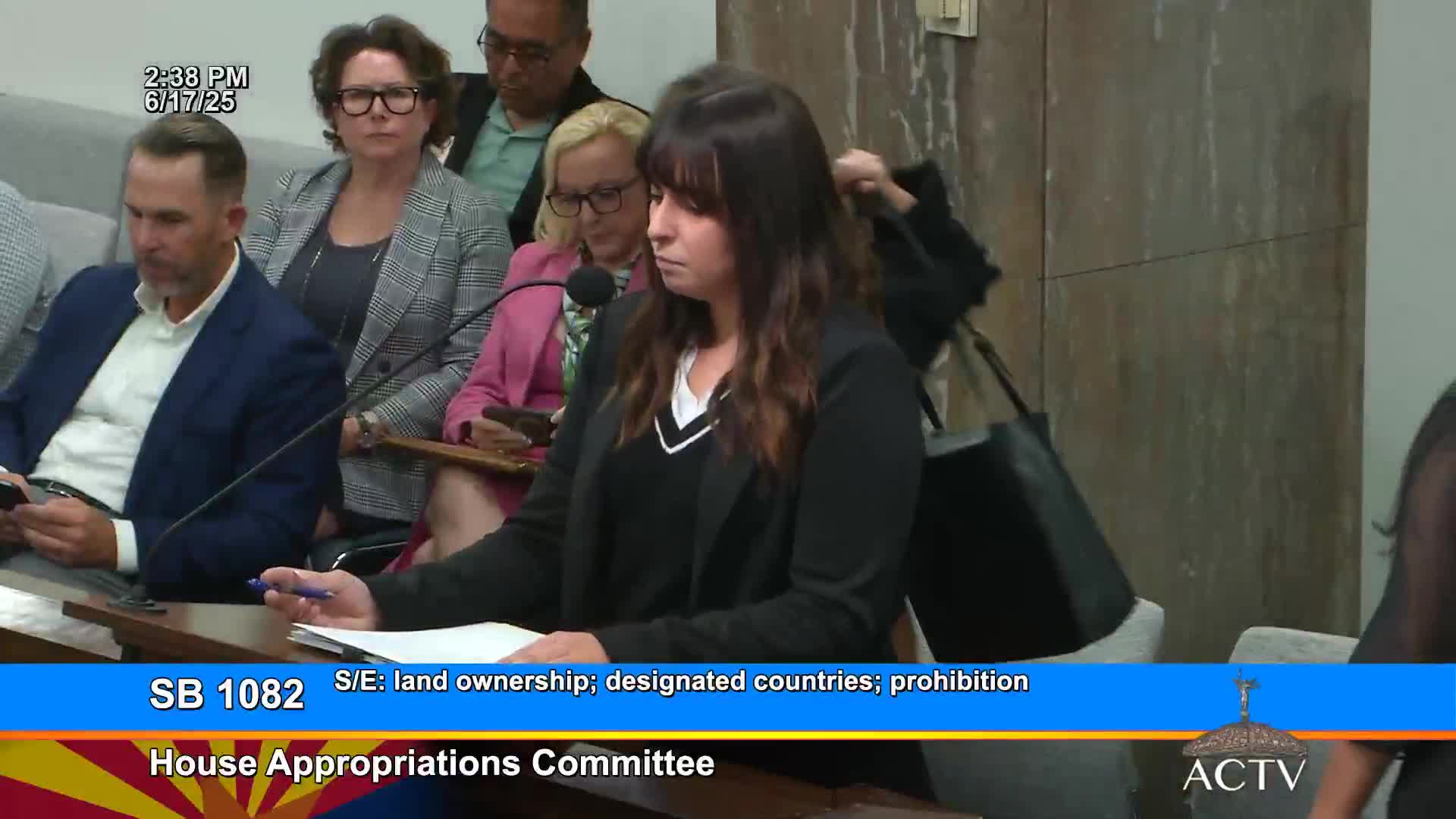
Summary
Senate Bill 10‑82, as amended, would bar persons tied to nations designated as foreign adversaries from purchasing or holding real property in Arizona near military installations or critical infrastructure, require attorney general enforcement and reporting, and allow limited divestment windows; committee returned the bill with a due‑pass rec.
The House Committee on Appropriations on June 17 adopted a strike‑everything amendment to Senate Bill 10‑82 that would prohibit certain foreign adversaries from purchasing or owning real property in Arizona and require state enforcement and reporting when violations are discovered.
Sponsor Sen. Jenae Shamp told the committee the bill targets nations and entities identified by the Director of National Intelligence and aims to reduce the state’s "surface area of risk" around military installations and critical infrastructure. Shamp said she will provide data to federal law enforcement on entities she and staff identified during a records review.
Luke Air Force Base and homeland‑defense officials urged strengthening the bill’s reporting requirements and closing voluntary reporting gaps. James Mitchell, formerly director of Luke’s community initiatives team, recommended making submission to the federal Committee on Foreign Investment in the United States (CFIUS) mandatory in certain divestiture cases: "That loophole needs to be closed," he told the committee.
Gabe Levine, director of the state Division of Emergency Management, said the bill’s broad applicability across Arizona military and sensitive sites is a strength but suggested tightening the divestment window: "A year of foreign adversaries owning property adjacent to sensitive sites and military installations is a year of intelligence collection," Levine said, arguing the time allowed for divestiture creates risk.
What the amendment does: committee staff said the amendment prohibits foreign principals from countries designated by the Director of National Intelligence from buying, owning or acquiring real property; requires the attorney general to bring enforcement actions in superior court and report suspected espionage activities to federal law enforcement; allows limited exemptions and sets conditions on parcel size, location and proximity to military installations; and gives a one‑year divestment window for transfers after acquisition.
Formal action: committee members adopted the strike‑everything amendment and returned SB 10‑82 as amended with a due‑pass recommendation. The committee recorded the bill as returned with a due‑pass recommendation (tally reported in committee: 11 yeses, 5 noes, 1 voting present, 1 not voting).
Next steps and open issues: witnesses and several legislators asked for edits — including shortening the divestment period, clarifying definitions of "foreign adversary" to cover agents acting on behalf of adversary governments, and requiring mandatory CFIUS filings — and the sponsor said she is open to revisions and to working with the governor’s office.
Ending note: supporters framed the measure as a statewide safeguard for military installations and infrastructure; critics and some members asked for technical changes to avoid unintended impacts on individuals and private property rights.