Get AI Briefings, Transcripts & Alerts on Local & National Government Meetings — Forever.
Senate approves some "foreign adversary" restrictions but rejects one after constitutional debate
Loading...
Summary
The Arizona Senate advanced several bills restricting transactions with entities from designated foreign adversaries on June 2025; lawmakers raised constitutional and economic concerns and one measure failed on final passage.
PHOENIX — The Arizona Senate on June 2025 approved multiple House bills that include provisions restricting commerce and ownership tied to countries listed as "foreign adversaries," but it rejected one related measure after several senators raised constitutional and economic concerns.
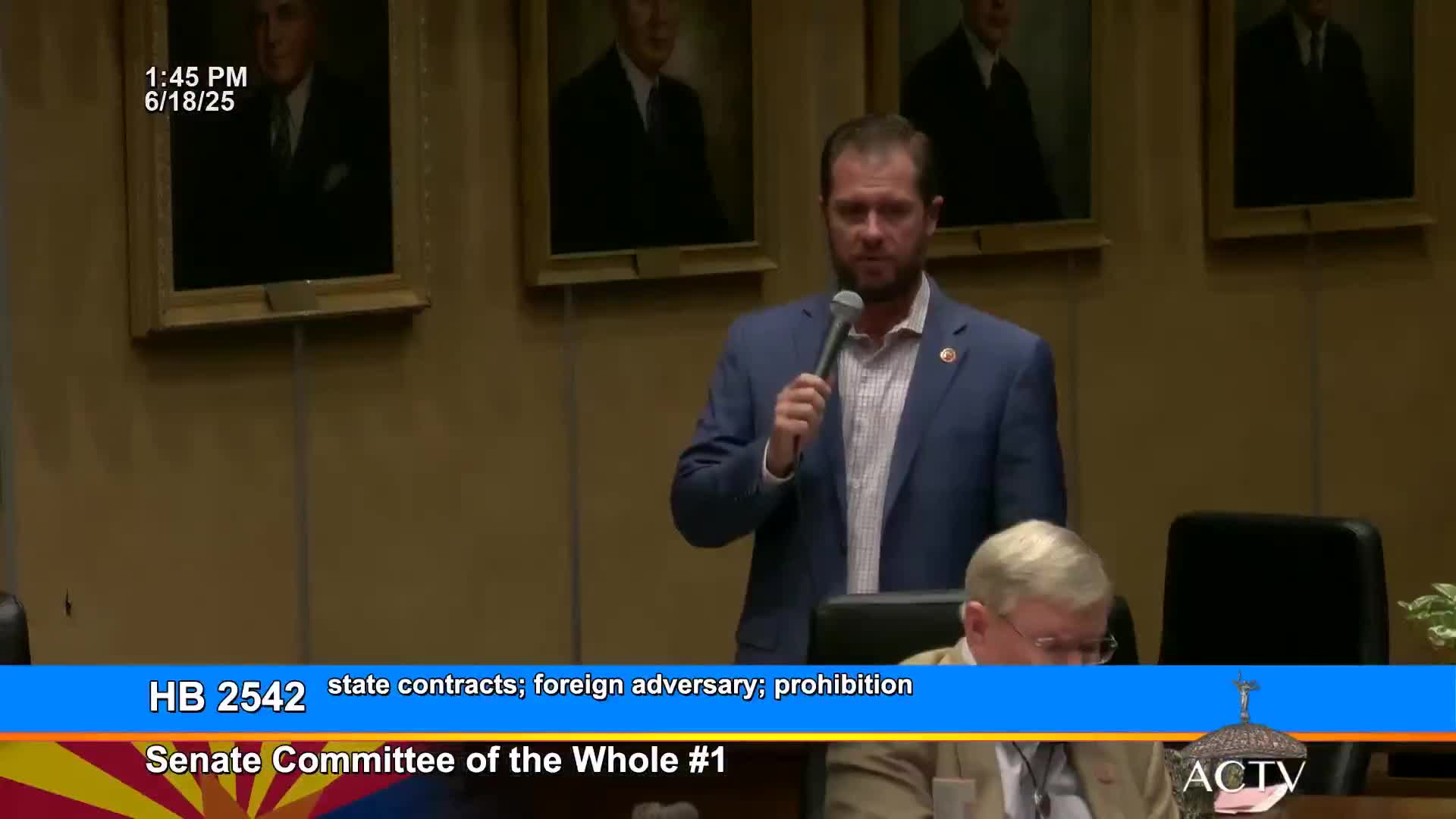
Senators voted to advance and pass House Bill 23‑74 and House Bill 23‑86, while House Bill 25‑42 failed on third reading. HB 25‑42 had been amended on the floor to exempt the Arizona Department of Public Safety (DPS) from the prohibition; that amendment was offered by Senator John Kavanaugh and adopted in committee. On final passage, the Senate recorded 14 ayes, 13 nays and 3 not voting on HB 25‑42, and the bill failed.
Supporters said the bills are intended to protect state interests from actors tied to hostile foreign governments. Senator Frank Carroll, who spoke in favor, argued the bills rely on an existing federal designation: "There's a key phrase in here — 'foreign adversary.' It's clearly defined in the law, and that alone speaks to why we need this kind of bill," he said.
Opponents urged caution and warned of legal exposure. Senator Raquel Ortiz said the bills "present profound constitutional issues, risk significant economic and social harm, and undermine Arizona's foundational principles of equity and fairness." Ortiz cited equal protection concerns and federal preemption, saying state-level restrictions could conflict with the U.S. Constitution and federal foreign‑relations authority: "There is a conflict that is presented with federal authority on foreign relations ... these bills potentially encroach upon this authority by creating a state specific restriction on foreign property ownership based on the grantee's nationality."
Senator Q.B. (recorded as "Senator QB" in the transcript) urged a no vote as well, describing the measures as overly broad and vulnerable to unintended consequences: "These foreign adversary bills ... rely on vague definitions that could sweep up individuals or businesses, small businesses too, with tenuous connections to targeted countries, undermining due process and stoking xenophobia."
At the committee stage the Senate adopted a floor amendment authored by Senator David Gowen to HB 23‑86 to prevent certain funds from lapsing; that bill later passed on third reading by 22 ayes, 6 nays, 2 not voting. House Bill 21‑33, a separate measure concerning provisional nursing licenses that carried a committee amendment, passed on third reading by 26 ayes, 2 nays, 2 not voting.
Senator John Kavanaugh described his amendment to HB 25‑42 as narrowly tailored to allow DPS to continue buying equipment and replacement parts "only available through that country," saying it "exempts DPS from the prohibition because they purchased certain items and replacement parts only available through that country." The amendment was adopted in committee, but that exemption did not prevent the bill from failing on final passage.
The debate underscored differing views on state authority and the practical effects of the measures. Supporters said federal listings provide clear guidance; opponents warned of litigation risk, harm to immigrant communities and potential chilling effects on foreign investment and small businesses.
Outcome summary from the Senate session: - HB 21‑33 (nursing provisional license, as amended) — Passed (third reading: 26 ayes, 2 nays, 2 not voting). - HB 23‑74 (foreign‑adversary‑style restrictions) — Passed (third reading: 16 ayes, 12 nays, 2 not voting). - HB 23‑86 (includes adopted floor amendment by Gowen) — Passed (third reading: 22 ayes, 6 nays, 2 not voting). - HB 25‑42 (foreign adversary restrictions, as amended to exempt DPS) — Failed (third reading: 14 ayes, 13 nays, 3 not voting).
Members who voiced opposition asked for tighter drafting and warned the measures could prompt costly litigation. Supporters said the bills were defensible based on federal listings of hostile parties. The legislation will proceed as required by the regular legislative process: passed bills were transmitted to the House as indicated by the secretary of the Senate; failed measures are not advancing from the Senate.
The transcript shows the primary objections were legal — equal protection under the Fourteenth Amendment and possible conflict with federal authority under the Supremacy Clause and the foreign commerce authority. Several senators called for clearer statutory definitions and tighter language to avoid unintended consequences.
No court rulings were announced during the session; senators opposing the bills recommended further refinement before pursuing similar restrictions again.