Get Full Government Meeting Transcripts, Videos, & Alerts Forever!
Get email alerts on the Community Event topic
No spam. Unsubscribe anytime.
Montana Black Collective holds fourth annual Missoula Juneteenth; city and county proclamation read
Summary
On June 19 at Fort Missoula, the Montana Black Collective Missoula held its fourth annual Juneteenth celebration, drawing community members, local officials and partner organizations for readings, speeches and cultural performances.
On June 19 at Fort Missoula, the Montana Black Collective Missoula held its fourth annual Juneteenth celebration, drawing community members, local officials and partner organizations for readings, speeches and cultural performances.
The event opened with remarks from Murray Pierce, a founding member of the Montana Black Collective Missoula, who led housekeeping announcements and introduced dignitaries. Martin Charlot, Pablo District council representative and secretary of his tribal council, delivered a land-stewardship message, saying in part, "You should always leave it better than you found it." Charlot connected the holiday's themes to Native stewardship and urged attendees to "stand together" with other marginalized communities.
Matt Lotzenhauser of the Historic Museum at Fort Missoula described a long-running partnership with the collective, tracing the event's origin to a Buffalo Soldiers gathering and saying the museum has completed a three-year collaboration with the Montana Black Collective. John Lund, pastor at University Congregational Church, read a prepared land acknowledgment citing the Salish and Kootenai peoples as original stewards of the valley and urged learning and friendship across communities.
Missoula County Commissioner Josh Slodnick placed Juneteenth in historical context and urged celebration rather than retreat in the current political climate. Mayor Andrea Davis read a proclamation "adopted by Missoula County and the City of Missoula" recognizing June 19 as Juneteenth Independence Day and summarizing the holiday's history, including the June 19, 1865 announcement in Galveston, Texas.
Members of the Montana Black Collective spoke about the holiday's continuing meaning. Jeton described Juneteenth as the "realizations of a long held dream," LaShawn traced the holiday's role in enabling Black Americans to enter professions previously barred to them, and Chris (collective member) said the day allows reflection on "how far we have come in the quest for equity, as well as how far we have to go." Sylvia urged continual civic engagement: "Juneteenth serves as a reminder of the need to continually make our voices heard and our desires known."
A short reenactment of General Order No. 3, read historically by Union forces in Galveston on June 19, 1865, was performed by a presenter introduced during the program. Several speakers also referenced scholarly concepts of multigenerational trauma (referred to during the program as "post traumatic slave syndrome") and paralleled those frameworks with Native American historic trauma as described by Maria Yellow Horse Braveheart.
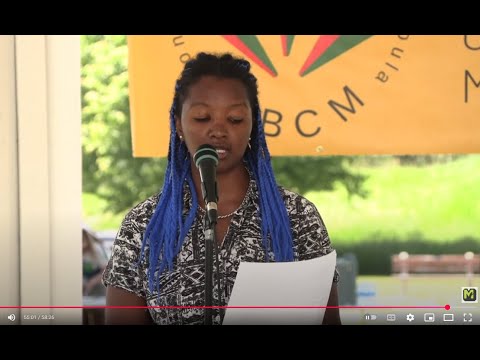
The program included an introduction of Zion Moore as director of the University of Montana's multicultural center (referred to in the program as the Brant/Brent Center) and a closing reading of poetry by Amanda Gorman, performed by Sylvie Tower, a University of Montana student. Event organizers announced upcoming related events and film screenings and thanked sponsors, including the Historic Museum at Fort Missoula, the University Congregational Church (which provided free food), the United Way of Missoula County (collective fiscal sponsor), Missoula Public Library, University of Montana Black Student Union and others.
Organizers closed by encouraging attendees to sign up at information tables for future events and volunteer opportunities. The program combined historical reflection, calls for continued civic engagement and cultural celebration.