Get Full Government Meeting Transcripts, Videos, & Alerts Forever!
Get email alerts on the State Military Authority topic
No spam. Unsubscribe anytime.
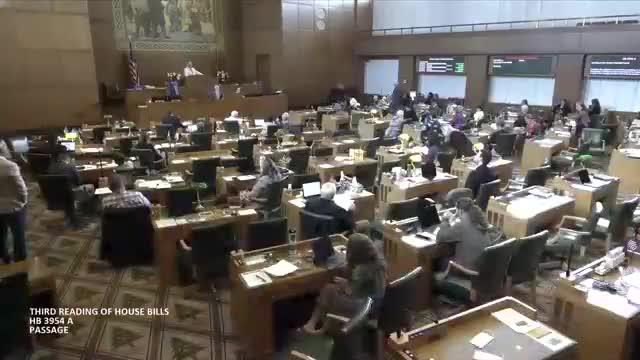
House backs bill to limit certain federal orders to Oregon National Guard over law‑enforcement uses
Summary
House passage of House Bill 39 54 clarifies state authority over the Oregon National Guard and bars state legal assistance to federal activations for domestic law‑enforcement uses deemed inconsistent with posse comitatus principles.
The Oregon House on June 20 approved House Bill 39 54, a measure clarifying the governor’s authority over the Oregon National Guard and restricting certain state legal assistance related to federal mobilizations for domestic law‑enforcement activities.
Sponsor Representative Paul Evans framed the bill as a preventative measure to preserve federalism and guard against requests that would place service members in domestic law enforcement roles. On the floor Evans said the bill “clarifies the appropriate duties of the Oregon National Guard” and that it is meant to respect the Posse Comitatus Act and the state’s constitutional roles.
Under the bill’s framework, the attorney general would be prohibited from facilitating communications between the Department of Defense and individual guardsmen or Oregon National Guard units about orders to place members on active duty under U.S. Code title 10 or title 32 for purposes that conflict with prohibitions on domestic law enforcement. The bill references legal precedent including Perpich v. Department of Defense (1990) to explain limits on federal/state authority and the National Guard’s dual status.
Evans said the measure is limited to ensuring that, for orders that would require the National Guard to perform law‑enforcement activities domestically, the state voice retains the capacity to protect state resources and people. “This bill attempts to provide remedy so that the state of Oregon, when it comes to matters of the dual nature of the national guard, speaks with 1 voice,” Evans said.
Representative Graeber, supporting the bill, displayed a map of predicted wildland‑fire potential and argued that extraordinary natural disasters will require the governor to have reliable access to the National Guard for firefighting and disaster response. He said the bill helps keep the Guard available for state catastrophes during periods when multiple jurisdictions could seek assistance.
Supporters described the bill as preserving the governor’s constitutional role as commander in chief of the state National Guard while ensuring the Guard remains available for state emergencies; opponents were not prominently recorded in the excerpt.
The measure passed the House and was declared adopted. Sponsors said it does not change federal authority to mobilize forces for overseas or other authorized missions; rather, it aims to prevent use of Oregon National Guard units in domestic law enforcement roles inconsistent with statutory limits and longstanding practice.
The bill will proceed to the Senate; implementation details and any required federal consultations would follow if the measure becomes law.