Get Full Government Meeting Transcripts, Videos, & Alerts Forever!
Get email alerts on the Forest‑products Taxation topic
No spam. Unsubscribe anytime.
Senate extends forest products harvest tax rates and sparks debate on wildfire funding fairness
Summary
The Senate passed House Bill 20‑72A to extend components of the forest products harvest tax and adjust the harvest‑tax rate; senators raised the need for a broader review of the tax's complexity and whether volume‑based charges fairly fund wildfire programs.
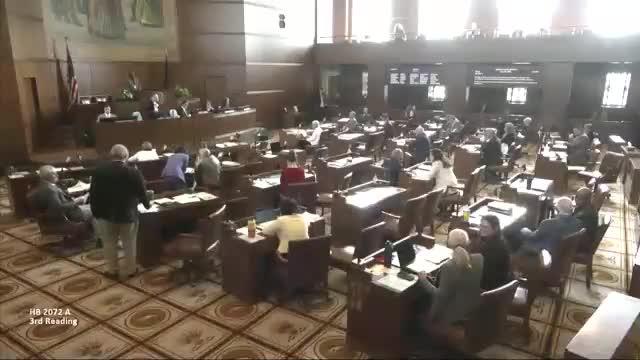
The Oregon Senate passed House Bill 20‑72A on third reading, extending three components of the forest products harvest tax through 2026 and 2027 and adjusting the harvest tax rate from 253.46¢ to 265.44¢ per thousand board feet to support a larger share of administration costs for the Oregon Forest Practices Act.
Senator Frederick, presenting the bill, said the adjustments "provide funding for the Oregon State University Forest Research Laboratory, administration of the Oregon Forest Practices Act by the Department of Forestry, and professional forestry education at the OSU College of Forestry," and noted the new harvest tax rate takes effect Jan. 1, 2026. He also said other rate components for forest research, fire suppression, and education remain at 90¢, 62.5¢, and 20¢ per thousand board feet respectively.
Senator Golden, speaking in support but urging follow‑up work, said: "This harvest tax is a major policy problem for us in Oregon because it is so massively complex." Golden argued the current tax is volume‑based and therefore does not track the market value of timber, raising concerns about fairness when wildfire funding needs rise. "If we had the old value based severance tax 5%, it would be $25," Golden said in hypothetical examples contrasting volume and value approaches to funding wildfire programs.
The Senate completed a roll call and the bill was declared passed; the formal count recorded the measure as receiving the constitutional majority required for passage.
Supporters framed the bill as a technical and temporary measure to maintain funding for forestry research, agency administration, and forestry education, while several senators asked for a broader policy review of the harvest tax structure and its adequacy for wildfire funding going forward.